








Bhramari Pranayama (Humming Bee Breath): Meaning, Steps, Benefits, and Precautions
Table of Contents
- What is Bhramari Pranayama?
- 9 Bhramari Pranayama Benefits (Humming Bee Breath Benefits)
- 1. Calms the Mind Almost Immediately
- 2. Reduces Stress and Anxiety
- 3. Helps Lower Blood Pressure
- 4. Improves Sleep Quality
- 5. Stimulates the Pituitary and Pineal Glands
- 6. Strengthens and Improves the Voice
- 7. Supports Faster Recovery of Body Tissues
- 8. Improves Concentration and Mental Clarity
- 9. Relieves Tension Headaches and Sinus Pressure
- Best Time to Practice Bhramari Pranayama and How Long
- How to Do Bhramari Pranayama: Step-by-Step
- Here’s What You Should Not Do
- Conclusion
- Bhramari Pranayama FAQs
- 1. What is Bhramari Pranayama?
- 2. Who should not practice Bhramari?
- 3. Who should do Bhramari pranayama?
- 4. Why are ears closed in Bhramari?
- 5. Can we do Bhramari at night?
- 6. Is Bhramari Pranayama good for anxiety?
- 7. How is Bhramari different from Anulom Vilom?
What is Bhramari Pranayama?
Bhramari Pranayama, also called Humming Bee Breath, is a breathing technique from classical yoga where you exhale slowly while making a soft humming sound similar to the buzz of a bee. The word Bhramaricomes from the Sanskrit word Bhramara, meaning “bee,” which refers to that gentle humming sound you make during the exhale.
What makes Bhramari different from most other pranayamas is the vibration it creates inside your head and chest. When you close your ears, shut your eyes, and hum on the exhale, that sound travels inward rather than outward. It creates a kind of inner stillness that’s hard to describe until you’ve felt it yourself.
In yoga, Bhramari is considered one of the most effective practices for calming the nervous system quickly. It works directly on the vagus nerve, the nerve responsible for your body’s rest-and-digest response, which is why even a few rounds can noticeably shift how you feel.
9 Bhramari Pranayama Benefits (Humming Bee Breath Benefits)
1. Calms the Mind Almost Immediately
This is the one benefit most people notice first. When you close your ears and hum, outside noise fades, and your attention naturally turns inward. The humming vibration slows the mental chatter down in a way that’s difficult to achieve through willpower alone. Even three to five rounds can leave you noticeably quieter inside.
2. Reduces Stress and Anxiety
Bhramari activates the parasympathetic nervous system, the part of your body that signals safety and rest. When that kicks in, stress hormones like cortisol begin to drop. Regular practice over weeks genuinely changes how your body handles daily pressure, not just in the moment of practice but throughout the day.
3. Helps Lower Blood Pressure
The slow, extended exhale in Bhramari naturally brings the heart rate down. Over time, practitioners with mild hypertension often report a measurable improvement. It’s not a replacement for medical treatment, but as a daily support practice, it makes a real difference.
4. Improves Sleep Quality
Doing a few rounds of Bhramari before bed signals the nervous system to wind down. The humming vibration settles restlessness in both the mind and the body. Many people who struggle to fall asleep find this more effective than scrolling or reading, because it actively slows the breath rather than just distracting the mind.
5. Stimulates the Pituitary and Pineal Glands
The vibration from the humming passes through the bones of the skull and is said to gently stimulate the pituitary and pineal glands — the glands responsible for hormone regulation, sleep cycles, and mood. This is one reason Bhramari is considered particularly useful during times of hormonal change or imbalance.
6. Strengthens and Improves the Voice
The controlled humming tones the muscles of the throat and vocal cords over time. Singers, teachers, and public speakers who practice Bhramari regularly often notice greater resonance, clarity, and endurance in their voice.
7. Supports Faster Recovery of Body Tissues
The internal vibration created during Bhramari is thought to have a mild healing effect on body tissues, particularly in the head, throat, and chest area. Some practitioners use it as a gentle support tool after illness or surgery, alongside medical care.
8. Improves Concentration and Mental Clarity
Because the practice requires you to hold your attention on the sound and the breath simultaneously, it trains the mind to focus. With consistent practice, this quality of attention starts to carry over into work, study, and daily conversations.
9. Relieves Tension Headaches and Sinus Pressure
The vibration of the hum passes through the sinus cavities and skull, which can bring noticeable relief from tension headaches and mild sinus congestion. Many practitioners use a few rounds of Bhramari specifically when they feel a headache beginning to build.
Best Time to Practice Bhramari Pranayama and How Long
When to practice: Early morning, ideally before breakfast, is the best time for Bhramari. The mind is naturally quieter at that hour, and the practice settles in more deeply. The second-best time is just before bed, which helps the body shift out of the day’s stress and into genuine rest.
You can also do a few rounds mid-afternoon if you’re feeling overwhelmed or mentally scattered. Bhramari is one of the few pranayamas flexible enough to use as a quick reset during the day.
How many rounds: Beginners should start with 5 to 7 rounds per session. Each round is one full inhale followed by a complete humming exhale. Don’t rush; give yourself a breath or two of normal breathing between rounds if needed. As your practice builds over weeks, you can work up to 11 to 17 rounds comfortably.
How long each session: A focused session of 7 rounds takes roughly 5 to 7 minutes. That’s genuinely enough to feel the effect. You don’t need 30 minutes — consistency matters far more than duration with Bhramari.
How to Do Bhramari Pranayama: Step-by-Step
Before you begin, make sure your stomach is empty at least 3 to 4 hours after a meal. Find a quiet spot where you won’t be disturbed for 5 to 10 minutes.
Get Comfortable First Sit cross-legged on the floor with a folded blanket or cushion under your hips if needed. If the floor isn’t comfortable, sit on a chair with your feet flat on the ground. Sit tall, spine straight, shoulders relaxed, chin roughly parallel to the floor. Gently close your lips but keep your teeth slightly apart so the jaw stays soft.
Step 1 – Set Your Hand Position (Shanmukhi Mudra).
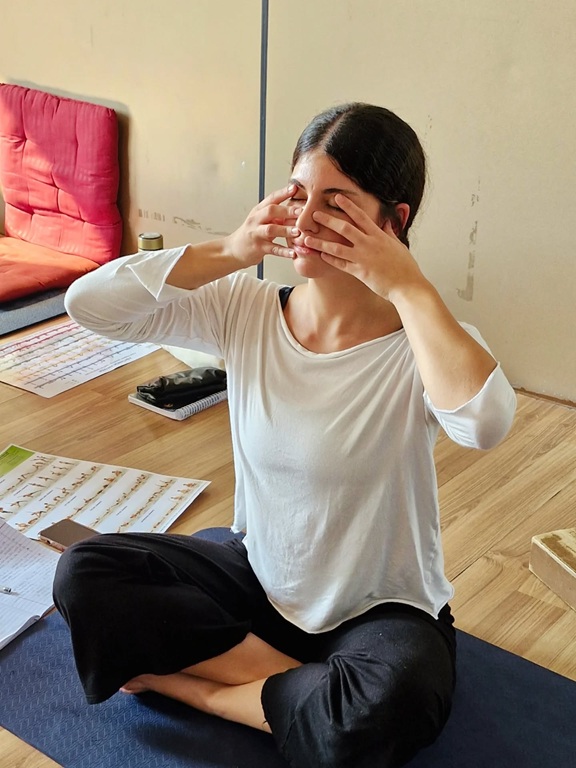
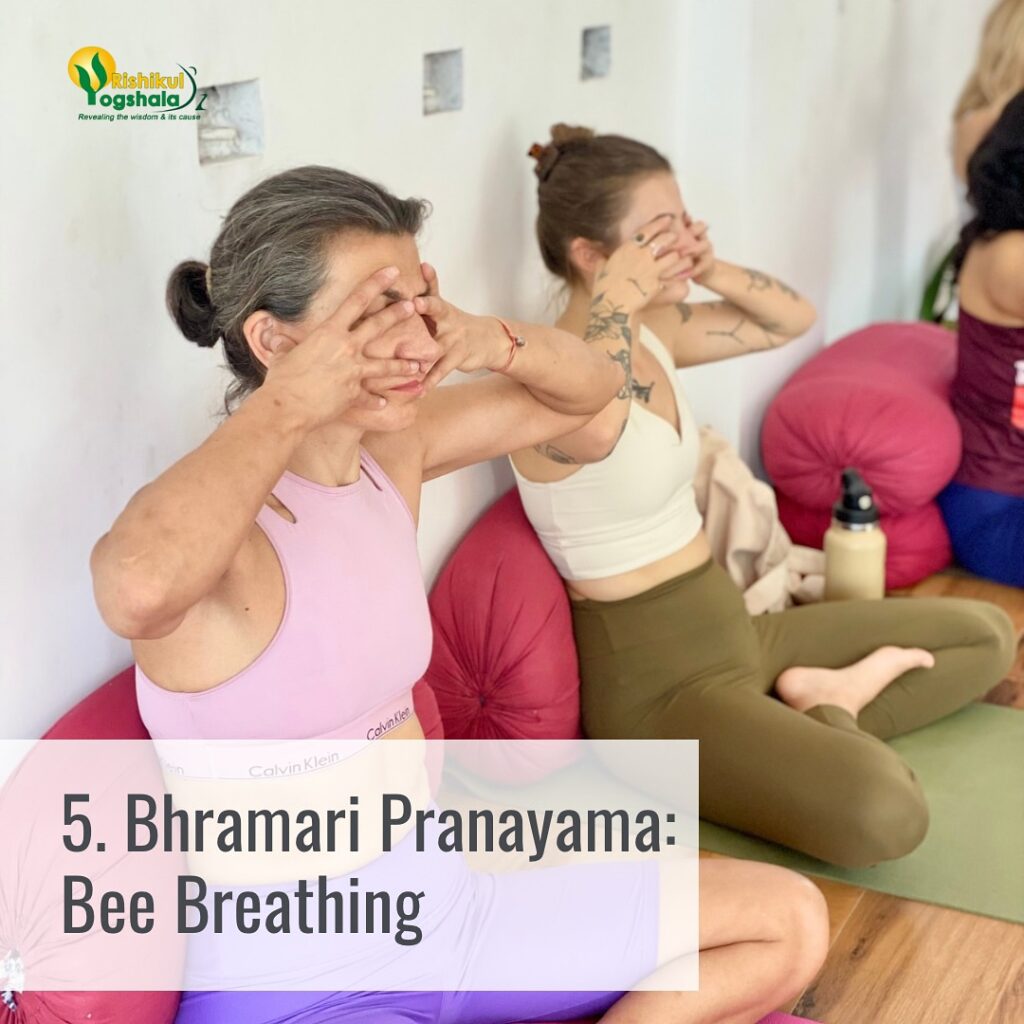
Bring both hands up to your face. Press your thumbs gently on the cartilage just outside each ear — not inside the ear canal, just the small flap of cartilage that closes the ear opening. Rest your index fingers lightly on your forehead just above the eyebrows. Place your middle, ring, and little fingers gently across the bridge and sides of your nose. Close your eyes. This hand position is called Shanmukhi Mudra — it closes the six gates of the senses and turns your awareness inward.
Step 2 – Take a Deep, Slow Inhale
Breathe in steadily through both nostrils. Let the breath fill your abdomen first, then your chest. Take your time, there’s no rush here. Keep your face and jaw relaxed throughout.
Step 3 – Drop Your Chin Slightly and Begin Humming
As you start to exhale, gently lower your chin toward your chest. Breathe out slowly through your nose while making a steady, low humming sound from the back of your throat, like the sound a bee makes, not a forced or loud hum. The sound should feel effortless and smooth. If your throat feels tight, soften the hum until it does.
Step 4 – Let the Vibration Fill Your Head
While you hum, bring your focus to the space between your eyebrows — the Ajna chakra. Feel the vibration moving through your skull, your sinuses, and behind your eyes. Keep your body completely still. Don’t rush the exhale; let it last as long as it feels natural.
Step 5 – Lift Your Chin and Repeat
When the exhale is complete, slowly raise your chin back to the starting position and take your next deep inhale. That is one complete round. Beginners should aim for 5 to 7 rounds. Each week, you can add one more round, working gradually up to 11 to 17 rounds as your practice deepens.
After you finish, lower your hands gently to your knees. Sit quietly for a minute or two before opening your eyes. Notice how you feel; the stillness after Bhramari is part of the practice, not just the waiting time before you get up.
Also Read:- Pranayama: A Simple Guide to Cleansing Your Body and Mind

Here’s What You Should Not Do
Bhramari is gentle, but it’s not for everyone. Please skip this practice or consult a doctor first if any of the following apply to you:
Avoid completely:
- Pregnant women should not practice Bhramari, as the breath retention and pressure involved may not be safe during pregnancy
- Women who are menstruating should also avoid it during those days
- Anyone with active epilepsy
- Those with severe or uncontrolled high blood pressure
- Anyone with an active ear infection or pain inside the ear
Practice with caution:
- If you have chest pain or a heart condition, check with your doctor before starting
- Do not practice Bhramari while lying down — always sit upright
- Never insert your thumbs inside the ear canal — press gently on the cartilage just outside the ear opening
- Do not force or strain the humming sound. It should feel comfortable, not tight in the throat
If you’re new to pranayama or have any ongoing health condition, learning Bhramari directly from an experienced teacher is always safer than learning from a guide alone.
Also Read – How To Do Kapalbhati Pranayama And What Are Its Benefits
Conclusion
Bhramari is one of those practices that sounds almost too simple to work: close your ears, breathe in, hum on the way out. But sit with it for five minutes, and you’ll feel why yogis have been teaching it for centuries.
Start with 5 to 7 rounds every morning. Give it two weeks before judging the results. The changes are subtle at first: you sleep a little better, you react a little slower to stress, you feel slightly more settled after a session. Over time, those small shifts become very noticeable.
If you want to go deeper into pranayama and understand not just how to practise but why each technique works, our 200 Hour Yoga Teacher Training in Rishikesh covers pranayama in full detail, theory, practice, sequencing, and how to teach it to others. Learning directly from experienced teachers in Rishikesh is a completely different experience from any online guide, including this one.
Bhramari Pranayama FAQs
1. What is Bhramari Pranayama?
Bhramari Pranayama is a yogic breathing technique where you inhale deeply and exhale slowly while making a humming sound like a bee. You close your ears with your thumbs and keep your eyes shut during the practice. The vibration of the hum works inward, calming the nervous system and settling the mind within just a few rounds.
2. Who should not practice Bhramari?
Pregnant women, menstruating women, and anyone with epilepsy, severe hypertension, active ear infections, or chest pain should avoid Bhramari. It should also never be practiced lying down; always sit upright with a straight spine.
3. Who should do Bhramari pranayama?
The primary characteristic of Bee Breath is the internal sound of a vibrating humming when all six gates of sense are shut. Bhramari yoga is accessible to all people, regardless of gender or age.
4. Why are ears closed in Bhramari?
You close your eyes, cover your ears, and hum audibly while performing Bhramari’s breath. This can assist in reducing outside distractions (such as loud traffic outside your window) and the humming can help you concentrate while also calming any internal dialogue or ideas.
5. Can we do Bhramari at night?
Any time of day can be used to practice the Bhramari Pranayama. But it’s important to keep in mind that the asana can only be done on an empty stomach. The best times would be early in the morning, before sunlight, or even right before bed.
6. Is Bhramari Pranayama good for anxiety?
Yes, it’s one of the most effective yoga practices specifically for anxiety. The humming exhale activates the vagus nerve, which directly triggers the body’s calming response. Many people find even three rounds during a moment of anxiety brings quick, noticeable relief.
7. How is Bhramari different from Anulom Vilom?
Anulom Vilom is alternate nostril breathing — it focuses on balancing the two sides of the nervous system and works primarily through the nostrils. Bhramari uses humming on the exhale and works more directly on the brain, nervous system, and stress response. Both are excellent practices and complement each other well when done in the same session.

 +91-8433225327,
 Rishikul Yogshala Rishikesh, Narayan Kunj, Jonk Village, Ram Jhula, Swarg Ashram, Rishikesh, Uttarakhand 249304
 By Airway
 By Railway
 By Bus/Cabs