








Bhramari Pranayama for Anxiety and Stress: A Gentle, Honest Guide to the Humming Bee Breath’s Therapeutic Use
Table of Contents
- First, a Few Things You Probably Don’t Know About Bhramari Pranayama
- So What Exactly Is Bhramari Pranayama?
- How to Do Bhramari Pranayama?
- The Healing Power of Bhramari Pranayama
- 1. It Speaks Directly to Your Vagus Nerve
- 2. It Pulls You Out of Fight-or-Flight.
- 3. It Brings Blood Pressure Down
- 4. It Dramatically Increases Nasal Nitric Oxide.
- 5. It Genuinely Helps You Sleep
- 6. It Eases Anxiety, Not Just in the Moment, But Over Time
- 7. It Clears Headaches and Tension In the Skull
- Can You Do Bhramari Pranayama at Night?
- Who Needs to Take Extra Care?
- Why Bhramari Pranayama (Humming Bee Breath) Works for Modern Life?
- Last Thought
- FAQ – Bhramari Pranayama (Humming Bee Breath)
- How many times a day should I do Bhramari Pranayama?
- Can I do Bhramari Pranayama if I have never done yoga before?
- How long before I notice any benefits?
- Is the humming supposed to be loud?
- Can children do Bhramari Pranayama?
The first time someone tells you to sit down, cover your ears, and hum like a bee, it sounds more like a children’s game than a therapeutic practice. And then you try it — and the mind, almost without permission, begins to soften. Bhramari Pranayama, the humming bee breath, is one of yoga’s most quietly powerful tools for anxiety and stress. In this guide, we’ll meet the therapeutic side of Bhramari with care, look at what research suggests about how it calms the nervous system, and explore how to weave it into difficult moments.
So I hummed.
And something happened that I still find difficult to fully explain. Within three or four rounds of that slow, low humming exhale, my shoulders dropped about two inches. The tightness behind my eyes softened. The constant mental scrolling, that relentless background noise, went quiet. Not completely, not forever. But enough. Just enough to breathe.
That was my introduction to Bhramari Pranayama. And if you’ve landed here, chances are you’re looking for the same thing I was: relief, calm, something that actually works.
So let’s discuss it in detail.
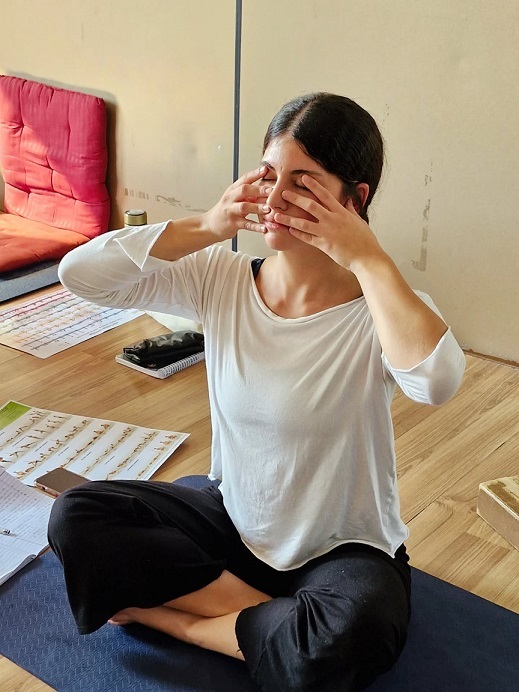
First, a Few Things You Probably Don’t Know About Bhramari Pranayama
Before we get into the how and the why, here are some facts worth sitting with:
- Bhramari Pranayama or Humming Bee Breath is documented in the Hatha Yoga Pradipika, a Sanskrit yogic text written in the 15th century. This is not a wellness trend. It is a 600-year-old practice with roots going back even further in oral tradition.
- The humming sound produced during this practice increases nitric oxide levels in the nasal passages by up to 15 times compared to normal breathing. Scientists have measured this. It is not a metaphor.
- A 2024 review published in the Indian Journal of Physiology and Pharmacology looked at multiple clinical trials and found significant reductions in anxiety, depression, stress scores, and blood pressure in people who practised Bhramari regularly.
- BKS Iyengar — arguably the most influential yoga teacher of the 20th century — wrote in Light on Pranayama that the best time to do Bhramari is in the quiet of the night. Not the morning. The night.
- The practice gets its name from Bhramara, the Sanskrit word for the large black Indian bee, because the exhale sounds exactly like one.
None of this makes it complicated. If anything, it makes it more compelling. Because something this old, this simple, and this well-researched deserves more than a passing mention in a yoga class.
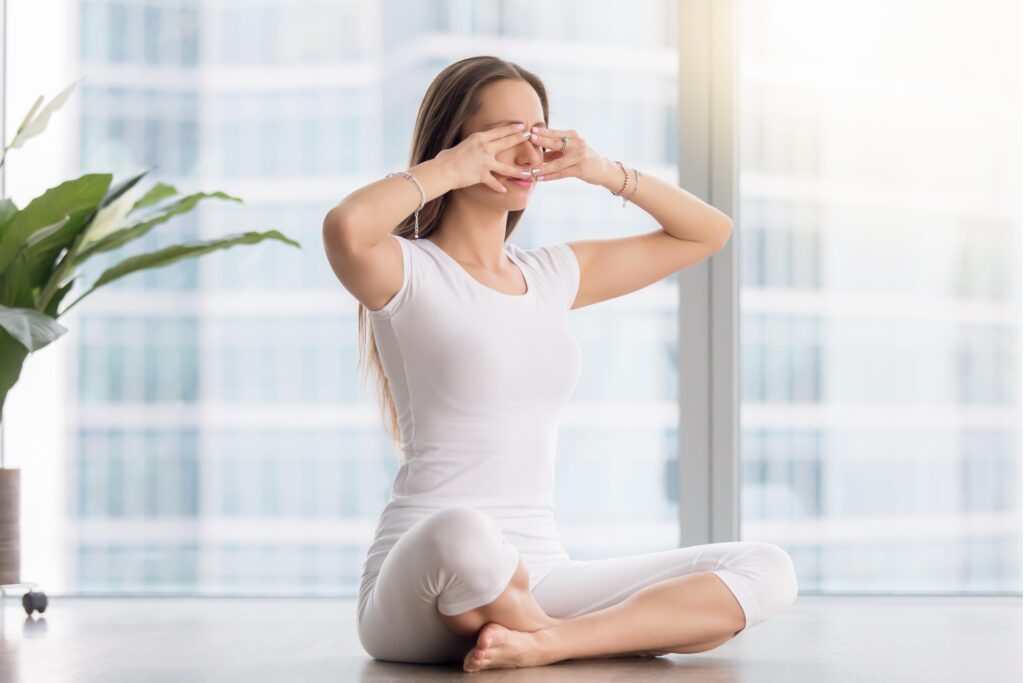
So What Exactly Is Bhramari Pranayama?
At its simplest, Bhramari Pranayama, also called Humming Bee Breath, is a breathing practice where you inhale deeply through your nose and exhale while producing a soft, steady humming sound.
That’s really it.
But the reason it works so well lies in what that humming actually does to your nervous system, and we’ll get there in a moment.
The word Pranayamaitself breaks down into two Sanskrit roots: Prana, meaning life force or vital energy, and Yama, meaning to regulate or extend. So pranayama, in any form, is about learning to consciously work with your breath to affect how you feel, physically, mentally, and energetically.
What makes Bhramari unique within the pranayama family is the addition of sound. Most breathing techniques work purely through the mechanics of breath. Bhramari adds vibration. And that vibration, as we’re about to see, changes everything.
How to Do Bhramari Pranayama?
We want to give you this in the most honest, practical way we can, not as a clinical instruction manual, but the way you’d explain it to a friend sitting across from you.
- Find somewhere quiet: Not silent, just reasonably undisturbed. Your bedroom works. Your living room before the rest of the house wakes up works. Even a parked car works, if that’s where you get your five minutes.
- Sit up straight: Cross-legged on a cushion if that’s comfortable. On a chair with your feet flat on the floor, if it’s not. The posture matters — a slumped spine muffles the vibration and shortcuts the practice. Just sit tall, easily, without forcing it.
- Close your eyes: Take two or three ordinary breaths first. Nothing fancy, just let yourself arrive. Let the outside world get a little further away.
- Now place your index fingers gently on the cartilage of your ears: That little flap just beside the ear opening, not inside the canal. Lightly. You’re not blocking out the world aggressively; you’re just turning the volume down.
- Inhale slowly through your nose: Let the breath fill your lungs fully, feel the ribcage expand, feel the belly soften outward. Don’t rush it.
- As you exhale, close your lips gently and begin to hum: One steady, low-pitched sound from the back of your throat. Like a bee sitting still somewhere nearby. Not loud, not strained, smooth and sustained, for the entire length of your exhale.
Feel that? The vibration in your chest. In your skull. Behind your eyes. That’s it. That’s the practice working.
At the end of the exhale, gently lift your chin, release the fingers slightly, and inhale again.
Repeat for seven rounds to start. That’s it. Seven slow, humming exhales.
After the last one, put your hands down on your knees and just sit there for a minute. Don’t immediately check your phone or jump up. Just sit with what the practice left behind.
A few things to keep in mind as you go:
- Keep the humming tone consistent, one smooth note for the whole exhale, not a melody or a pulse.
- Don’t press hard on the ears. Just lightly rest your fingers there.
- Your mouth stays closed throughout the exhale. Teeth slightly apart so the sound can resonate rather than get trapped.
- Always practise on an empty stomach, at least two to three hours after eating.
- Never practise lying flat on your back. Seated only.
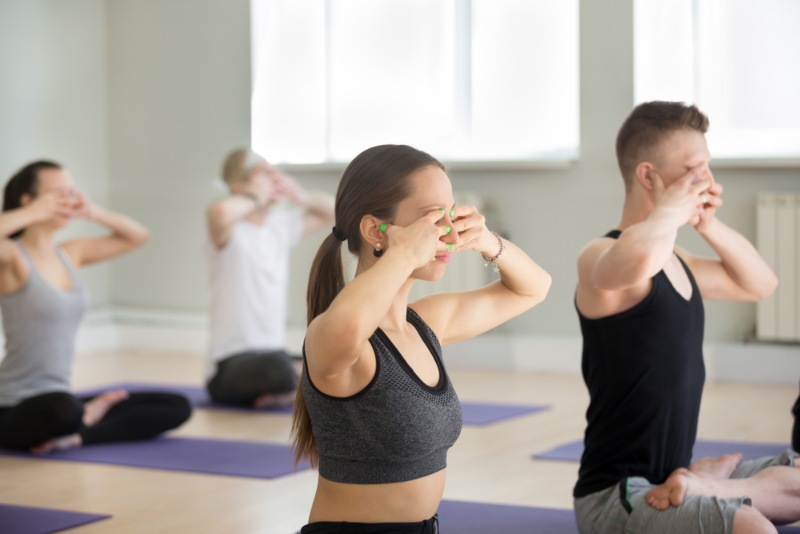
The Healing Power of Bhramari Pranayama
Here’s where it gets genuinely interesting, and where ancient yogic wisdom and modern science start telling the same story from different directions.
1. It Speaks Directly to Your Vagus Nerve
The vagus nerve is the longest cranial nerve in the human body. It runs from your brainstem all the way down through your heart, lungs, and digestive organs. One of its branches directly innervates the vocal cords. So when you hum, when your vocal cords vibrate, you are literally stimulating the vagus nerve. And the vagus nerve is the main highway of your parasympathetic nervous system, the part of you responsible for rest, calm, digestion, and recovery.
This is why the effect of Bhramari feels almost immediate. You’re not talking yourself into relaxing. You’re triggering a physiological response that bypasses the thinking mind entirely.
2. It Pulls You Out of Fight-or-Flight.
Most of us spend more of our waking hours than we realize in a low-grade stress response. Not full panic, just that background hum of alertness, tension, readiness. Bhramari interrupts that pattern by activating what researchers call the “relaxation response.” Cortisol drops. Heart rate slows. Muscles that have been holding tension without you noticing begin to let go.
3. It Brings Blood Pressure Down
Multiple studies have confirmed this. The slow, extended exhale combined with vagal stimulation reduces both systolic and diastolic blood pressure. One important caveat: this is not a substitute for medical treatment if you have been diagnosed with hypertension. But as a complementary practice, the evidence is clear.
4. It Dramatically Increases Nasal Nitric Oxide.
Nitric oxide is a molecule your body produces that does a remarkable range of things: dilates blood vessels, improves circulation, supports immune function, and reduces inflammation in the airways. Humming through the nose, specifically, has been shown to increase nitric oxide production in the sinuses by up to 15 times. This is why Bhramari practitioners often report relief from sinus congestion and why researchers became particularly interested in the practice during the COVID-19 pandemic.
5. It Genuinely Helps You Sleep
If you practise Bhramari Pranayama within an hour of going to bed, your body interprets it as a clear signal: it’s time to wind down now. The nervous system shifts, the mind quietens, and sleep comes more naturally. Many people who struggle with a racing mind at bedtime find this practice more effective than anything else they’ve tried.
6. It Eases Anxiety, Not Just in the Moment, But Over Time
A study on generalised anxiety disorder found meaningful improvement in anxiety scores after a consistent Bhramari practice. The mechanism makes sense. Extended exhalation is inherently calming. Focused internal sound gives the mind something real to anchor to, interrupting the loop of anxious thought. And over weeks of daily practice, the nervous system begins to re-regulate itself at a baseline level, not just during the practice, but across the day.
7. It Clears Headaches and Tension In the Skull
The vibrational resonance of the humming travels specifically into the sinus cavities, the forehead region, and the temples. People who suffer from regular tension headaches or migraines often find remarkable relief with Bhramari Pranayama, because the sound does a kind of gentle internal massage that no external treatment can replicate.
Learning the correct technique matters more than most people realise, something the students at Rishikul Yogshala’s 200 Hour Yoga Teacher Training in Rishikeshdiscover early on, where Bhramari Pranayama is taught not just as a technique but as a daily non-negotiable.
Read More: Pranayama: Bhramari Pranayama: Steps, Benefits, Precautions, and More!
Can You Do Bhramari Pranayama at Night?
Yes. And honestly, you probably should do Bhramari Pranayama.
BKS Iyengar said it himself: night is the best time. There’s less ambient noise, your mind is already moving toward rest, and the practice deepens effortlessly in that quieter environment. The humming sounds more resonant, the internal awareness becomes more acute, and the transition to sleep afterward is almost seamless.
What makes nighttime Bhramari Pranayama particularly powerful is that the relaxation response it triggers aligns perfectly with what your body is trying to do anyway in the evening: cool down, slow down, prepare for restoration. You’re not fighting your biology; you’re supporting it.
A simple routine worth trying: seven to ten rounds of Bhramari, ten to fifteen minutes before bed, in a seated position either on your mattress or beside it. No screens beforehand if possible. Just the dark, the hum, and your breath.
The only things to keep in mind at night are the same as any other time: stay seated, practise on an empty stomach, and don’t press hard on your ears.
Who Needs to Take Extra Care?
Bhramari Pranayama or Humming Bee Breath is one of the gentlest, most accessible pranayama practices there is. Almost anyone can do it. But there are a handful of situations where you should either modify the practice or check with a doctor first:
- If you have an active ear infection, give it a rest until you’ve healed. The pressure on the cartilage and the internal sound can be uncomfortable and potentially aggravating.
- If you are pregnant, approach all pranayama practices with care and under the guidance of an experienced teacher. Bhramari is generally considered safe in pregnancy, but each pregnancy is different.
- If you have severe hypertension or epilepsy, please consult your physician before adding any new breathwork practice.
- Anyone with chest pain, active, undiagnosed chest pain, should not practise without medical clearance.
For everyone else: once you’ve learned the technique properly, ideally from a qualified teacher, at least the first few times, this is a practice you can carry with you anywhere.
Why Bhramari Pranayama (Humming Bee Breath) Works for Modern Life?
We live in an era of relentless stimulation. Screens, notifications, noise, deadlines, the constant pressure of being available and responsive, and productive. The nervous system was not designed to sustain this level of input. And the toll shows, in rising anxiety rates, deteriorating sleep quality, blood pressure climbing in younger and younger people, and a general sense of barely keeping up.
Bhramari Pranayama will not fix any of that on its own. But it gives you a door out, even if only for five minutes. And those five minutes, practised daily, begin to add up into something more durable, a calmer baseline, a slightly longer fuse, a mind that can notice its own agitation before it spirals.
The ancient teachers who developed this practice were not facing iPhones or twenty-four-hour news cycles. But they understood something fundamental about the human mind, that it needs to be turned inward regularly, that sound and breath together can recalibrate the nervous system in ways that nothing external can replicate, and that the simplest practices, done consistently, go the deepest.
What if I feel dizzy during the practice? Stop, breathe normally, and do not continue that session. This usually happens from breath-holding or over-efforting. With a qualified teacher and relaxed approach, dizziness should not occur. Start with fewer rounds and build slowly.
Also Read: Five Pranayamas To Include In Your Everyday Exercise Routine
Last Thought
There’s something about the image of a bee that feels right for this practice. A bee is not rushing. It moves with intention, produces a sound that carries through a garden, and goes about its work steadily and without drama.
Maybe that’s the invitation here, to be, for a few minutes each day, a little more like the bee. To move more slowly. To make a sound that resonates from the inside out. To not be in such a hurry to get to the next thing.
Seven breaths. A soft hum. That’s where it starts.
FAQ – Bhramari Pranayama (Humming Bee Breath)
How many times a day should I do Bhramari Pranayama?
Once a day is a great starting point — seven rounds per session. Over time, twice daily (morning and before bed) with eleven to seventeen rounds is considered an established practice. Don’t rush the progression.
Can I do Bhramari Pranayama if I have never done yoga before?
Absolutely. This requires no flexibility, no prior experience, and no equipment. If you can sit upright and breathe through your nose, you can do this.
How long before I notice any benefits?
Many people notice a shift in mental calmness within their very first session. For deeper, more sustained changes — better sleep, lower anxiety, improved blood pressure — give it four to six weeks of daily practice.
Is the humming supposed to be loud?
No. The humming should be soft, smooth, and sustained — not a performance. You’re creating internal resonance, not projecting sound. Think of it as something you feel more than you hear.
Can children do Bhramari Pranayama?
Yes — and many yoga teachers find it one of the most effective practices for children, particularly around focus, exam anxiety, and emotional regulation. It’s also genuinely fun for kids, which makes consistency much easier.
This article is for general information and is not medical advice. If you have a respiratory or heart condition, are pregnant, or are unsure whether these practices suit you, please speak to your doctor before beginning.

 +91-8433225327,
 Rishikul Yogshala Rishikesh, Narayan Kunj, Jonk Village, Ram Jhula, Swarg Ashram, Rishikesh, Uttarakhand 249304
 By Airway
 By Railway
 By Bus/Cabs