








Baddha Konasana Benefits: What This Pose Really Does for Your Body and Mind
Table of Contents
- Baddha Konasana Benefits at a Glance
- What the Pose Actually Stretches?
- Physical Benefits – Baddha Konasana Benefits
- 1. Better hip and inner thigh flexibility
- 2. A comfortable seat for meditation
- 3. Relief for the lower back after long sitting
- 4. Better mobility for other poses
- Benefits of Bound Angle Pose for Women
- Menstrual Pain
- Chronic Pelvic Pain
- Pregnancy
- Benefits of Bound Angle Pose for Men
- Mental and Nervous System Benefits
- It helps you slow down
- It helps before sleep
- It builds patience
- What the Tradition Says?
- Claims That Don’t Hold Up?
- How Long Until You Feel The Benefits?
- How To Get The Most Benefit?
- Variations of Baddha Konasana (and what each one is for)
- Quick Comparison
- 1. Supported Baddha Konasana — the version most people should be doing
- 2. Titli Asana — the flapping version
- 3. Ardha Baddha Konasana — the half version
- 4. Bound Angle Forward Fold — the deeper stretch
- 5. Supta Baddha Konasana — the reclined version
- 6. Butterfly at the wall
- 7. Chair Butterfly
- 8. Star Pose — the Pregnancy Substitute
- Which Variation Should You Choose?
- Who Should Be Careful?
- Final Takeaway
- Frequently Asked Questions
- What are the main benefits of Baddha Konasana?
- Is Baddha Konasana the same as Butterfly Pose?
- What are the benefits of Baddha Konasana for males?
- Does Baddha Konasana help with periods?
- Does Baddha Konasana balance hormones?
- How long should I hold it to get the benefits?
- Can I do it every day?
- Why can’t my knees touch the floor?
- Does it help you lose weight?
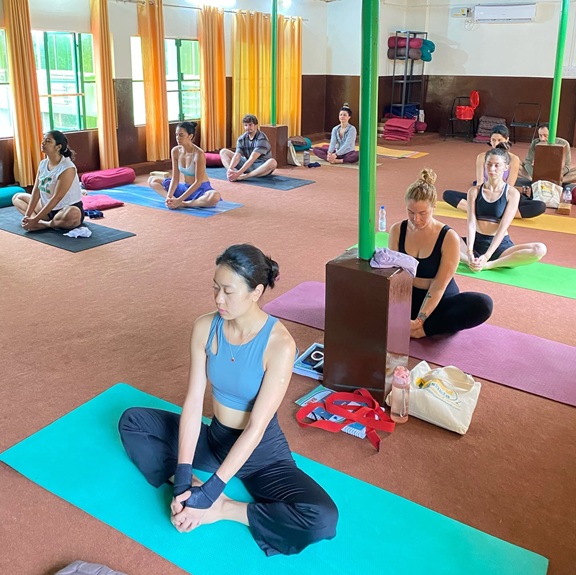
Baddha Konasana (Bound Angle Pose) stretches the inner thighs and groin, opens the hips, and helps the body settle into rest. The strongest evidence supports three things: better hip and inner-thigh flexibility, less menstrual pain, and a calmer nervous system. Many other claims you will read online are not supported.
Baddha Konasana Benefits at a Glance
| Benefit | How strong is the evidence? |
|---|---|
| Inner thigh and groin flexibility | Strong — direct mechanical effect |
| Easier cross-legged sitting | Strong — direct mechanical effect |
| Less menstrual pain | Good — supported by meta-analysis of yoga programmes |
| Lower stress, easier rest | Good — supported for yoga practice overall |
| Relief in chronic pelvic pain | Early — small studies only |
| Better sleep | Reasonable — mostly from the calming effect |
| Digestion | Weak — no direct evidence |
| Hormone balance, fertility | Not supported — see the honest section below |
What the Pose Actually Stretches?
Baddha Konasana works on your adductors. These are the muscles along your inner thigh that pull your legs together. It also reaches the gracilis and the pectineus, and it opens the groin by rotating the thigh bones outward in the hip socket.
That is the whole mechanical story. Everything else follows from that stretch, from the stillness, and from the slow breathing.
One correction worth making, because many articles get this wrong: Baddha Konasana does not stretch your hip flexors. In this pose your hips are bent, so the hip flexors are short, not long. If sitting at a desk has made your hip flexors tight, you need lunges or a supported backbend instead.
Physical Benefits – Baddha Konasana Benefits
1. Better hip and inner thigh flexibility
This is the main benefit and the most reliable one.
Tight adductors are very common. Runners, cyclists, footballers, and anyone who climbs a lot of stairs will usually have them. Sitting in a chair all day does not help either.
Baddha Konasana targets these muscles directly. With regular practice, most people notice their knees resting lower within six to eight weeks.
2. A comfortable seat for meditation
This is the traditional reason the pose exists.
If you cannot sit cross-legged for twenty minutes without knee pain, the problem is usually adductor tightness and limited hip rotation. Baddha Konasana works on both. In our 200-hour training, we place it early in the morning session for exactly this reason.
3. Relief for the lower back after long sitting
Not because it stretches hip flexors, but because it moves the hips through a range a chair never asks for. Sitting tall in the pose also teaches the pelvis to stop tipping backwards, which is the habit behind a lot of desk-related backache.
4. Better mobility for other poses
Malasana, Upavistha Konasana, Padmasana, and most seated forward folds all need adductor length. Baddha Konasana builds that foundation.
Benefits of Bound Angle Pose for Women
Menstrual Pain
This is the best-supported benefit after flexibility, and it is worth explaining properly.
A meta-analysis of four randomised controlled trials, covering 230 women with primary dysmenorrhoea, found that yoga programmes significantly reduced menstrual pain. The effect size was large. (Kim SD, Complementary Therapies in Clinical Practice, 2019; PMID 31383452)
A larger network meta-analysis of 29 randomised trials with 1,808 women found that yoga reduced menstrual pain by about 2.75 points on a 10-point scale after eight weeks, compared with no exercise.
The honest detail: In that larger analysis, yoga worked, but simple relaxation exercise worked slightly better. So yoga helps with period pain. It is not magic, and it is not the only thing that helps.
A separate single-blind randomised trial in undergraduate students also found reduced menstrual cramps and menstrual distress in the yoga group compared with the control group.
How to use it: practise gently in the days before your period. During heavy flow, sit upright or use the reclined supported version. Do not force a deep forward fold.
Chronic Pelvic Pain
A group-based yoga programme for women with chronic pelvic pain reported improvements in daily activities, emotional wellbeing and sexual function. Baddha Konasana variants were part of the sequence.
Read this carefully: that trial had sixteen women and no control group. A separate randomised study of sixty women also found improvements. This is early and promising evidence, not settled proof. If you have chronic pelvic pain, see a pelvic health physiotherapist as well.
Pregnancy
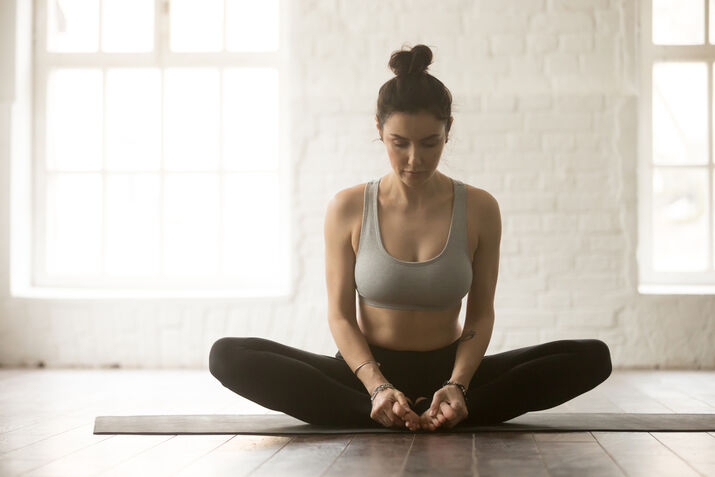
Baddha Konasana or Bound Angle Pose is a standard prenatal posture. It stays comfortable into the third trimester and helps prepare the hips for the wide positions used in labour.
Sit upright with a blanket under your hips and blocks under your knees. Skip it if you have pubic bone pain (SPD), SI joint pain, a breech baby, or placenta previa. Always check with your doctor.
Benefits of Bound Angle Pose for Men
Nothing here is only for women, and men usually need this pose more.
Men typically have tighter adductors and external rotators, especially if they run, cycle, lift weights, or play any field sport. If your knees sit up near your ears, that is a mobility gap worth working on.
For men, the pose is most useful:
- After training, as a cool-down stretch for the inner thighs
- Before meditation, so sitting cross-legged does not hurt
- For general hip health, alongside squats and lunges
Sit on more height than you think you need and move your feet further from your body. Expect progress in months, not weeks.
Mental and Nervous System Benefits
It helps you slow down
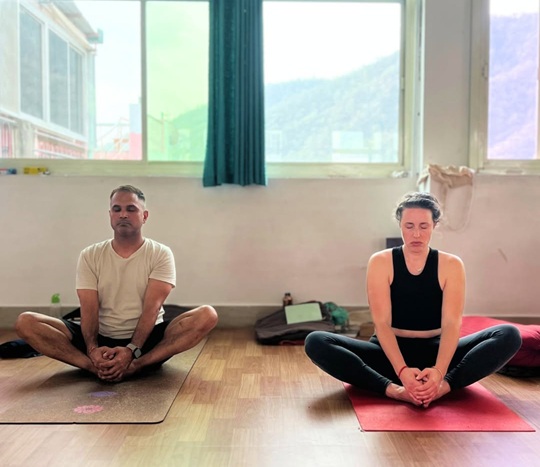
Held quietly for two or three minutes with slow breathing, Baddha Konasana is one of the more reliable “come down” postures. Reviews of yoga for stress in healthy adults are broadly positive.
Be clear about the mechanism, though. The calming effect comes from stillness and slow breathing, not from the shape of your legs. Any comfortable seated posture held the same way would do something similar. This one just happens to be easy to hold and easy to support with props.
It helps before sleep
The reclined version over a bolster, held for five minutes before bed, works well for a lot of people. It is a simple, low-effort way to signal to your body that the day is over.
It builds patience
This sounds soft, but it is real. Baddha Konasana gives you nothing quickly. Sitting in a stretch that will not change for weeks teaches you to stay with discomfort without fighting it. That skill carries into everything else.
What the Tradition Says?
In the Hatha tradition, this posture appears as a seated preparation for meditation and pranayama, and as one of the postures used to keep the hips open enough for long sitting.
The name Cobbler’s Pose comes from the way cobblers in India sat to work, holding a shoe between the soles of their feet. Anyone who has watched a cobbler work in Rishikesh has seen this pose held for hours without effort.
Classical texts also describe it as a posture that works on the pelvic region and the lower abdomen. Traditional teaching and modern research do not always line up, and we think it is more useful to tell you both than to pretend they say the same thing.
Claims That Don’t Hold Up?
- “It balances your hormones.” There is no evidence that a stretch changes hormone levels. Regular exercise of any kind supports hormonal health broadly. This specific pose does nothing special.
- “It cures infertility.” No. Yoga may reduce stress in people going through fertility treatment, which matters. But no posture treats infertility, and anyone claiming otherwise is not being honest with you.
- “It reduces thigh fat.” No. You cannot lose fat from one body part by stretching it. Spot reduction has been tested many times, and it does not work.
- “It improves digestion by massaging your organs.” Sitting upright is fine for digestion. But this is a passive stretch, and there is no direct evidence for organ massage effects.
- “It cures depression.” Yoga programmes show some benefit for mild depression. One posture does not.
- “Twenty minutes is best.” Long passive holds in external rotation load the inside of the knee. There is no benefit to justify it. One to five minutes is enough.
How Long Until You Feel The Benefits?
| Timeframe | What you can realistically expect |
|---|---|
| First session | A stretch in the inner thighs. Some calming if you stay a few minutes. |
| 2 weeks | The pose feels less awkward. Breathing in it gets easier. |
| 6–8 weeks | Knees noticeably lower. Cross-legged sitting is easier. |
| 3 months | Real change in adductor length. Other seated poses feel better. |
Short daily holds beat long weekly ones. Sixty seconds every day will take you further than fifteen minutes once a week.
How To Get The Most Benefit?
- Sit on a folded blanket. About four inches high. Almost everyone needs this. If your pelvis rolls backward, the stretch leaves your inner thighs and lands in your lower spine, and you lose most of the benefit.
- Support your knees. Blocks or cushions under both knees let the muscles relax. A relaxed muscle lengthens. A guarding muscle does not.
- Do not push your knees down. You are forcing the joint past what the muscle will give. Let gravity do it.
- Keep your spine long. Length matters more than reaching your toes. Hold your shins if you need to.
- Breathe slowly. Most of the calming benefit is here, not in the shape.
- Be patient with the knees. Some people will never touch the floor with their knees because of hip socket shape. This is normal, and it is not a measure of progress.
For the full step-by-step method, see our complete guide to Butterfly Pose.
Variations of Baddha Konasana (and what each one is for)
Different versions of this pose give you different benefits. Pick the one that matches what you actually want, rather than always doing the hardest one.
Quick Comparison
| Variation | Best for | Hold time | Props needed |
|---|---|---|---|
| Supported Baddha Konasana | Beginners, tight hips | 2–5 min | Blanket, 2 blocks |
| Titli Asana (flapping) | Warm-up, circulation | 20–30 flaps | Blanket |
| Ardha Baddha Konasana | Uneven hips, one tight side | 1–2 min each side | Blanket |
| Bound Angle Forward Fold | Deeper adductor stretch | 1–3 min | Blanket, blocks |
| Supta Baddha Konasana | Rest, sleep, stress | 5–10 min | Bolster, 2 blocks |
| Butterfly at the wall | Tired legs, swollen ankles | 5–10 min | Wall, blanket |
| Chair Butterfly | Desk work, limited mobility | 1–2 min | A chair |
1. Supported Baddha Konasana — the version most people should be doing
What it is: the basic seated pose with a folded blanket under the hips and a block or cushion under each knee.
Why it helps: a muscle only lengthens when it feels safe. If your knees are hanging in space, your adductors grip to protect the hip joint, and you get almost no stretch. Support them, and the muscle lets go.
How to set up: sit on the front edge of a blanket about four inches high. Place blocks under each thigh, close to the knee. The knees should feel held, not stretched.
Who it suits: beginners, anyone with tight hips, anyone over 40 starting yoga, and honestly, most people. This is not a beginner downgrade. Experienced practitioners use it for long holds.
A note we give every student: if the blocks feel too high, you have chosen correctly. Lower them over weeks, not days.
2. Titli Asana — the flapping version
What it is: the dynamic warm-up where you gently move the knees up and down like wings. Titli is Hindi for butterfly.
Why it helps: this is a mobility drill, not a stretch. The movement brings blood into the hip joint and warms the adductors before you ask them to lengthen. It also feels good, which matters more than people admit.
How to do it: sit tall, soles together, hands on the feet or ankles. Let the knees bounce gently up and down 20 to 30 times. Keep it small and relaxed.
Two traditional forms you will see in the Bihar School lineage:
- Ardha Titli Asana (half butterfly) — one leg extended, the other knee moved slowly up and down with the hand
- Purna Titli Asana (full butterfly) — both knees together, as described above
Important: flapping is a warm-up, not the pose. Ten to thirty gentle flaps is plenty. Vigorous flapping for minutes irritates some knees and adds nothing.
3. Ardha Baddha Konasana — the half version
What it is: one leg stretched straight out in front, the other foot drawn in to the inner thigh.
Why it helps: almost everyone has one hip tighter than the other. Working one side at a time lets you spend longer on the tight side without the loose side taking over. It also stretches the hamstring of the extended leg at the same time.
How to set up: sit on a blanket. Extend the right leg, bring the left foot to the right inner thigh. Support the left knee with a block. Stay one to two minutes, then swap.
Who it suits: anyone with a noticeable left–right difference, and runners, who are usually asymmetrical.
4. Bound Angle Forward Fold — the deeper stretch
What it is: from the seated pose, folding forward over your feet.
Why it helps: the fold adds a stretch through the groin and lower back that the upright version does not reach. It is the strongest adductor stretch in this family.
How to do it safely: hinge from the hips, not the waist. Keep the spine long. When your back starts to round, stop and rest your forehead on a stack of blocks or a bolster. Rounding down to reach further is the single most common mistake we correct.
Who should skip it: anyone with a disc problem or sciatica, and anyone in the second or third trimester of pregnancy, because it compresses the belly.
5. Supta Baddha Konasana — the reclined version
What it is: lying back with the soles together and the knees supported. Sometimes called Reclining Bound Angle or Reclining Goddess Pose.
Why it helps: this is the version for the mind rather than the muscles. Lying down removes the work of holding yourself upright, so the nervous system can actually downshift. It is one of the most useful poses in restorative yoga and one of the best things you can do before sleep.
How to set up properly — this matters more than people think:
- Place a bolster lengthwise behind you, with the short end at your lower back
- Sit just in front of it, soles together, and lie back over it
- Put a block or cushion under each knee
- Let the arms rest out to the sides, palms up
- A folded blanket under the head if the chin lifts
Hold time: five to ten minutes. This is one of the few variations where a long hold is genuinely useful, because the knees are supported and the stretch is passive.
Pregnancy note: after the first trimester, do not lie flat on your back for long. Prop the bolster on an incline so your chest is higher than your hips, or rest on your left side instead.
6. Butterfly at the wall
What it is: legs up the wall, then let the soles come together, and the knees slide open down the wall.
Why it helps: the wall holds the weight of your legs so the adductors do nothing at all. It also drains tired legs and helps with swollen ankles and feet. The combination of gentle inversion and hip opening is very restful.
How to set up: sit sideways against the wall, swing your legs up, and shuffle your hips close. Soles together, knees open, let them slide down as far as is comfortable. Hands on your belly.
Who it suits: people who are on their feet all day, runners after a long run, and anyone with tired or swollen legs. Also good in pregnancy, propped on an incline.
7. Chair Butterfly
What it is: the shape done sitting on a chair, with the knees open and the feet either on the floor or ankles crossed.
Why it helps: it gives you a version you can actually do at a desk. Not as deep, but a stretch you do every day beats a better stretch you never do.
How to do it: sit forward on the chair, feet wider than your hips, and let the knees open outward. Hands on the thighs. Sit tall and breathe for a minute.
Who it suits: office workers, older students, anyone who cannot get down to the floor, and people recovering from injury.
8. Star Pose — the Pregnancy Substitute
What it is: a seated wide-legged position with the feet apart rather than pressed together, knees bent and supported.
Why it helps: it gives similar hip opening with much less strain through the pubic joint. This is the version to use if Baddha Konasana feels wrong in pregnancy.
Use it instead of Baddha Konasana if you have: symphysis pubis dysfunction (SPD), pubic bone pain, SI joint pain, a breech baby, or placenta previa.
Which Variation Should You Choose?
- Hips are tight, and this is new to you → Supported Baddha Konasana
- Warming up before practice → Titli Asana flapping
- One side is much tighter → Ardha Baddha Konasana
- You want a deeper stretch → Bound Angle Forward Fold, with blocks
- You are stressed or cannot sleep → Supta Baddha Konasana
- Your legs are tired or swollen → Butterfly at the wall
- You are at a desk → Chair Butterfly
- You are pregnant, and it feels wrong → Star Pose
Who Should Be Careful?
- Knee injury, especially meniscus or inner ligament problems. Always use blocks under the knees.
- Groin strain or adductor tear. Wait until it has healed.
- Sciatica. Sit high on a bolster. Stop if anything travels down the leg.
- SI joint pain.
- Recent hip replacement. Wide outward rotation is often restricted. Ask your surgeon.
- Pubic bone pain in pregnancy. Skip it.
Pain in the knee means stop. Pain in the inner thigh is usually just the stretch. Learn the difference.
Final Takeaway
Baddha Konasana is a simple yet valuable yoga posture that can be included in both beginner and regular yoga practices. With mindful practice, it can support hip and inner-thigh flexibility, encourage relaxation, and create a more comfortable seated position for meditation. The key is to practise gently, respect your body’s range of movement, and avoid forcing the knees toward the floor.
For those who want to explore yoga beyond individual asanas, Rishikul Yogshala Rishikesh offers Yoga Teacher Training in Rishikesh, where students can develop a deeper understanding of asana, alignment, pranayama, meditation, and traditional yoga practices.
Frequently Asked Questions
What are the main benefits of Baddha Konasana?
Better inner thigh and groin flexibility, easier cross-legged sitting, less menstrual pain, and a calmer nervous system.
Is Baddha Konasana the same as Butterfly Pose?
Yes. Baddha Konasana is the Sanskrit name. Butterfly Pose, Bound Angle Pose, Cobbler’s Pose and Titli Asana all mean the same posture.
What are the benefits of Baddha Konasana for males?
Inner thigh flexibility, better hip mobility for running and lifting, and a more comfortable meditation seat. Men usually need it more than women because their adductors are typically tighter.
Does Baddha Konasana help with periods?
Yes, for pain. Yoga programmes have been shown to reduce menstrual pain in randomised trials. Practise gently in the days before your period.
Does Baddha Konasana balance hormones?
No. There is no evidence for this. Regular exercise supports overall health, but this pose does nothing hormone-specific.
How long should I hold it to get the benefits?
One to three minutes for most people. Up to five in a restorative practice. Thirty to sixty seconds if you are new.
Can I do it every day?
Yes. It is a low-load stretch and needs no recovery day.
Why can’t my knees touch the floor?
Usually hip socket shape, which you cannot change, plus adductor tightness, which you can. Knees on the floor is not the goal.
Does it help you lose weight?
No. It is a stretch and burns very few calories. It improves mobility, which helps you train better, but that is an indirect effect.
This article is for general information and is not medical advice. If you have a respiratory or heart condition, are pregnant, or are unsure whether these practices suit you, please speak to your doctor before beginning.

 +91-8433225327,
 Rishikul Yogshala Rishikesh, Narayan Kunj, Jonk Village, Ram Jhula, Swarg Ashram, Rishikesh, Uttarakhand 249304
 By Airway
 By Railway
 By Bus/Cabs