








Baddha Konasana (Butterfly Pose): Steps, Benefits & Precautions
Table of Contents
- Baddhakonasana / Butterfly Pose
- Powers Of Butterfly
- Physical Powers
- Mental Powers
- Psychic Powers
- How To Do The Asana
- Anatomy Of Badhakonasana
- Preparatory and follow-poses
- Key Alignment Of Asana
- Importance Of Breathing In Badhakonasana
- Process Of Meditation In Badhakonasana
- Benefits Of Badhakonasana
- Physical Benefits
- Psychological Benefits
- Mystical Benefits
- Spiritual Benefits
- Contra-Indications
- Conclusion
Baddhakonasana / Butterfly Pose
Baddhakonasana — the Bound Angle Pose, also called Butterfly or Cobbler’s Pose — opens the hips in a way that often surprises practitioners. The cobblers of traditional India sat in this exact shape for hours, and the pose retains both that quiet utility and a deeper symbolic dimension. Hip openers in particular are said to release stored emotions — grief, anger, old held feelings — and Baddhakonasana is one of yoga’s quietest doorways into that emotional terrain. While our companion posts cover the practical how-to, this guide takes a slower look at the symbolism and the emotional dimensions.
A butterfly is a beautiful, weightless creature, whose body is well-balanced. The butterfly pose (Baddhakonasana) brings lightness within you, your inner beauty blossoms and you get the Physical symmetry of a butterfly. Performing butterfly pose gives the practitioner strength, balance, and energy. The mind becomes more creative and the thoughts would be more logical. Around the whole world, people view the butterfly as representing endurance, change, hope, and life. There is no doubt the butterfly has significant meanings to us.
Powers Of Butterfly
Physical Powers
The butterfly has a physical body that is almost without any mass, this allows the creature to float in the air effortlessly. Butterflies are known to sense and to spot the nectar, hence a good sense of smell is also among the physical powers of the yogi who practices the butterfly pose. Some of the Butterfly species like the monarch butterfly are migratory and are able to cover thousands of miles by flight without losing their way. Another fascinating fact about the migratory pattern of butterflies is that the fixed destination is conveyed by some natural force at the time of pupa.
Butterflies are also beautiful, the pigmentation on their skin attracts mates and repels predators. Butterfly wings are hydrophobic, meaning they repel water. The micro topography on the wings allows water molecules to easily roll off the surface. This quality teaches the yogi to be unaffected with certain actions. Butterflies use their antennae to detect which plants are producing nectar. The antenna works for assessing the environment’s physical and chemical properties. This quality yogis can incorporate within by sensing the situation better and can develop a good sense of discrimination.
Mental Powers
The butterfly is among the most patient creatures, they are able to stay still for long hours to escape predators and while laying eggs. A butterfly lays eggs, waits for the larvae to flap and tends to the pupa even while the group is on the move. Butterflies whisper of your hidden potential. The transformation from caterpillar to winged wonder happens, quite naturally. As the butterflies are so graceful, Balanced and weightlessness, these qualities can be acquired by a yogi upon performing Baddhakonasana. This asana teaches us how to be calm, balance, steady and still even when there are chaotic situations in life.
Psychic Powers
“We are all butterflies. Earth is our chrysalis.” – LeeAnn Taylor
The butterflies are the symbol of powerful transformations. The butterfly emphasizes the ability to move from one state, perspective, and lifestyle to another. They create such a light and graceful energy around which is so impactful, that transforms everything within us so positively.
Performing this pose may change the way to look at a conflicting situation with more lightness and different perspectives. In addition to this, you start to know that this is the time for a change and need the courage to break free from your “cocoon.”You may experience a major life change, and you will start to take things sincerely. The spiritual powers that manifest on a yogi who performs the butterfly pose might reflect the same.
How To Do The Asana
Overview & Steps
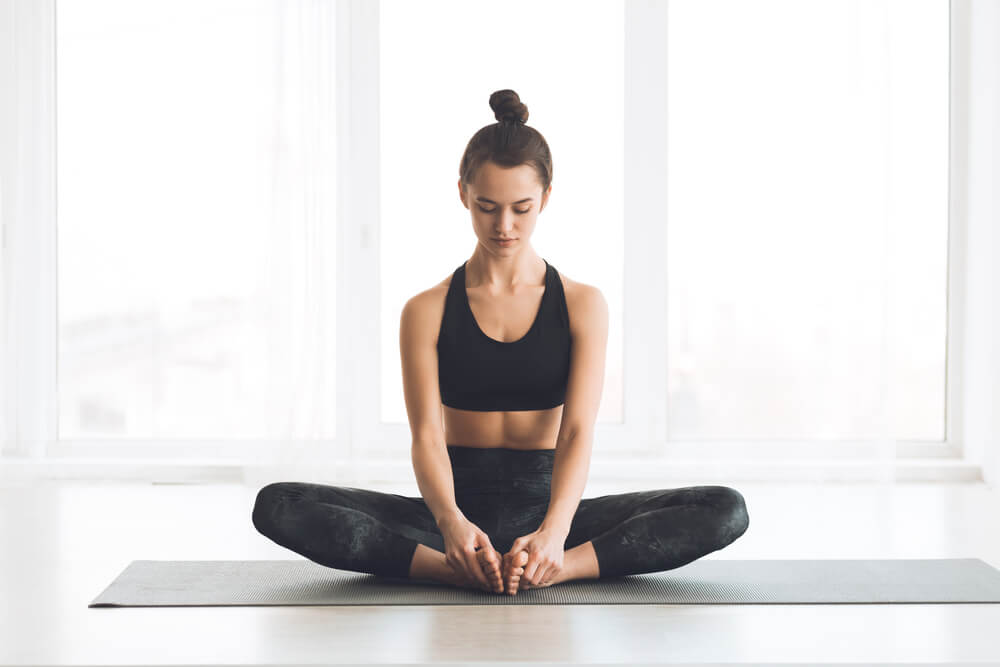
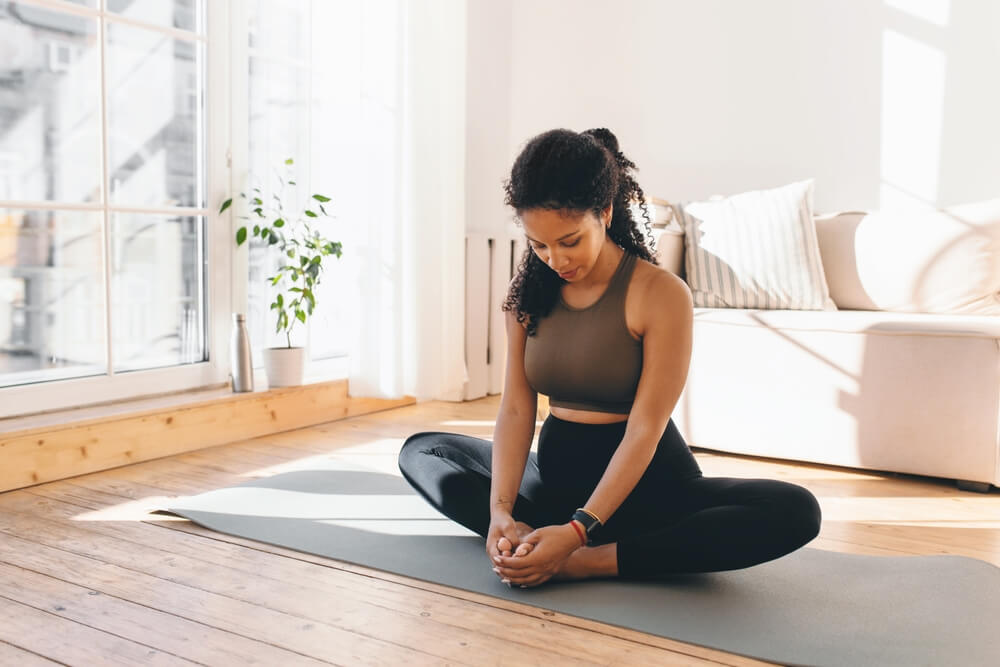
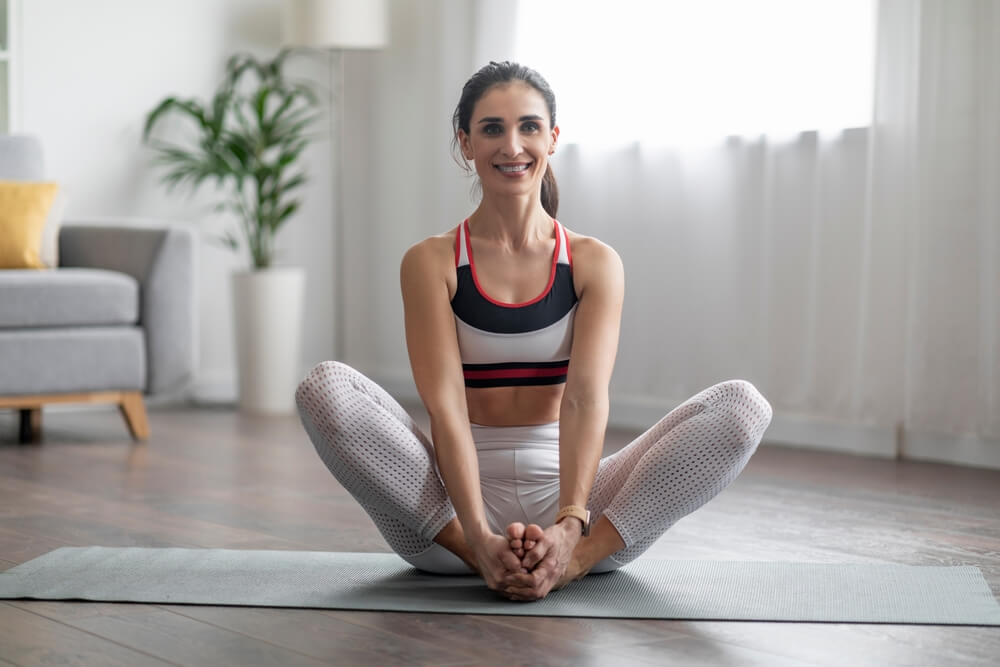
- Be seated on a flat soft surface with your spinal cord upright.
- Curve your knees and make the soles of your feet touch each other.
- Take hold of your feet with your palms and maintain a strong grip.
- Draw the joined feet as close to your body as possible.
- Inhale in slowly and exhale while aligning the knees with the floor.
- Imitate the flapping of butterfly wings with your legs increasing the pace steadily.
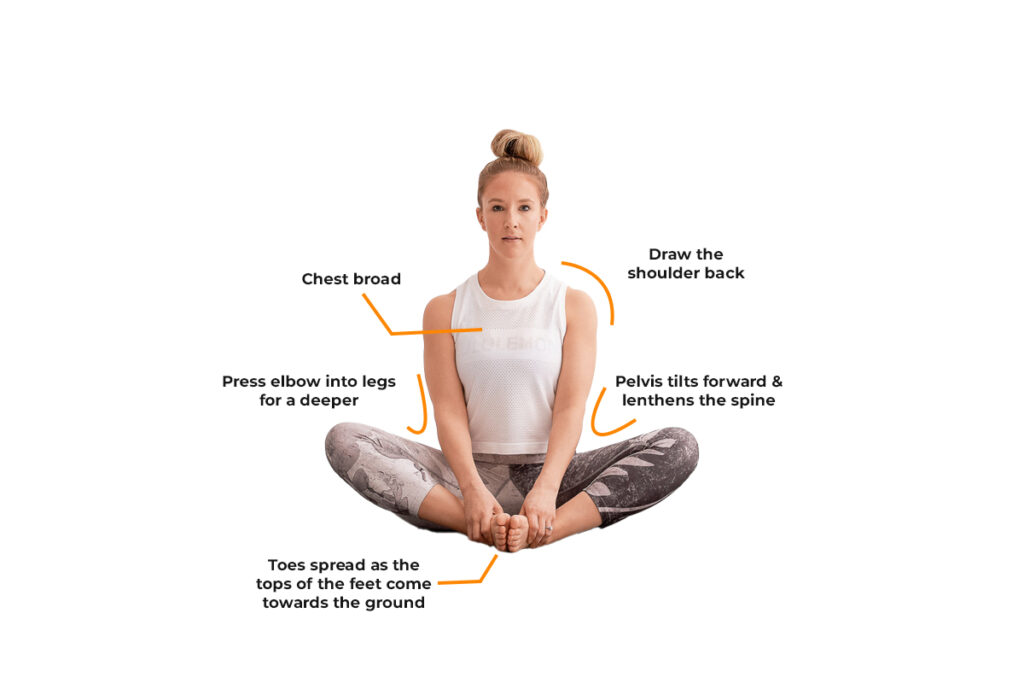
- Press your elbows on the thighs or on the knees, pushing the knees and thighs closer to the floor.
Safety & Precaution To Prevent Injuries
- Avoid arching your back and keep the spine erect while practicing.
- Ensure you don’t use force on the knees while practicing this asana. Only push the thighs down.
- If you experience discomfort in the knees place a blanket below the thighs for support.
Anatomy Of Badhakonasana
Badhakonasana can be challenging for the knees. The supination of the feet (soles toward the ceiling) causes a rotation of the tibia that, combined with flexion, destabilizes the ligamentous support for the knees. If the hips are not very mobile and the legs are pushed into this pose, the lower leg torque can travel into the knee joints. One way to protect them is to avert the feet (press the outer edges into the floor). This activates the peroneal muscles, which, via fascial connections, can stabilize the lateral ligaments of the knees and help to keep them from rotating too much. The result is that more of the pose’s action is directed into the hip joints.
Preparatory and follow-poses
Preparatory asana –
- Supta Padangusthasana
- Virasana
- Vrikshasana
- Follow up asana –
- Standing poses
- Forward Bends
Key Alignment Of Asana
Importance Of Breathing In Badhakonasana
Practicing the Butterfly pose generates a good amount of strength and requires the normal breathing process in the pose. In this pose while holding both the feet with hand, keeping the spine erect, it opens the chest up widely. This helps to bring more oxygenated blood into the stream and supply them all across the body. This helps to give more power and stamina to flap the legs for higher repetitions.
Process Of Meditation In Badhakonasana
(Sthiram Sukham Asanam)
Baddhakonasana is a simple, but powerful hip opener pose. This pose allows the practitioner to focus on the benefits, to experience. While performing this pose, the practitioners can withdraw their senses away from mind, body, emotions and thoughts and visualize themselves transforming into a universal butterfly that is light, cosmic and beautiful. As the butterfly floats in the air effortlessly, likewise, practitioners can also visualize themselves floating very lightly, without effort high in the sky. This will help the practitioners in the process of Meditation.
Also Read: Bow Pose (Dhanurasana): Steps and Benefits of The Bowing Pose
Benefits Of Badhakonasana
Physical Benefits
- The butterfly posture is beneficial to the nervous system, respiratory system, skeletal system and muscular system.
- It opens up the breathing tracts, enriches nerve sensitivity, strengthens the bones, and tones the muscles.
- The yogi develops a sense of smell, attains heightened auditory sense and forms sensitive taste buds through this pose.
- This asana builds the back muscles and thigh muscles.
- The neck and the upper spine is stabilized through this pose.
- Blood circulation to the brain and the face increases through this pose.
- It is also beneficial for sciatica.
- It stretches thighs and legs, easy bowel movements, reduces fatigue, enhances menstrual health, and easy childbirth.

For the mind the Baddhakonasana offers quietness, lightheartedness, and balance. Encourages you to dig deep to reconnect with your courage and excitement to live in alignment with your passions and heart’s desire. This pose helps to let go of a limiting belief, negative pattern or habit, or a way of relating to others and to the world. Butterfly pose encourages staying positive, reconnecting with joy, and follow your inner happiness and excitement to positively transform your life experience.
Psychological Benefits
Mystical Benefits
This pose is connected with the Power of Intuition, Openness and Evenness. The butterfly sign is a powerful mystical symbol that signifies rebirth, reincarnation, and deep transformation. A balance between the subtle form and the gross form of human existence is formed through the determined practice of the Baddhakonasana. It helps you to let go of the physical world and transform yourself at a higher level.
Spiritual Benefits
The true power of Butterfly is to bring the feeling of love within. This practice supports and encourages you to be happy and follow your heart to live in joy and love the whole world as a part of you. A wider vision of this asana is to cultivate the courage to serve others selflessly, which is the highest form of spirituality. This is the entrance into a new phase of life where you transform and begin to experience greater love, peace, harmony, and spiritual connection.
Contra-Indications
If you suffer from any of the following conditions avoid practising this Pose – Knee or groin injury, thighs or legs injury, lower back injury, sciatica, or sacral conditions.
Conclusion
Baddha Konasana is more than a simple seated yoga posture; it is a valuable asana for improving flexibility, supporting healthy movement, and creating a sense of physical and mental relaxation. With regular and mindful practice, it can become an important part of a balanced yoga routine.
If you want to understand yoga beyond individual poses and develop a deeper connection with its traditional teachings, Yoga Teacher Training in Rishikesh at Rishikul Yogshala can be a meaningful next step. The program offers an opportunity to refine your personal practice, learn authentic yogic techniques, and gain the knowledge and confidence to guide others on their yoga journey.
This article is for general information and is not medical advice. If you have a respiratory or heart condition, are pregnant, or are unsure whether these practices suit you, please speak to your doctor before beginning.

 +91-8433225327,
 Rishikul Yogshala Rishikesh, Narayan Kunj, Jonk Village, Ram Jhula, Swarg Ashram, Rishikesh, Uttarakhand 249304
 By Airway
 By Railway
 By Bus/Cabs