








Upavistha Konasana (Wide-Angle Seated Forward Bend): Steps, Benefits, and Beginner Tips
Table of Contents
- What is Upavistha Konasana?
- How to do Upavistha Konasana: Step by Step
- How to Breathe in the Pose?
- What Does Upavistha Konasana Stretch?
- Benefits of Upavistha Konasana
- Why can’t I fold forward in Upavistha Konasana?
- Tips for Beginners Practising Upavistha Konasana
- Props and Modifications for Beginners
- Variations To Try as You Progress
- Common Mistakes
- Who Should Avoid Upavistha Konasana?
- Upavistha Konasana vs. Paschimottanasana
- Conclusion
- Frequently Asked Questions
- Is Upavistha Konasana good for beginners?
- How long should I hold Upavistha Konasana?
- How can I improve my wide-leg forward bend?
- Is Upavistha Konasana good for sciatica?
- Can I do Upavistha Konasana during pregnancy?
- What is the difference between Upavistha Konasana and Prasarita Padottanasana?
- Is Upavistha Konasana the same as the splits?
- When is the best time to practise this pose?
Have you ever tried sitting with your legs wide apart and folding forward, only to feel your back round and your inner thighs tighten? This is a common challenge when practising Upavistha Konasana (Wide-Angle Seated Forward Bend), a seated yoga pose that stretches the inner thighs, hamstrings, and hips while encouraging a longer spine.
The key to practising this pose comfortably is not simply trying to reach the floor. Your hip mobility, hamstring flexibility, pelvic position, and sitting posture all influence how far you can fold. Using a folded blanket or yoga blocks can help you maintain better alignment and make the pose more accessible, especially if you are a beginner.
In this guide, we explain how to practise Upavistha Konasana step by step, explore its potential benefits, and share beginner-friendly modifications, common mistakes, and precautions. Whether you are new to yoga or working to improve your flexibility, you will learn how to approach this pose with greater comfort, control, and awareness.
Quick facts
| Sanskrit name | Upavistha Konasana |
| Pronunciation | oo-pah-VEESH-tah koh-NAH-sah-nah |
| English names | Wide-Angle Seated Forward Bend, Wide-Legged Seated Forward Fold, Seated Straddle |
| Pose type | Seated forward bend, hip opener |
| Level | Beginner to intermediate (with props, anyone can start) |
| Main stretch | Hamstrings, inner thighs (adductors), calves, lower back |
| Hold time | 30 seconds to 2 minutes; up to 5 minutes in a supported, restorative version |
| Best time to practise | Later in your practice, once the hips and legs are warm |
What is Upavistha Konasana?
Upavistha Konasana (Wide-Angle Seated Forward Bend) is a seated yoga pose where you sit with your legs spread wide and fold forward from the hips. It stretches the hamstrings, inner thighs, and lower back, and it calms the mind. Beginners should sit on a folded blanket and bend the knees slightly so they can fold with a long spine.
The name comes from three Sanskrit words:
- Upavistha means seated or sitting
- Kona means angle
- Asana means posture
Put together, it simply means “seated angle pose.” The angle is the wide V your legs make on the floor.
The pose belongs to the Hatha yoga family of seated forward bends, alongside Paschimottanasana (Seated Forward Bend) and Janu Sirsasana (Head-to-Knee Pose). It is also part of the seated sequence in the Ashtanga Primary Series, where it is practised with the hands holding the outer edges of the feet and the chin moving towards the floor.
What makes it different from a regular forward bend is the width. When the legs open, the inner thigh muscles get involved, and the pelvis has to tilt forward in a new direction. That is why someone who can touch their toes easily in Paschimottanasana can still feel stuck here.
How to do Upavistha Konasana: Step by Step
Warm up first. A few rounds of Sun Salutations, a minute in Baddha Konasana (Butterfly Pose), and some gentle hamstring stretches will make this pose far kinder to your body.
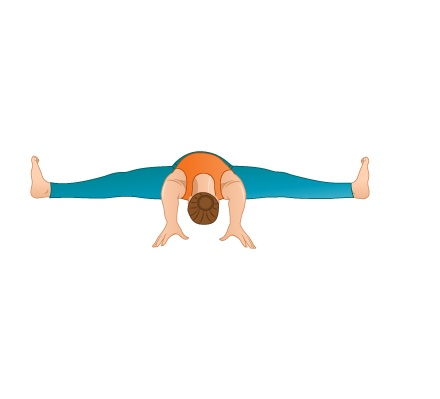
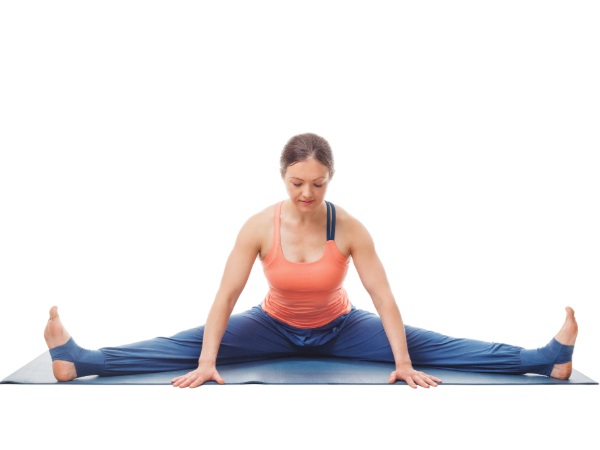
- Sit tall with both legs straight in front of you. If your back rounds, sit on a folded blanket.
- Open your legs wide into a V shape. Go only as wide as feels comfortable.
- Point your toes and knees up to the ceiling. Flex your feet.
- Place your hands on the floor in front of you, between your legs.
- Breathe in and sit up tall, lifting your chest.
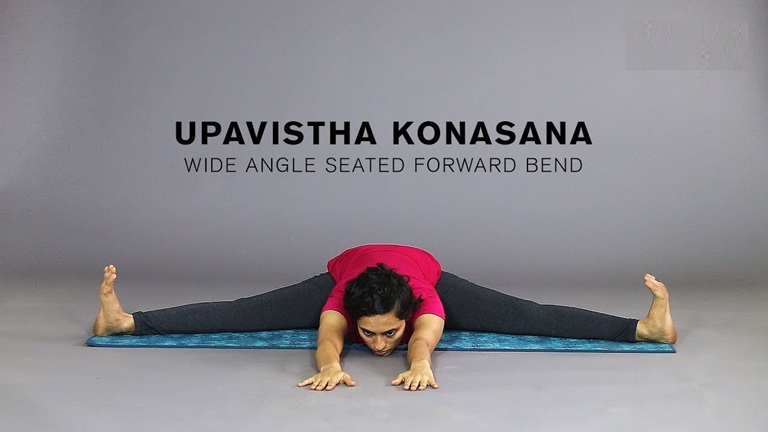
- Breathe out and slowly walk your hands forward, bending from your hips. Keep your back straight.
- Stop where you feel a gentle stretch. Don’t force it or bounce. Bend your knees a little if your legs feel very tight.
- Stay for 5–10 slow breaths.
- To come out, walk your hands back, sit up, and bring your legs together slowly.
How to Breathe in the Pose?
Use each inhale to create length in the spine. Use each exhale to soften a little deeper into the fold. If your breath becomes short or you start to hold it, you have gone too far. Back off until the breath is smooth again. Slow nasal breathing is one of the biggest reasons this pose feels calming.
What Does Upavistha Konasana Stretch?
Knowing what is actually stretching helps you practise smarter.
- Inner thighs (adductors): The five adductor muscles (adductor longus, brevis and magnus, pectineus and gracilis) run along the inside of the thigh. Opening the legs wide lengthens all of them.
- Hamstrings: The muscles along the back of the thigh stretch as you fold forward with straight legs.
- Calves: Flexing the feet adds a gentle calf stretch.
- Lower back muscles: The spine lengthens as you fold, which eases stiffness from long hours of sitting.
The hidden key is the pelvis. A forward fold does not start in the spine. It starts with the pelvis tilting forward over the thigh bones. If tight hamstrings and adductors keep the pelvis tucked under, the back has no choice but to round. That is why props that lift the hips make such a big difference (more on that below).
Benefits of Upavistha Konasana
Here is what regular practice can do for you, based on what we see in students and what the pose does mechanically.
- Improves hip and leg flexibility. This is the most obvious benefit. Over weeks, you will notice your legs opening wider and your fold getting deeper. Runners, cyclists and people who sit all day often feel the difference first.
- Supports better posture. Learning to sit tall with a neutral pelvis carries over to how you sit at your desk. Many students say their lower back feels less tired by the end of the day.
- Prepares you for deeper poses. Upavistha Konasana builds the openness needed for poses like Kurmasana (Tortoise Pose), Samakonasana (straddle splits) and seated twists.
- Calms the mind. Forward bends turn your attention inward. Combined with slow breathing, this pose can help settle a busy mind, which is why we often teach it near the end of class.
- May aid digestion. The gentle compression of the belly in a forward fold may help some people feel less bloated. Think of it as a support, not a treatment.
- May ease mild menstrual discomfort. Some women find a supported version, with the chest resting on a bolster, soothing during their cycle. Skip it if it feels uncomfortable.
- Builds patience and body awareness. You cannot force this pose. It teaches you to notice your limits and work with them, a skill that matters both on and off the mat.
A quick honest note: yoga poses support health, but they do not cure medical conditions. If you have a specific health concern, speak with your doctor along with your yoga teacher.
Why can’t I fold forward in Upavistha Konasana?
This is the question we hear most. If you are sitting upright with your legs wide and you simply cannot lean forward, you are not doing anything wrong. Your pelvis is tilted backwards, usually because of tight hamstrings and inner thighs.
Try these fixes, one at a time:
- Sit higher. Place a folded blanket or a block under your sitting bones. Even 5 to 10 cm of height lets the pelvis roll forward.
- Bend your knees. A small bend takes the pull off the hamstrings. Straight legs can come later.
- Bring the legs in. A narrower angle is easier. Width is not the goal; a long spine is.
- Think chest forward, not head down. Aim your breastbone towards the horizon. Chasing the floor with your forehead only rounds the back.
- Be patient. Hip and hamstring flexibility builds over weeks of steady practice, not one session.
Tips for Beginners Practising Upavistha Konasana
If you are new to Upavistha Konasana, focus on comfort and proper alignment rather than trying to fold deeply. These simple tips can help you practise the pose with greater ease.
- Start with a comfortable leg width: Spread your legs only as far as you can without straining your inner thighs or groin.
- Use a folded blanket: Sit on a folded blanket to help tilt your pelvis forward and maintain a longer spine.
- Bend your knees slightly: If your hamstrings feel tight, keep a gentle bend in your knees to make the position more comfortable.
- Keep your spine long: Lift your chest and fold forward from your hips instead of rounding your back to reach the floor.
- Use yoga blocks for support: Place blocks in front of you and rest your hands on them if you cannot comfortably reach the floor.
- Breathe slowly and naturally: Avoid holding your breath or forcing yourself deeper into the stretch.
- Practise consistently: Include the pose in your regular yoga routine and increase your range of movement gradually.
- Stop if you feel pain: A gentle stretch is normal, but sharp pain, joint discomfort, or tingling means you should come out of the pose.
Remember, flexibility develops at different rates for different people. Practising with patience and appropriate support is more important than how far you can fold.
Props and Modifications for Beginners
Props are not a sign of weakness. In Rishikesh, our teachers use them every day, with beginners and advanced students alike.
- Folded blanket: Under the sitting bones to help the pelvis tilt forward.
- Yoga blocks: Place them in front of you and rest your hands or forehead on them instead of the floor.
- Bolster: Lay it lengthwise between your legs and rest your chest on it for a restorative version. Stay 3 to 5 minutes.
- Rolled blankets under the knees: Helpful if the backs of your knees feel strained.
- Wall version: Sit with your back against a wall and simply open the legs. This is a great first step if folding is not possible yet.
- Chair version: Sit on the edge of a chair with feet wide and lean forward from the hips. Useful for office workers or anyone who cannot sit on the floor.
- Supine version (Supta Upavistha Konasana): Lie on your back with your legs up the wall, then let them slide apart into a V. Gravity does the work and your back stays fully supported.
Variations To Try as You Progress
- Parsva Upavistha Konasana (side fold): Turn your chest towards one leg and fold over it, keeping both sitting bones grounded. Stretches the side body and the hamstring of that leg.
- Parivrtta Upavistha Konasana (twisted): Reach the opposite hand towards one foot and open the other arm up. Adds a gentle spinal twist. Hold about 30 seconds to 1 minute per side.
- Upavistha Konasana side bend: Stay upright, place one forearm on the inner thigh and reach the other arm overhead. A good option if forward folding is still hard.
- Partner version: Sit facing a partner, feet touching, and hold hands. One person leans back slowly while the other folds forward. Communicate the whole time and never pull hard.
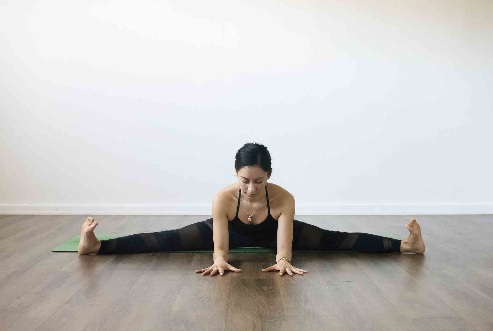
- Full classical version: Hold the outer edges of the feet, bring the chest and chin towards the floor, and keep the spine long. Only work towards this once the basic pose feels easy.
Common Mistakes
| Mistake | What happens | The fix |
|---|---|---|
| Rounding the back to get lower | Strain moves into the lower back | Sit higher, fold less, keep the chest lifted |
| Knees and toes rolling inward | Stress on the inner knee | Bring legs closer; kneecaps point up |
| Spreading the legs too wide | Groin strain, pelvis tucks under | Use a width where your back stays straight |
| Leading with the head | Neck tension, back rounds | Lead with the belly and breastbone |
| Holding the breath | Body tenses, stretch gets harder | Back off until breathing is slow and even |
| Bouncing to go deeper | Risk of hamstring or groin tears | Hold still and let the breath do the work |
| Coming out quickly | Can jolt tight hamstrings | Walk the hands back and bend the knees |
Who Should Avoid Upavistha Konasana?
This pose is safe for most people when done gently, but take extra care, or skip it, if any of these apply to you:
- Hamstring or groin injury: Avoid deep folding until it has fully healed. An upright, supported version may be fine with your therapist’s approval.
- Acute lower back pain, herniated or slipped disc: Forward folding can increase pressure on the discs. Practise only the upright version, or skip it.
- Sciatica: Some people find gentle versions helpful, while for others a deep fold makes the nerve pain worse. If you feel tingling, burning, or shooting pain down the leg, come out right away.
- Knee injury: Keep the knees softly bent and a rolled blanket underneath.
- Pregnancy: Avoid deep folding that compresses the belly. A gentle, upright version with the back supported, or with the chest on a high bolster, may be suitable. Always check with your doctor or a qualified prenatal yoga teacher first.
- Recent abdominal or hip surgery: Wait until your doctor clears you.
The golden rule: stretching should feel like a strong, even pull in the muscle. Sharp pain, pain in a joint, or nerve pain means stop.
Upavistha Konasana vs. Paschimottanasana
Upavistha Konasana and Paschimottanasana are both seated forward bends, but they differ in leg position and the areas they emphasise. Understanding these differences can help you practise each pose with better alignment.
| Feature | Upavistha Konasana | Paschimottanasana |
|---|---|---|
| English name | Wide-Angle Seated Forward Bend | Seated Forward Bend |
| Leg position | Legs spread wide in a V shape | Legs together and extended forward |
| Main areas stretched | Inner thighs, adductors and hamstrings | Hamstrings, calves, and muscles along the back of the body |
| Movement | Forward fold with legs apart | Forward fold with legs together |
| Beginner modification | Sit on a folded blanket and use blocks for support | Sit on a folded blanket and bend the knees slightly |
| Main focus | Comfortable leg width and forward pelvic movement | Forward pelvic movement and maintaining a long spine |
Both poses can help develop flexibility and body awareness when practised appropriately. Choose a variation that allows you to breathe comfortably and maintain control without forcing the stretch.
Conclusion
Upavistha Konasana (Wide-Angle Seated Forward Bend) is a useful yoga pose for developing flexibility in the inner thighs and hamstrings while improving awareness of posture and movement. With the right technique, regular practice, and support from props, beginners can gradually become more comfortable in this seated forward bend.
Remember to keep your spine long, fold from your hips, and work within your comfortable range of motion rather than forcing yourself to reach the floor. Whether you practise the pose as part of your daily yoga routine or during a structured yoga teacher training programme, patience and consistency are more valuable than achieving a deep fold.
At Rishikul Yogshala Rishikesh, students learn to practise yoga asanas with proper alignment, mindful breathing, and an understanding of individual abilities. Through our yoga teacher training in Rishikesh, students develop their yoga practice under the guidance of experienced teachers while building a deeper understanding of traditional yoga and its principles.
Frequently Asked Questions
Is Upavistha Konasana good for beginners?
Yes, as long as you use props. Sit on a folded blanket, bend your knees slightly and keep your hands on blocks. Many beginners start by sitting upright with legs wide and do not fold at all for the first week or two.
How long should I hold Upavistha Konasana?
Hold for 30 seconds to 1 minute (5 to 10 slow breaths) at first. As you get comfortable, you can build up to 2 minutes. A fully supported version on a bolster can be held for 3 to 5 minutes.
How can I improve my wide-leg forward bend?
Practise 3 to 4 times a week. Warm up the hips and hamstrings first, lift your hips on a blanket, and focus on tilting the pelvis forward. Adding Baddha Konasana and reclining hamstring stretches to your routine helps a lot.
Is Upavistha Konasana good for sciatica?
It depends. A gentle, upright version may ease tightness for some people. A deep fold can irritate the sciatic nerve in others. If you feel nerve pain, come out and talk to a doctor or physiotherapist before trying again.
Can I do Upavistha Konasana during pregnancy?
Deep folding is not recommended. A gentle upright version, or one with your chest resting on a high bolster, may be fine. Always get approval from your doctor first and practise with a qualified prenatal teacher.
What is the difference between Upavistha Konasana and Prasarita Padottanasana?
Both are wide-legged forward bends. Upavistha Konasana is done sitting on the floor. Prasarita Padottanasana is done standing, with the head moving towards the floor.
Is Upavistha Konasana the same as the splits?
No. Upavistha Konasana is a seated straddle with the legs in a V. Full middle splits (Samakonasana) require the legs to open to about 180 degrees. Regular practice of Upavistha Konasana is a common way to work towards them.
When is the best time to practise this pose?
Near the end of your practice, when your body is warm. Practise on an empty stomach, or wait 2 to 3 hours after a meal.
This article is for general information and is not medical advice. If you have a respiratory or heart condition, are pregnant, or are unsure whether these practices suit you, please speak to your doctor before beginning.

 +91-8433225327,
 Rishikul Yogshala Rishikesh, Narayan Kunj, Jonk Village, Ram Jhula, Swarg Ashram, Rishikesh, Uttarakhand 249304
 By Airway
 By Railway
 By Bus/Cabs