








Supta Baddha Konasana (Reclining Bound Angle Pose): Steps, Benefits, Props & Precautions
Table of Contents
- What is Supta Baddha Konasana?
- Supta Baddha Konasana at a Glance
- What Does Supta Baddha Konasana Mean?
- Where Does The Pose Come From?
- Supta Baddha Konasana vs Baddha Konasana: What Is the Difference?
- How to Do Supta Baddha Konasana?
- Supta Baddha Konasana With a Bolster: The Restorative Setup
- Benefits of Supta Baddha Konasana
- Physical benefits
- Mental and Emotional Benefits
- The Yogic View
- How Long to Hold It and When to Practise?
- Variations and Modifications
- Common Mistakes and How to Fix Them
- Contraindications and Precautions
- Preparatory and Follow-Up Poses
- Final Thoughts
- Want to teach poses like this with confidence?
- Frequently Asked Questions
- What is Supta Baddha Konasana called in English?
- Is Supta Baddha Konasana good for beginners?
- Can I do Supta Baddha Konasana before sleep?
- Is it good for period pain?
- Can I practise it during pregnancy?
- Why do my knees stay high off the floor?
- Is Supta Baddha Konasana a Yin or restorative pose?
Supta Baddha Konasana is the pose our students ask about most after their first week in Rishikesh. Not because it is hard, but because it is the first time many of them feel what real rest in the body is like.
You lie on your back, bring the soles of your feet together and let your knees fall open. That is the whole shape. Yet when the body is supported well with a bolster and a few blocks, something shifts. The breath slows, the belly softens, and the hips let go of tension they have been holding for years.
In this guide, our teachers share how we teach Supta Baddha Konasana in the classroom here in Rishikesh: the steps, the prop setup, the benefits, the mistakes we correct every day, and who should be careful.
What is Supta Baddha Konasana?
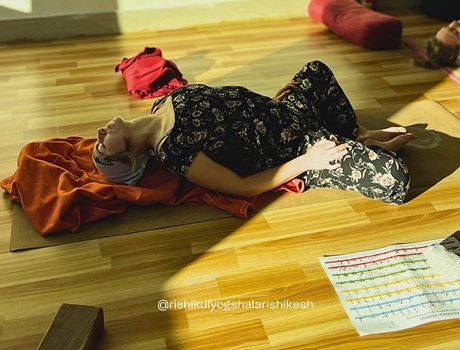
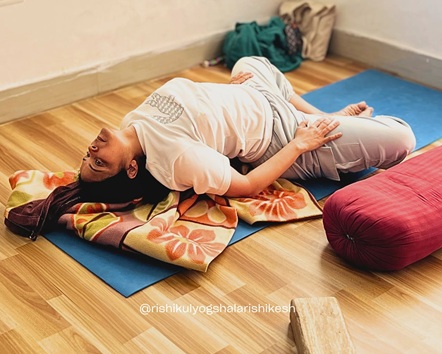
Supta Baddha Konasana (Reclining Bound Angle Pose) is a restorative yoga pose in which you lie on your back with the soles of your feet together and your knees open to the sides. It gently stretches the inner thighs and chest, and helps the body shift into a calm, resting state. It is usually held for 1 to 10 minutes, often with a bolster under the spine and blocks under the thighs.
Supta Baddha Konasana at a Glance
| Sanskrit name | Supta Baddha Konasana |
| Hindi name | सुप्त बद्ध कोणासन |
| English names | Reclining Bound Angle Pose, Reclined Butterfly Pose, Reclining Goddess Pose |
| Pose type | Restorative, supine hip opener |
| Level | Beginner (all levels with props) |
| Hold time | 1 to 3 minutes in class; 5 to 10 minutes in restorative practice |
| Props | Bolster, 2 blocks or blankets, strap, eye pillow (optional) |
| Stretches | Inner thighs, groin, hips, chest |
| Key benefits | Calms the nervous system, eases hip tightness, opens the chest, supports sleep, may ease period discomfort |
| Best time | End of practice, evening, before sleep, rest days |
| Take care with | Groin, hip or knee injury; lower back pain; pregnancy; recent surgery |
| Preparatory poses | Baddha Konasana, Malasana, Supta Matsyendrasana |
| Follow-up poses | Knees-to-chest, Savasana |
What Does Supta Baddha Konasana Mean?
The name comes from four Sanskrit words:
- Supta (सुप्त) means reclining or lying down
- Baddha (बद्ध) means bound
- Kona (कोण) means angle
- Asana (आसन) means posture or seat
Put together, it means “reclining bound angle pose.” In Hindi, it is written सुप्त बद्ध कोणासन, and many Indian teachers simply call it lying-down butterfly, or letkar titli asana.
You will also see it called Reclined Bound Angle Pose, Reclined Butterfly Pose, Reclining Cobbler’s Pose, and Reclining Goddess Pose. They all describe the same shape.
Where Does The Pose Come From?
The leg position is old. The seated version, known as Bhadrasana, is described as a meditation seat in the 15th-century Hatha Yoga Pradipika (verses 1.53 to 1.54). You can read more about that seated form in our Bhadrasana article and our post on the power of Baddha Konasana.
The reclining, prop-supported version is more modern. It became popular through the Iyengar tradition, which uses bolsters, blankets, and straps so that students can stay in a pose longer without strain. Today it is one of the most-used poses in restorative yoga, prenatal yoga, and Yin classes around the world.
Supta Baddha Konasana vs Baddha Konasana: What Is the Difference?
The legs make the same shape in both poses. What changes is gravity, effort, and purpose. In the seated pose, you hold yourself up and work into the hips. In the reclining pose, the floor and the props hold you, and your only job is to let go.
| Baddha Konasana (seated) | Supta Baddha Konasana (reclining) | |
|---|---|---|
| Body position | Sitting upright | Lying on the back |
| Effort | Active: spine lifts, core works | Passive: props carry the weight |
| Main feeling | Stretch in hips and inner thighs | Softening in hips, belly, and chest |
| Effect on the mind | Focusing, grounding | Calming, restful |
| Typical hold | 30 seconds to 3 minutes | 1 to 10 minutes or longer |
| Best time | Warm-up, meditation seat | End of practice, before sleep, rest days |
If your hips feel tight, the reclining version is often the easier way in, because you are not fighting your own body weight to sit tall. Many of our students find their seated Butterfly Pose improves after a few weeks of practising the supported reclined version.
How to Do Supta Baddha Konasana?
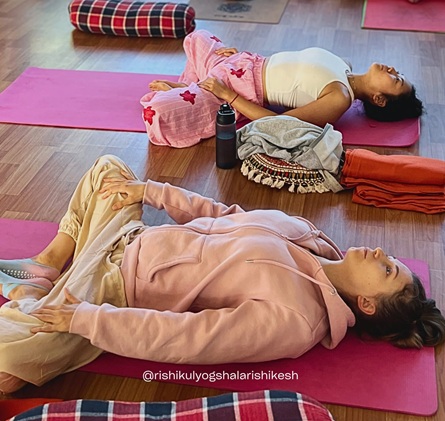
This is the basic version without props. If your knees stay high or your lower back complains, go straight to the prop setup in the next section.
- Sit and set up. Sit on your mat with your legs stretched out in front of you. Bend your knees and place your feet flat on the floor, hip-width apart.
- Lower yourself down. Lean back onto your forearms, then slowly lower your back, shoulders, and head to the floor. Keep your knees bent and feet flat.
- Bring the soles together. Let your knees drop open to the sides and press the soles of your feet together. Your legs now make a diamond shape.
- Find your heel distance. Slide your heels toward your groin only as far as feels easy. For most beginners, this is a foot or so away from the body.
- Settle the spine. Lengthen your tailbone gently toward your heels so your lower back rests without a big arch. Draw your shoulders away from your ears.
- Place your arms. Rest your arms on the floor at about 45 degrees from your body, palms facing up. Or place one hand on your chest and one on your belly.
- Breathe and stay. Close your eyes. Breathe slowly through the nose and let the knees fall with gravity. Stay for 1 to 5 minutes.
- Come out slowly. Use your hands to press your knees back together. Roll onto your right side, rest for a few breaths, then press up to sit, bringing your head up last.
Teacher’s tip: Step 8 matters more than people think. Coming out too fast can strain the groin and the lower back, especially after a long hold. Always help your knees back together with your hands.
Supta Baddha Konasana With a Bolster: The Restorative Setup
Props are not a crutch. In restorative yoga, they are the whole point. When the body feels fully supported, the nervous system stops bracing and starts to rest. This is how we set up the pose in our restorative classes in Rishikesh.
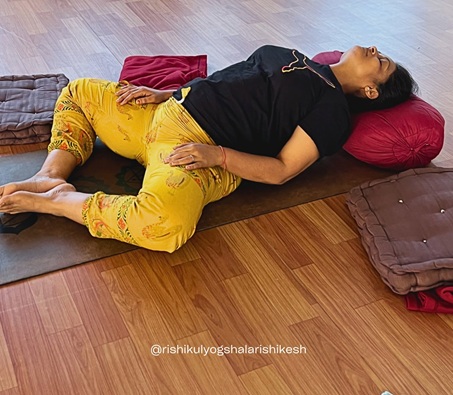
What you need: one bolster (or two firm pillows stacked lengthwise), two blocks or folded blankets, one yoga strap, and optionally a blanket for your head and an eye pillow.
- Place the bolster. Lay the bolster lengthwise on your mat. Sit with your back to its short end, with your hips touching it.
- Add the strap (optional). Loop the strap around your lower back, bring it over the tops of your thighs, and hook it under your feet. Tighten it just enough to hold your feet near you without effort.
- Lie back. Lower your spine onto the bolster so it supports you from the lower back to the head. Your chest should feel open, not squeezed.
- Support the knees. Slide a block or rolled blanket under each outer thigh. The legs should feel held, with no pulling in the groin.
- Support the head. If your chin tilts up, place a folded blanket under your head so your forehead is slightly higher than your chin.
- Rest. Arms out to the sides on the floor, palms up. Cover your eyes if you like. Stay for 5 to 10 minutes.
If your lower back feels tight, raise the bolster higher by putting a block under its far end. The more incline you add, the gentler the pose becomes. You can see how this pose fits into a full restful practice in our guide to restorative yoga poses.
Teacher’s tip: At home, a sofa cushion and two thick books work well. The test is simple: if any part of you is holding on, add more support there.
Benefits of Supta Baddha Konasana
Supta Baddha Konasana works on two levels at once: it opens the hips and front body, and it calms the mind. Here is what our students notice most, and what the research says.
Physical benefits
- Gently opens the hips and groin. Gravity does the stretching, so the inner thighs and hip rotators release without force. This helps people who sit for long hours.
- Opens the chest. Lying back over a bolster lifts the ribs and lets the shoulders fall open, which counters the rounded posture of desk and phone work.
- Makes breathing easier. With the belly and chest open, the breath naturally moves deeper into the diaphragm.
- Eases the lower back. When the spine is well supported, the lower back can relax after long days of standing or sitting.
- May ease menstrual discomfort. Many women find the supported version soothing during their period, and teachers often suggest it as a gentle alternative to inversions such as Halasana at that time.
- Brings awareness to the pelvic floor. The open position helps you notice and relax this area, which is often held tight without our knowing.
Mental and Emotional Benefits
- Calms the nervous system. Long, supported holds help the body move from “fight or flight” into “rest and digest.”
- Helps you wind down for sleep. A few minutes before bed can quiet a busy mind.
- Supports meditation and pranayama. It is an easy, comfortable position for breath awareness or Yoga Nidra.
These are promising signs, not proof of a cure. We see the pose as a support for rest and recovery, alongside medical care where it is needed.
The Yogic View
In yogic tradition, the pelvis is linked to the Muladhara (root) and Svadhisthana (sacral) chakras. Opening this area with softness, not force, is said to help release stored tension and build a sense of safety and grounding.
How Long to Hold It and When to Practise?
How long you stay depends on how the pose is used:
| Practice | Hold time |
|---|---|
| Short rest inside a Hatha or Vinyasa class | 1 to 3 minutes |
| Yin yoga | 3 to 5 minutes, few or no props |
| Restorative yoga | 5 to 10 minutes or more, fully propped |
| Before sleep | 5 minutes |
The best times are at the end of a practice before Savasana, in the evening to unwind, or on rest and recovery days. Because it puts no pressure on the belly, you can practise it an hour or so after a light meal, which is rare among yoga poses. For longer, quieter holds, see our Yin Yoga article.
Variations and Modifications
The right version is the one where you can breathe easily and stay still. Try these depending on your body and your goal.
- Feet farther away (beginners). Keep the heels well away from the groin. This reduces the stretch in the inner thighs and hips. Bring them closer over weeks, not days.
- Blocks under the thighs (tight hips or sore knees). Support each outer thigh with a block or pillow so nothing hangs in the air. This is the version we teach most.
- Strap-bound version (deep rest). Use a strap around the hips and feet, as in the bolster setup, so the legs stay in place without any muscle effort.
- Legs up the wall. Lie with your hips close to a wall, legs up. Then bend the knees and bring the soles together, letting the feet slide down the wall. This is lovely for tired legs.
- Arms overhead (more chest opening). Take your arms above your head and hold opposite elbows. This adds a stretch to the shoulders and sides of the body.
- Supported version for pregnancy. Use a high bolster so the upper body stays well raised, and blocks under both thighs. Later in pregnancy, lying flat can make some women feel dizzy or breathless, so keep the incline and practise only with your doctor’s approval.
Common Mistakes and How to Fix Them
These are the corrections our teachers make most often in class.
| Mistake | Why it is a problem | The fix |
|---|---|---|
| Pushing the knees down | Tightens the very muscles you want to relax and can strain the groin | Let gravity do the work; support the thighs with blocks |
| Heels too close to the groin | Too much stretch too soon, pressure on the knees | Move the feet farther away |
| Big arch in the lower back | Compresses the lower spine | Lengthen the tailbone gently or raise the bolster |
| Chin lifted up | Strains the neck | Fold a blanket under the head |
| Holding the breath | Keeps the body in a stressed state | Slow nasal breathing, longer exhales |
| Coming out too fast | Can jerk the groin and lower back | Close the knees with your hands and roll to the side |
Contraindications and Precautions
Supta Baddha Konasana is safe for most people when it is well supported. Take extra care, or ask a qualified teacher first, if any of these apply to you:
- Groin, hip or knee injury. Use high support under the thighs, or keep the legs straight instead.
- Recent hip or knee surgery. Wait for your doctor’s clearance.
- Lower back pain. Raise the bolster or add a folded blanket at its base. Stop if the pain increases.
- Pregnancy. Use the supported, inclined version only, and check with your doctor first.
- After childbirth. Some teachers advise waiting until the pelvic area has recovered. Follow your doctor’s or physiotherapist’s advice.
- Shoulder injury. Keep the arms low and supported, not overhead.
A stretch should feel like mild, even sensation. Sharp pain, pinching in the knee or numbness in the legs means it is time to come out and adjust.
Preparatory and Follow-Up Poses
Warming the hips first makes the reclined pose feel much softer. Try this simple 15-minute evening sequence:
- Baddha Konasana (seated butterfly), 1 minute, to wake up the inner thighs
- Malasana (garland pose), 1 minute, to open the hips and ankles
- Supta Matsyendrasana (reclined twist), 1 minute each side, to release the lower back
- Viparita Karani (legs up the wall), 3 minutes, to calm the body
- Supta Baddha Konasana with props, 5 to 8 minutes
- Savasana, 3 minutes, to finish
After Supta Baddha Konasana, a gentle knees-to-chest hug or a few minutes of Savasana helps the hips settle back to neutral.
Final Thoughts
Supta Baddha Konasana teaches something most of us were never taught: how to stop trying. With a bolster, a couple of blocks and ten quiet minutes, you give your hips, your breath and your mind permission to soften.
Start with the supported version, keep your feet at a comfortable distance, and let gravity do the work. Over weeks, you will likely find the hips open further and the mind settles faster.
Want to teach poses like this with confidence?
Knowing how to set up props, adjust students safely and build restorative sequences is a skill every yoga teacher needs. In our Yoga Alliance-certified 200 Hour Yoga Teacher Training in Rishikesh, you learn restorative and prop-based yoga in the Iyengar-influenced way we teach in class, along with Hatha, alignment, anatomy, and philosophy.
Frequently Asked Questions
What is Supta Baddha Konasana called in English?
It is called Reclining Bound Angle Pose. It is also known as Reclined Butterfly Pose, Reclining Cobbler’s Pose and Reclining Goddess Pose.
Is Supta Baddha Konasana good for beginners?
Yes. It needs no strength or flexibility when you use props. Beginners should keep the feet farther away and support the thighs with blocks or pillows.
Can I do Supta Baddha Konasana before sleep?
Yes. Five minutes of the supported version in bed or on the floor is a simple way to calm the mind before sleep.
Is it good for period pain?
Many women find the supported version comforting during their period. It is gentle and puts no pressure on the belly. If pain is severe, see a doctor.
Can I practise it during pregnancy?
Often yes, with a high bolster so your upper body stays raised, and only with your doctor’s approval. Avoid lying flat on your back later in pregnancy.
Why do my knees stay high off the floor?
Tight inner thighs and hips are common, especially if you sit a lot. It is not a problem. Support the knees with blocks, and the hips will open slowly with regular practice.
Is Supta Baddha Konasana a Yin or restorative pose?
It is used in both. In Yin yoga it is held with little support to stress the connective tissue. In restorative yoga it is fully propped to rest the nervous system.
This article is for general information and is not medical advice. If you have a respiratory or heart condition, are pregnant, or are unsure whether these practices suit you, please speak to your doctor before beginning.

 +91-8433225327,
 Rishikul Yogshala Rishikesh, Narayan Kunj, Jonk Village, Ram Jhula, Swarg Ashram, Rishikesh, Uttarakhand 249304
 By Airway
 By Railway
 By Bus/Cabs