








Cat Cow Pose: Steps, Breath, Benefits & Who Should Avoid It
Table of Contents
- What Is Cat Cow Pose?
- Cat Pose and Cow Pose: How They Differ and Why It Matters
- How to Do Cat-Cow Pose Correctly (And Why Most People Get the Breath Wrong)?
- Setting up
- The Movement
- Now — The Breath
- Common Mistakes in the Cat Cow Stretch
- Benefits of Cat and Cow Pose
- Physical Benefits
- Mental Benefits
- Who Should Avoid Cat-Cow Pose Or Modify It
- Modifications That Make It Accessible
- Variations to Explore
- 1. Tiger Pose (Vyaghrasana) — Add one leg
- 2. Sunbird (Chakravakasana) — Add an arm too
- 3. Thread the Needle — A gentle twist
- 4. Cat-Cow Circles — Move in a circle instead of a line
- 5. Side-to-Side Cat-Cow — Curve sideways
- How Often Should You Practice?
- Best Times of Day
- How Many Days a Week?
- A Realistic Expectation
- Where Cat-Cow Fits in a Practice
- Closing Thoughts
- Frequently Asked Questions
- Is it cat-cow or cow cat?
- Do I inhale on cat or cow?
- Is Cat-Cow good for lower back pain?
- Can beginners do Cat-Cow Pose?
- Is Cat-Cow safe during pregnancy?
- What is Cat-Cow called in Sanskrit?
- How long should I hold each pose?
- My wrists hurt in Cat-Cow. What should I do?
Most yoga classes start with Cat-Cow Pose. It takes about ninety seconds; it looks simple enough that nobody asks questions, and almost everyone does it slightly wrong.
The mistake is not the shape. The shape is easy: you get on your hands and knees, you round your back, you drop your belly. The mistake is the breath. And once the breath is backwards, the pose stops doing about half of what it is supposed to do.
This guide covers what Cat-Cow Pose actually is, how to do it properly, why the breathing confuses so many people, what it genuinely helps with, and, just as important, who should leave it alone or change it.
What Is Cat Cow Pose?
Cat-Cow Pose is a gentle, flowing movement done on your hands and knees. You inhale and let your belly drop toward the floor for Cow Pose, then exhale and round your spine toward the ceiling for Cat Pose. Repeating this warms the spine, improves flexibility, and links breath to movement. In Sanskrit, it is called Marjaryasana-Bitilasana.
That is the short version. The rest of this article is the part your class never had time for.
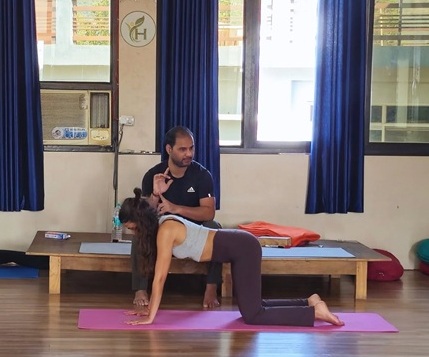
Cat Pose and Cow Pose: How They Differ and Why It Matters
The cat and cow pose is really two postures joined into one continuous movement.
Cow Pose (Bitilasana) comes from the Sanskrit bitila, meaning cow. Your belly softens toward the mat, your tailbone lifts, your chest opens, and your gaze rises slightly. Anatomically, this is spinal extension — a gentle backbend.
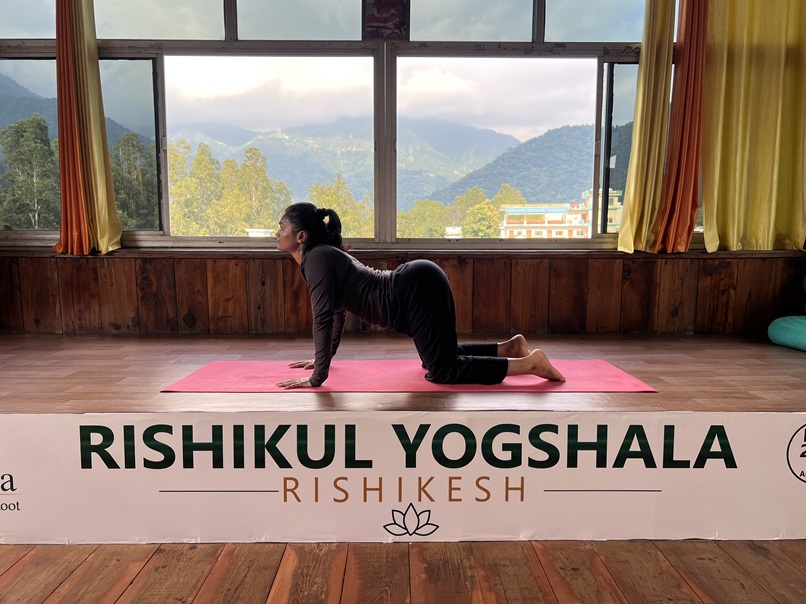
Cat Pose (Marjaryasana) comes from marjari, meaning cat. Your spine rounds up toward the ceiling, your tailbone tucks under, your chin drops toward your chest. This is spinal flexion — a gentle forward rounding.
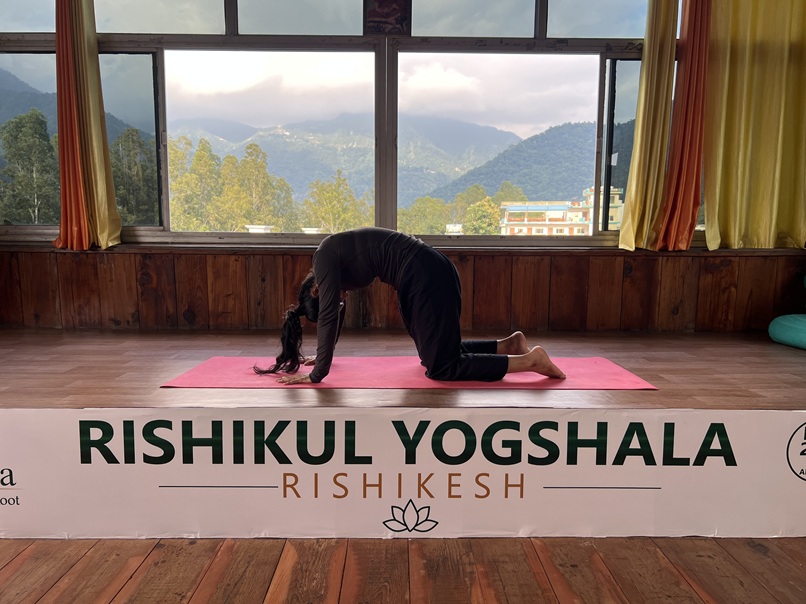
Practiced separately, they are two ordinary poses. Practiced together, moving with the breath, they become something more useful: a way to take your spine through its full range of front-to-back motion while your nervous system settles. That is why teachers put the cat-cow stretch at the start of class. It wakes up the spine and slows down the mind at the same time.
How to Do Cat-Cow Pose Correctly (And Why Most People Get the Breath Wrong)?
Here is the full sequence. Read it once through before you try it.
Setting up
1. Come onto all fours. Start in a tabletop position on a mat. Place your wrists directly under your shoulders and your knees directly under your hips. If your knees complain, fold a blanket underneath them.
2. Check your hands. Spread your fingers wide. Press down through the base of your index finger and thumb, not just the heel of the hand. This protects your wrists and stops you from collapsing into them.
3. Find a neutral spine. Before you move anywhere, pause here. Your back should be long and flat, the crown of your head reaching forward, your tailbone reaching back. Look down at the mat, not forward. Your neck stays in line with your spine.
4. Take one normal breath. Do not start moving on your first breath. Feel where you are.
The Movement
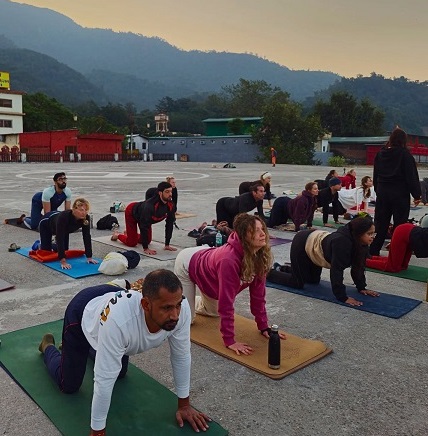
5. Inhale into Cow Pose. As you breathe in, let your belly drop toward the floor. Tilt your pelvis so your tailbone lifts. Let your chest broaden, and your shoulder blades draw gently down your back. Lift your gaze only slightly, a few inches, not a full head-tilt. The movement starts at your pelvis and travels up your spine, finishing at your neck.
6. Exhale into Cat Pose. As you breathe out, tuck your tailbone under, draw your navel up toward your spine, and let your back round toward the ceiling. Press the floor away with your hands so the space between your shoulder blades widens. Your chin comes toward your chest last, not first.
7. Keep Going. Move slowly. One breath, one movement. Five to ten rounds is plenty for a warm-up.
8. Come Back to Neutral. Return to a flat, neutral spine. Sit back onto your heels in Child’s Pose for a few breaths if that feels good.
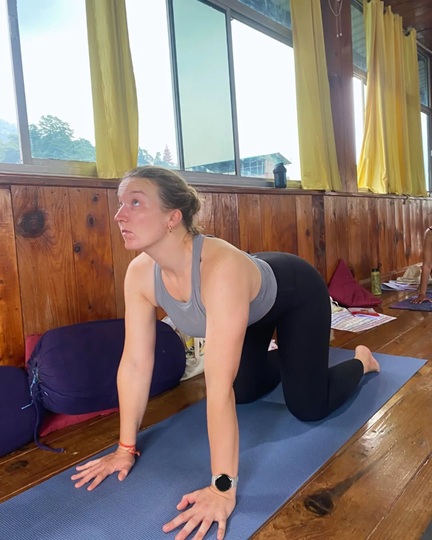
Now — The Breath
Here is the part that goes wrong constantly:
Inhale = Cow (belly drops).Exhale = Cat (spine rounds).
If you are doing the opposite, you are working against your own body. Here is why.
Reason One: Your diaphragm is already doing this. When you inhale, your diaphragm moves down and your belly naturally expands. That expansion wants to take your front body with it — which is exactly the shape of Cow Pose. When you exhale, your diaphragm rises, your abdominal wall draws in, and your navel naturally moves back toward your spine — which is exactly what Cat Pose asks for. Match the breath to the shape and the pose almost does itself. Reverse it, and every round becomes a small fight between your lungs and your spine.
Reason Two: The word “arch” is ambiguous. Teachers say “arch your back” all the time. To one student that means arching upward like an angry cat. To another it means arching downward like a swayback horse. Both are reasonable readings of the same word. This one vague cue has probably caused more confused Cat-Cow than anything else. If you teach, say “let your belly drop” or “round your spine” instead. Describe the direction, not the abstraction.
Reason Three: It gets cued too fast. In a busy class, Cat-Cow appears in the first two minutes and lasts thirty seconds. Students copy the shape from the person in front of them and never register which breath goes with which movement. The pattern gets learned wrong and then repeated for years.
Reason Four: A lot of written instructions are muddled. Search for this pose online, and you will find guides that combine both actions into a single sentence — “inhale and arch your back while drawing your navel in.” That is two different poses in one instruction. If you have been following something like that, it is not your fault.
One Honest Caveat. A few traditions do deliberately reverse the breath in certain practices — some Kundalini kriyas, for instance, use a different pattern on purpose to build heat. That is a specific, intentional technique with a specific goal. It is not the standard cat-cow yoga stretch, and it is not what most people are doing by accident. For general practice, inhale into Cow and exhale into Cat.
Common Mistakes in the Cat Cow Stretch
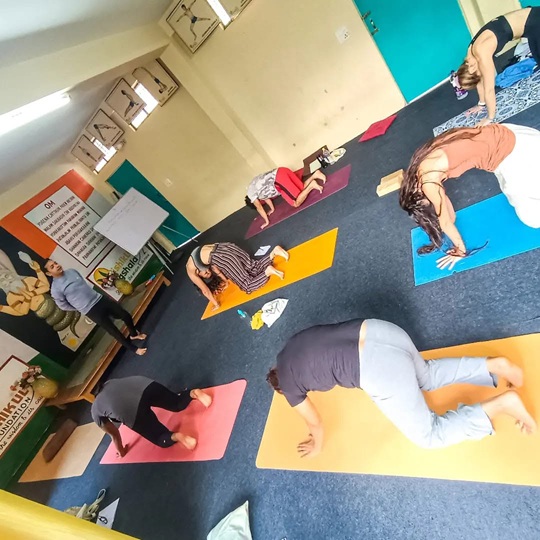
- Leading with your head. The movement should start in your pelvis and ripple up. Most people start with the neck, which means the spine barely moves at all.
- Cranking the neck in Cow. Throwing your head back to look at the ceiling compresses the back of your neck. Lift the gaze slightly and stop there.
- Collapsing into the shoulders. If your shoulder blades are squeezing together and your chest is sinking between your arms, you are hanging on your joints. Press the floor away actively.
- Moving faster than you are breathing. If you finish the movement before the breath finishes, slow the movement down. The breath sets the pace, not the other way around.
- Holding the breath. Common when people concentrate hard. If you notice it, pause, take one normal breath, and start again.
- Hands and knees out of position. Wrists drifting forward of the shoulders puts a lot of load on the joint. Check your alignment every few rounds.
- Forcing depth. This is a mobility warm-up, not a backbend competition. Small and smooth beats big and forced every time.
Benefits of Cat and Cow Pose
Physical Benefits
1. Restores spinal movement your day takes away
Your spine has twenty-four moving vertebrae, each designed to flex and extend a little. Sitting holds them in one shape for hours. Cat-Cow asks every segment to contribute movement again — without load, without impact, and without needing any flexibility to begin with.
2. Gives a stiff back somewhere safe to start
On all fours, your body weight spreads across four points instead of loading the spine vertically. Nothing is held at end range. For a back that has been guarded and sore, movement without threat is often what unlocks things.
3. Opens the front body
Cow Pose lengthens the chest, abdomen, and hip flexors, exactly the areas that spend the day folded shut in a chair.
4. Stretches the entire back line
Cat Pose rounds the spine, releasing the lower back and widening the space between the shoulder blades, where desk tension collects.
5. Builds a real sense of neutral spine
You start in neutral, travel to both extremes, and return. Ten rounds and your nervous system has a map: too rounded, too arched, this is the middle. That map carries into standing, sitting, and every other pose.
6. Warms the joints before harder work
Movement thins the synovial fluid in your joints, so they move more freely after a few rounds than before. Cat-Cow also loads the wrists gradually and takes the shoulders through range, useful insurance before anything demanding.
7. Improves posture over time
Better spinal mobility plus better positional awareness is the combination that actually changes how you hold yourself. Neither works well alone.
8. Supports digestion (traditional view)
Classical teaching credits the rhythmic compression and release of the abdomen with aiding digestion. Worth including, but treat it as traditional teaching rather than a clinical claim.
Mental Benefits
1. Settles the nervous system through the exhale
Breathing out activates the parasympathetic branch, the side that slows the heart rate. A steady rhythm of long exhales compounds that effect over a few minutes.
2. Interrupts a busy mind
Coordinating one specific movement with one specific breath takes just enough attention to occupy the part of your mind running loops about work or worry. Not enough to feel like effort. Enough to break the cycle.
3. Teaches breath-movement coordination
This is a skill, and Cat-Cow is where most people learn it, because the anatomy makes the link obvious. Inhale expands the belly, which is Cow. Exhale draws it in, which is Cat. Once you feel it here, you can find it in harder sequences where it’s far subtler.
4. Builds body awareness
Slow, deliberate movement with attention on where you are in space is a form of mindfulness practice, whether or not anyone calls it that.
Want to learn Cat-Cow Pose in depth? It is taught in detail at Rishikul Yogshala as part of our Yoga Teacher Training in Rishikesh.
Interested in joining? WhatsApp us for course details, dates, and fees.
Who Should Avoid Cat-Cow Pose Or Modify It
This is the section most articles skip, and it matters more than the benefits list.
- Osteoporosis or low bone density. Deep spinal flexion, the rounding part of Cat Pose, is generally not advised where bone density is significantly reduced, because of fracture risk in the vertebrae. If this applies to you, speak to your doctor or physiotherapist before practicing, and do not simply push through.
- Acute disc problems. If you have a current disc injury, flexion may aggravate symptoms for some people and relieve them for others. This genuinely varies by individual. Get guidance from a physio rather than guessing.
- Recent abdominal or spinal surgery. Wait until you are cleared.
- Neck injury. Keep your neck in line with your spine throughout and skip the gaze lift entirely.
- Wrist injury or carpal tunnel. Do not just endure it; use one of the modifications below.
- Knee pain. Pad underneath, or move to a seated or chair version.
- Late pregnancy. Cat-Cow is often recommended during pregnancy, and many people find it helpful for back comfort. But the deep rounding of Cat should be kept gentle as pregnancy progresses, and knees may need to be wider. Talk to your midwife or doctor, and ideally work with a prenatal-trained teacher.
- Vertigo or dizziness. The head position changes can trigger symptoms. Move slowly, or keep the head still.
If anything sharpens, pinches, or shoots, stop. Discomfort from a stiff back easing up feels different from pain, and it is worth learning that difference.
Modifications That Make It Accessible
- Wrist pain — forearms down. Come onto your forearms instead of your hands, elbows under shoulders. You lose a little range, but you keep the whole spinal movement.
- Wrist pain — fists. Make loose fists and rest on the flat of your knuckles, keeping your wrists straight.
- Wrist pain — wedge or rolled mat. Place a rolled towel under the heels of your hands to reduce the angle at the wrist.
- Knee pain — padding. Fold a blanket under your knees, or double your mat over.
- Seated cat-cow. Sit on a chair or cross-legged, hands on your knees. Inhale, lift your chest and tilt your pelvis forward. Exhale, round your spine and tuck your pelvis under. Same movement, no weight on wrists or knees at all.
- Chair cat-cow. Especially useful for older practitioners, office workers, and anyone who cannot easily get to the floor.
- Standing cat-cow. Hands on your thighs, knees soft, hinge forward slightly. Move the spine the same way.
Variations to Explore
Once the basic cat and cow yoga poses feel easy, there are a few places to take them. Try one at a time, not all in one session.
1. Tiger Pose (Vyaghrasana) — Add one leg
Start on all fours. As you breathe in, stretch your right leg straight back and lift it. As you breathe out, round your back and draw that knee in toward your nose. Repeat five times, then swap legs.
What it adds: The same spinal movement, plus glute and core work.
2. Sunbird (Chakravakasana) — Add an arm too
From all fours, stretch your right arm forward and your left leg back at the same time. Hold for two or three breaths, keeping your hips level. Lower, then switch sides.
What it adds: Balance and deep core strength. Harder than it looks.
3. Thread the Needle — A gentle twist
From all fours, slide your right arm under your left arm along the floor. Let your right shoulder and the side of your head rest on the mat. Stay for five slow breaths, then swap.
What it adds: A twist for the upper back and shoulders. A good place to finish after Cat-Cow.
4. Cat-Cow Circles — Move in a circle instead of a line
Stay on all fours. Rather than moving only forward and back, let your hips draw slow circles — right, back, left, forward. Five circles one way, five the other.
What it adds: Reaches side-to-side ranges the straight version never touches. Particularly good for tight lower backs and hips.
5. Side-to-Side Cat-Cow — Curve sideways
Keep your hands and knees where they are. Curve your spine to the right so your ribs and hip move toward each other, and look toward your right hip. Come back through the centre and repeat on the left.
What it adds:works the sides of your waist, which the standard flow leaves out entirely.
Where to begin: If you only try one, make it Cat-Cow Circles. It’s the easiest to pick up, and most people feel the difference straight away.
How Often Should You Practice?
Short answer: as often as you like. This is one of the few poses with almost no ceiling on daily practice.
- As a warm-up: 5 to 10 rounds, roughly one to two minutes. Enough to wake the spine before the rest of your practice.
- As a standalone practice: 3 to 5 minutes. This is the version for a stiff back, a long drive, or a day that has been spent entirely in a chair.
- At your desk: 6 to 8 rounds of the seated version, every couple of hours. Nobody will notice, and it works.
Best Times of Day
- Morning is when your spine is stiffest. Overnight, the discs rehydrate, and the surrounding tissue tightens up, so the first few rounds usually feel the most restricted — and give you the biggest change. If you only do it once a day, do it here.
- Evening is for the opposite reason. The long exhale and slow rhythm help you unwind, and it releases whatever the day loaded into your lower back and shoulders.
How Many Days a Week?
Daily is fine for most people. Cat-Cow is low-intensity, non-loading, and does not need recovery time the way strength work does. There is no reason to schedule rest days from it.
A Realistic Expectation
If your back is stiff, you will feel a difference within a single session; that is normal, and it is mostly the joints warming up. Lasting change in mobility takes longer: most people notice their morning rounds feeling easier after two to three weeks of daily practice. That is the point at which it is doing something for your spine rather than just for that morning.
What Changed: the durations are now scannable, I added a third use case (desk) since your existing content doesn’t cover office workers anywhere, and I explained why morning and evening work rather than just naming them. The last block is the addition worth keeping: telling readers what results to expect and when is a strong trust signal, and it’s the kind of specific claim that AI Overviews tend to pull.
Where Cat-Cow Fits in a Practice
Before anything else. Cat-Cow belongs in the opening minutes, before sun salutations, before standing poses, before anything that demands range from your spine.
It also works as a reset partway through practice — after a strong backbend, a few soft rounds can feel good — and as a wind-down before final relaxation.
Closing Thoughts
Cat-Cow may be a simple movement, but it can have an important place in a regular yoga practice. It gives the spine gentle movement, helps you connect breath with movement, and allows you to notice how your body feels before moving into more demanding poses.
There is no need to force the movement or make the shape bigger than feels comfortable. Move slowly, breathe naturally, and let the breath guide each transition. Remember the basic rhythm: inhale as you move into Cow, and exhale as you round into Cat.
At Rishikul Yogshala Rishikesh, this same focus on mindful movement, breath, and proper alignment is an important part of learning yoga. For those looking to develop a deeper understanding of yoga practice and teaching, Yoga Teacher Training in Rishikesh can provide an opportunity to explore these foundations in a more structured way.
Whether you are new to yoga or have been practicing for years, Cat-Cow is a simple movement worth returning to whenever your body needs a gentle reset.
Frequently Asked Questions
Is it cat-cow or cow cat?
Both names refer to the same flow. “Cat-Cow” is the more common order in English-language yoga, though you will see “cow and cat yoga pose” used too. The order of the names does not change the practice.
Do I inhale on cat or cow?
Inhale on Cow, when the belly drops. Exhale on Cat, when the spine rounds. This matches how your diaphragm naturally moves.
Is Cat-Cow good for lower back pain?
Many people find gentle spinal movement helpful for general stiffness and everyday back discomfort. But it is not a treatment for a diagnosed back condition, and certain conditions — particularly osteoporosis and acute disc injury — call for professional guidance first.
Can beginners do Cat-Cow Pose?
Yes. It is one of the most beginner-friendly poses in yoga, and one of the few that works equally well for complete beginners and experienced practitioners.
Is Cat-Cow safe during pregnancy?
It is commonly recommended and often helpful, with modifications. Keep the rounding gentle, widen the knees, and check with your healthcare provider.
What is Cat-Cow called in Sanskrit?
Marjaryasana (Cat) and Bitilasana (Cow). Together: Marjaryasana-Bitilasana.
How long should I hold each pose?
You do not hold them. Cat-Cow is a flow — you move continuously, one breath per movement. If you want to hold, pause in Cow for a breath or two and then in Cat, but the flowing version is the standard practice.
My wrists hurt in Cat-Cow. What should I do?
Move to your forearms, or make fists, or use a rolled towel under your hands. If the pain continues, use the seated version instead — you lose nothing important.
This article is for general information and is not medical advice. If you have a respiratory or heart condition, are pregnant, or are unsure whether these practices suit you, please speak to your doctor before beginning.

 +91-8433225327,
 Rishikul Yogshala Rishikesh, Narayan Kunj, Jonk Village, Ram Jhula, Swarg Ashram, Rishikesh, Uttarakhand 249304
 By Airway
 By Railway
 By Bus/Cabs