








Purna Matsyendrasana (Full Spinal Twist): Steps & Precautions
Table of Contents
- Purna Matsyendrasana at a Glance
- What is Purna Matsyendrasana?
- Is Purna Matsyendrasana Right for You Yet?
- How Do You Do Poorna Matsyendrasana?
- How Long Should You Hold Purna Matsyendrasana?
- How to Come Out Safely
- Preparatory Poses
- Common Mistakes
- Props and Modifications
- Benefits of Purna Matsyendrasana?
- Poorna Matsyendrasana Contraindications
- Conclusion
- Frequently Asked Questions
- What are the benefits of Purna Matsyendrasana?
- Is Purna Matsyendrasana the same as Ardha Matsyendrasana?
- Who should avoid Purna Matsyendrasana?
- What is the difference between Purna and Ardha Matsyendrasana?
- How long does it take to learn Purna Matsyendrasana?
- Why does my knee hurt in Purna Matsyendrasana?
- Can I practise Purna Matsyendrasana every day?
Purna Matsyendrasana, the Complete Lord of the Fishes Pose, is the deepest version of the Matsyendrasana family. Where Ardha Matsyendrasana (the half pose) folds one leg gently, and Matsyendrasana (the full pose) folds it more deeply, Purna takes both legs into a Lotus-style base before adding the spinal twist. The result is one of yoga’s most demanding seated postures, requiring open hips comfortable in Full Lotus PLUS a generous spinal twist, all held with a quiet breath. In this guide, we’ll meet Purna Matsyendrasana with deep care.
Performing the Full Spinal Twist Pose can be tricky, but the rewards are well worth the effort. This pose offers countless physical benefits and significant mental and emotional benefits. At Rishikul Yogshala in Rishikesh, our professional yoga experts guide students to experience the physical advantages and embrace the emotional and cognitive benefits, encouraging a more profound sense of balance and inner peace.
In this article, we will cover all the information related to Purna Matsyendrasana, including what it is, how to do it, its benefits, and who should avoid it.
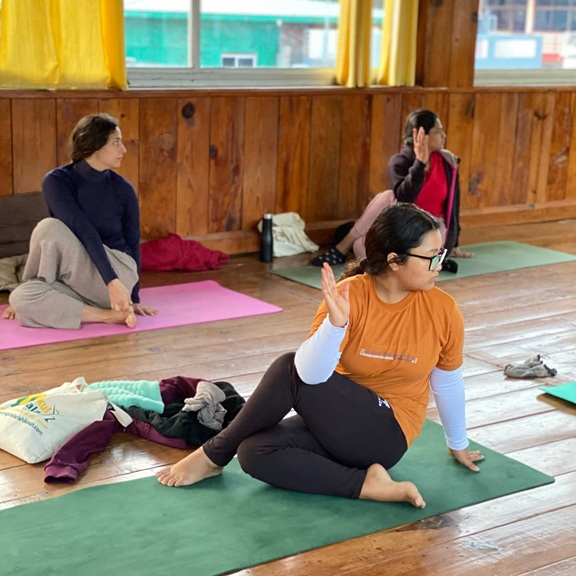
Purna Matsyendrasana at a Glance
| Sanskrit name | पूर्ण मत्स्येन्द्रासन (Pūrṇa Matsyendrāsana) |
| English name | Full Spinal Twist Pose, Complete Lord of the Fishes Pose |
| Also spelled | Poorna Matsyendrasana |
| Pose type | Seated, twist, hip opener, bind |
| Level | Advanced |
| Hold time | 20 seconds to start; 2 to 3 minutes with practice |
| Prerequisites | Comfortable half lotus, comfortable Ardha Matsyendrasana, mobile shoulders |
| Stomach | Empty — wait 4 hours after a meal |
| Where in a class | Near the end, once the body is fully warm |
| Main caution | Pregnancy, spine or knee injury, high blood pressure |
What is Purna Matsyendrasana?
Purna Matsyendrasana (Full Spinal Twist Pose) is a variation of Matsyendrasana. This asana involves an in-depth spine twist, helping to stretch and strengthen the entire body. “Purna” means “complete,” and “Matsyendra” refers to a mythical yogi, often regarded as the founder of Hatha Yoga. This asana symbolizes turning inward, aligning the body with the breath, and improving physical and mental flexibility.
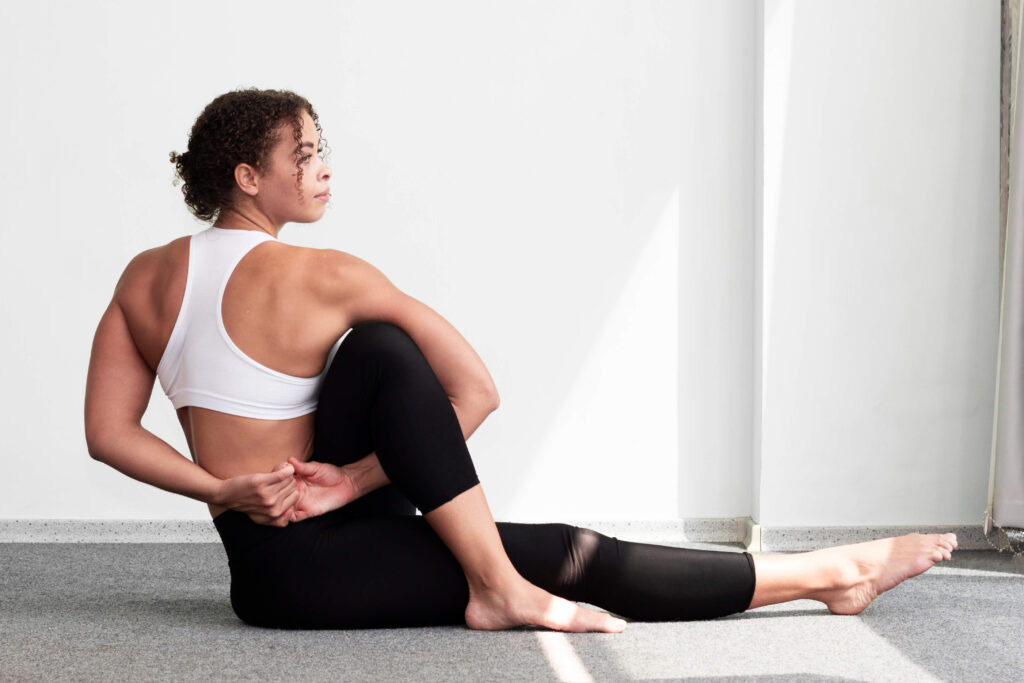
Is Purna Matsyendrasana Right for You Yet?
Purna Matsyendrasana is not a pose to try because it looks impressive. It asks four things of the body at once — a lotus-folded knee, an open hip, a deeply rotating spine, and shoulders mobile enough to bind behind the back. If any one of those is missing, the knee usually pays the price.
Before attempting it, you should be able to:
- Sit in half lotus for two minutes with no knee pain at all
- Hold Ardha Matsyendrasana comfortably on both sides, sitting level
- Clasp your hands behind your back in Gomukhasana arms on both sides
- Breathe slowly and evenly in a deep twist without straining
If any of these is still difficult, keep working on Ardha Matsyendrasana. It gives most of the same benefits with a fraction of the risk, and many lifelong practitioners never go further than it. There is no prize for rushing.
How Do You Do Poorna Matsyendrasana?
Full Spinal Twist Pose is a more challenging version of Ardha Matsyendrasana. This requires more flexibility, balance, and strength due to its more profound twist and the need to bring the foot over the thigh while maintaining proper alignment.
Here are the Steps:-
Steps to do Poorna Matsyendrasana (Full Spinal Twist Pose):-
- First, sit on the floor with your legs lengthened straight in front.
- Keep the trunk and the head in a vertically straight line.
- Place the right foot at the root of the left thigh and the right heel, pressing against the navel.
- Keep the left foot on the floor behind the right knee.
- Please take the right hand out from under the left knee and hold the toe of the left foot with the help of its thumb and first finger. Keep the left foot firm in this position.
- Take your left hand behind your back and turn your head and body to the left side.
- Twist the waist slightly. Look at the tip of the nose. Breathe in slowly.
- Retain this position for twenty seconds. After sufficient practice, you can hold it for two to three minutes.
- This asana maximises its benefits when practiced alternately on the right and left sides.
Note: In the final stage, breathe slowly while maintaining the pose. Try to exhale while twisting the body, then inhale while returning to the original position.
How Long Should You Hold Purna Matsyendrasana?
Start with 20 seconds on each side. As the pose becomes familiar, build gradually towards two to three minutes. Always give both sides the same length of time, even though one side will twist more easily than the other — give the tighter side the same time, never more force.
If the breath becomes short or uneven at any point, that is the signal to come out. A twist you cannot breathe in is too deep.
How to Come Out Safely
Unwind in the reverse order of how you went in. Release the bind first. Then bring the head back to centre. Then untwist the torso. Then carefully release the lotus leg, using your hands to lift the shin rather than letting the knee unfold on its own.
Sit in Dandasana for a few slow breaths before changing sides. Coming out quickly, especially unfolding the lotus knee without support, is one of the more common ways people hurt themselves in this pose.
Preparatory Poses
Never take a cold spine into a deep twist. Spend ten to fifteen minutes preparing:
For the hips and the lotus leg
- Baddha Konasana — opens the inner hips
- Ardha Padmasana — half lotus, held quietly on both sides
- Virasana — prepares the knee for deep folding
For the spine
- Cat-Cow — wakes up the whole spine
- Bharadvajasana — a gentle seated twist with both knees down
- Marichyasana C — a seated twist with one leg straight
- Ardha Matsyendrasana — the direct half version
For the shoulders and the bind
- Gomukhasana arms — the closest preparation for reaching behind the back
- Use a strap between the hands if they do not yet meet
A simple rule: if Ardha Matsyendrasana still feels tight today, Purna is not for today. That is information, not failure.
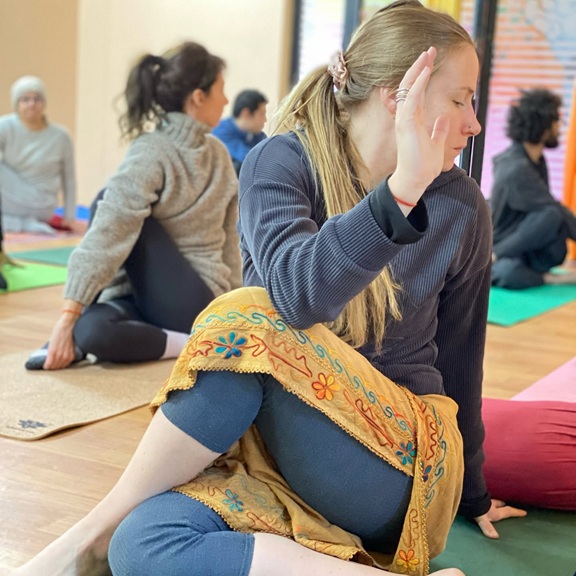
Common Mistakes
- Forcing the lotus leg. If the half lotus does not come easily, the knee absorbs the rotation instead of the hip. Knee pain here is never something to work through.
- Reaching for the bind too early. The bind is the last thing to arrive, not the goal. Chasing it collapses the chest and rounds the spine, which reduces the twist rather than deepening it.
- Lifting one sit bone. Very common, and it makes the twist look deeper while the spine actually rotates less. Press both sit bones down.
- Twisting from the neck. Turning the head hard while the spine stays still gives the sensation of a twist without the benefit. Spine first, head last.
- Rounding the lower back. If the pelvis tips backwards, sit up on a folded blanket.
- Holding the breath. People stop breathing in deep twists without noticing. If the breath stops, back off.
- Skipping the warm-up. The single most avoidable mistake, and the one most likely to cause injury.
Props and Modifications
- Folded blanket under the hips — the most useful prop by far. Lifting the pelvis lets the spine stay tall and takes pressure off the knee.
- Cushion under the lotus knee — if that knee floats above the floor, support it rather than pressing it down.
- A strap for the bind — hold one end in each hand behind the back and walk the hands closer over weeks.
- Skip the bind — place the back hand on the floor behind you and hook the front elbow outside the raised knee. This is a complete practice in itself.
- Drop the lotus — keep the bottom leg straight along the floor. Everything else stays the same, and the pose becomes accessible to almost anyone.
Also Read – Matsyendrasana for Spine Flexibility: Benefits, Variations & Steps
Benefits of Purna Matsyendrasana?
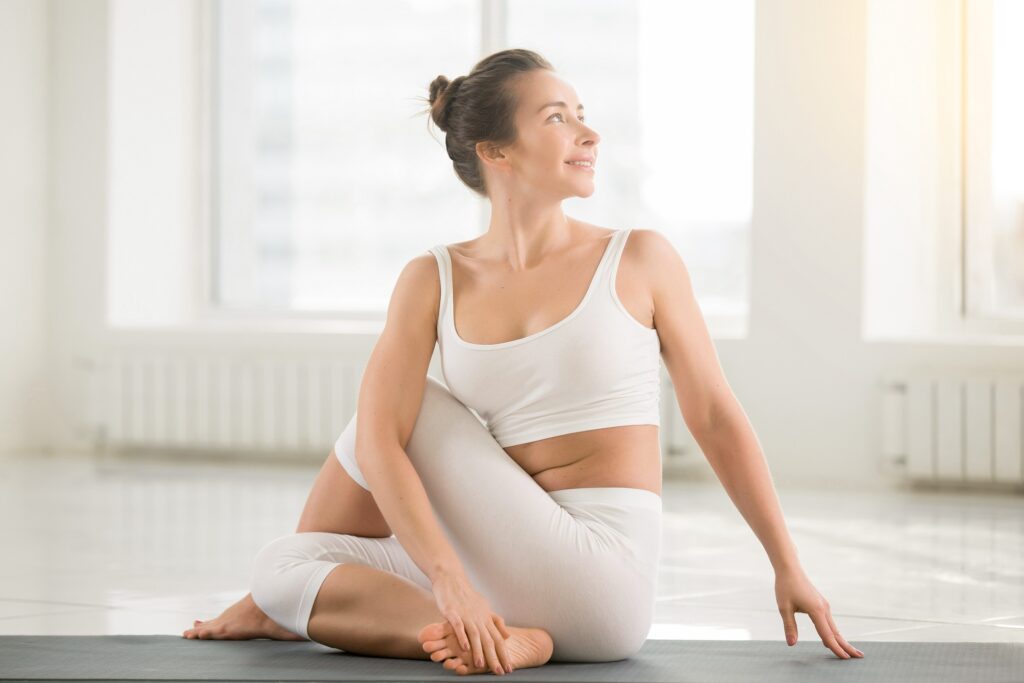
Purna Matsyendrasana offers several physical benefits, but its advantages extend beyond just the body. Here we will discuss Purna Matsyendrasana’s physical, mental, and emotional benefits.
Physical Benefits:
- Purna Matsyendrasana provides excellent alternate compression and stretching of the back and spine nerves and muscles, getting them into the best possible health condition.
- This asana’s compression and twisting of the yoga pose ensures that sluggish and stagnated blood is squeezed out of the spinal area and circulated to the heart and lungs for purification.
- It prevents connecting vertebrae from fusing, which is more common among the elderly.
- The pose helps treat backache, neckache, and headache.
- This asana helps to reduce body stiffness and improve body flexibility.
- It helps to overcome problems like rounded shoulders.
- This asana’s regular practice treats mild sciatica and decreased disc cases.
- It provides an incredible massage to the abdominal organs and has been found beneficial in treating conditions like diabetes, indigestion, rheumatism, and constipation.
- It provides good twisting and compression in the abdominal region. Regular practice of Matsyendrasana helps decrease the amount of pain.
- Purna Matsyendrasana benefits the adrenal glands, kidneys, spleen, and liver.
Benefits for the Mind:
- To perform Purna Matsyendrasana, you need concentration, mindfulness, and patience. These forces automatically calm the mind and enhance mental clarity.
- Purna Matsyendrasana releases tension from the back, shoulders, and neck, relieving stress and promoting mental relaxation.
- The twist’s intensity will help you become more aware of your body’s flexibility and emotions, increasing self-acceptance.
- Purna Matsyendrasana’s deep twist requires practice and flexibility over time, which develops patience. It teaches you to honor your body’s limits while slowly extending your practice.
Emotional Benefits:
- The deep twisting in this pose can help release pent-up emotions that may be held in your body, especially in the hips and lower back. This release will create a sense of emotional lightness and clarity.
- Purna Matsyendrasana’s focus on deep breathing and spinal alignment activates the parasympathetic nervous system, promoting relaxation and helping to calm the mind.
- This pose’s challenging nature helps build emotional strength and patience. By practising Purna Matsyendrasana, you will develop the stability to handle emotions.
- Purna Matsyendrasana stretches the body and calms the mind, encouraging inner peace and mental clarity and promoting emotional balance.
Poorna Matsyendrasana Contraindications
Purna Matsyendrasana is an intense pose, so particular people should approach it with caution or avoid it entirely, including:
- Injury and Surgery: People who have recently suffered injuries related to the elbows, wrists, fingers, rib cage, shoulders, hips, knees, and ankles, or any recent spinal injuries, should avoid Purna Matsyendrasana to prevent further strain on the spine.
- Pregnant Women: Purna Matsyendrasana involves deep twisting, which may put unnecessary pressure on the abdomen; it will be problematic for pregnant women.
- Lack of Connection Between Body and Breath: Unlike all other postures, Purna Matsyendrasana has a different style of breathing, as the face and upper portion of the body are in the reverse direction of the lower portion. Again, as this is an advanced pose, it must be performed carefully to balance the body while connecting to the breathing.
- Heart Patients: People with severe heart conditions or high blood pressure should avoid this pose, as it may strain the cardiovascular system.
- Beginners: Since Purna Matsyendrasana is an advanced pose, a beginner with limited flexibility might find it challenging to maintain proper alignment, potentially leading to injury.
Conclusion
Purna Matsyendrasana is the end point of a long road, not a pose to attempt on a curious afternoon. It asks for a comfortable half lotus, an open hip, a spine that rotates freely, and shoulders that can bind behind the back, four things that arrive at different speeds in different bodies.
That is worth accepting rather than fighting. Most students spend years in Ardha Matsyendrasana before the full pose becomes available, and many never move past it. There is nothing missing from a practice that stops there. The twist, the digestive squeeze, the release through the back and shoulders — Ardha gives you all of it.
If you do work towards Purna, work towards it slowly. Warm up properly, sit level, let the bind be the last thing to arrive, and treat knee pain as a full stop rather than a signal to push. The pose will wait.
Learning a posture like this properly- the preparation, the alignment, the safety checks, and knowing when a student is not ready — is what a full training gives you that no article can. Rishikul Yogshala Rishikesh has been running Yoga Teacher Training in India since 2010, with Yoga Alliance-certified 100 Hour, 200 Hour, 300 Hour, and 500 Hour courses on the banks of the Ganga — covering Hatha, Ashtanga Vinyasa, alignment, anatomy, pranayama, and yoga philosophy.
Frequently Asked Questions
What are the benefits of Purna Matsyendrasana?
It improves spinal flexibility, strengthens core muscles, and improves overall mental well-being.
Is Purna Matsyendrasana the same as Ardha Matsyendrasana?
No, “Purna Matsyendrasana” and “Ardha Matsyendrasana” are variations of “Matsyendrasana.”
Who should avoid Purna Matsyendrasana?
People with any injuries or issues like high or low blood pressure, migraines, pregnant women, or those experiencing menstruation should avoid this asana.
What is the difference between Purna and Ardha Matsyendrasana?
Ardha means half, Purna means full. In Ardha Matsyendrasana the bottom leg stays straight or folds loosely beside the hip, and no bind is needed. In Purna Matsyendrasana the bottom foot comes into half lotus with the heel near the navel, and the arms bind around the body. Ardha suits most students; Purna is an advanced pose.
How long does it take to learn Purna Matsyendrasana?
For most people, years rather than months. The limiting factor is usually the half lotus rather than the twist. Anyone who can already sit comfortably in lotus may find it comes within a few months of focused work.
Why does my knee hurt in Purna Matsyendrasana?
Come out immediately. Knee pain in this pose almost always means the hip is not open enough, so the knee is absorbing rotation it was never built for. Work on hip openers and half lotus separately, and practise Ardha Matsyendrasana in the meantime.
Can I practise Purna Matsyendrasana every day?
Yes, if it is comfortable and you warm up properly first. Practise on an empty stomach and give both sides equal time. If any joint feels sore the next day, reduce the hold or return to the half version for a while.
This article is for general information and is not medical advice. If you have a respiratory or heart condition, are pregnant, or are unsure whether these practices suit you, please speak to your doctor before beginning.

 +91-8433225327,
 Rishikul Yogshala Rishikesh, Narayan Kunj, Jonk Village, Ram Jhula, Swarg Ashram, Rishikesh, Uttarakhand 249304
 By Airway
 By Railway
 By Bus/Cabs