







Astavakrasana (Eight Angle Pose): Meaning, Benefits and How to Do It
Table of Contents
- Meaning & History Behind the Astavakrasana
- Warm-Up Poses Before Practicing Astavakrasana
- Beginner Warm-Up Tips:
- How To Do Astavakrasana (Eight Angle Pose): Step-by-Step
- Step 1: Start With Dandasana (Staff Pose)
- Step 2: Bring Your Right Leg Over Your Right Upper Arm
- Step 3: Place both hands on the mat
- Step 4: Cross your ankles
- Step 5: Shift your body weight forward
- Step 6: Lift your hips and extend your legs
- Step 7: Hold the Final Position
- Step 8: Drop the pose
- What Muscles Does Astavakrasana Work?
- The major muscle groups are:
- Common Mistakes While Practising Astavakrasana
- The Benefits of Practicing Astavakrasana
- 1. Astavakrasana builds core strength:
- 2. Improves Hip and Hamstring Flexibility:
- 3. Eight Angle Pose Enhances Body Balance and Proprioception:
- 4. Stimulates Abdominal Organs:
- 5. Cultivates Mental Focus and Confidence:
- Who Should Not Practice Astavakrasana?
- People with Wrist, Elbow, or Shoulder Injuries:
- Lower Back or Spinal Issues:
- High Blood Pressure or Heart Conditions:
- Avoid During Pregnancy:
- Additional Precautions to be Taken before Practicing the Astavakrasana
- What is the difference between Astavakrasana and Bakasana?
- Preparatory Exercises and Modifications for Astavakrasana
- Use Yoga Blocks Under Your Hands
- Elephant’s Trunk Pose (Eka Hasta Bhujasana)
- Support your body with a Bolster
- Quick Recap and Key Takeaways
- Frequently Asked Questions (FAQS)
- Is Astavakrasana difficult for beginners?
- What are the main benefits of Astavakrasana?
- How long should you hold Astavakrasana?
- Do I need strong arms to practise Astavakrasana?
- How can I prepare my body for Astavakrasana?
- Is Astavakrasana good for strengthening the core?
- What is the best way to improve Astavakrasana?
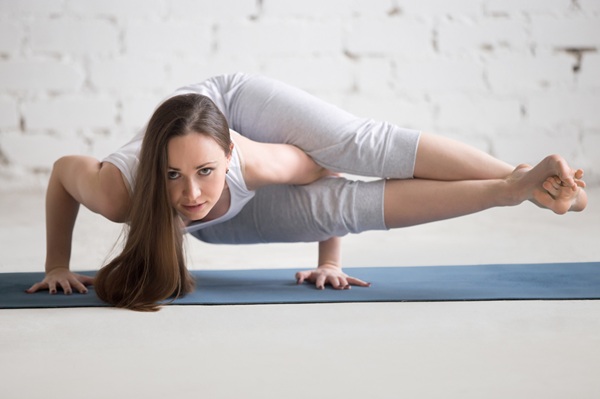
Astavakrasana is an asymmetrical advanced yoga pose. Also known as the Eight-Angle Pose. It is an arm-balancing yoga posture in which the whole body is lifted off the floor on the hands, with the torso lowered and twisted, and both legs extended to one side.
The pose challenges the strength, flexibility, and balance of the practitioner. The pose requires more than arm strength. It also depends on core engagement, hip flexibility, balance, and proper body alignment.
| About Astavakrasana pose | Details |
| Sanskrit Name | Astavakrasana |
| English Name | Eight-Angle Pose |
| Difficulty level | Advanced |
| Primary Muscles involved | Arms, shoulders, hips, and core muscles |
| Focus | Strength, flexibility, and balance |
Meaning & History Behind the Astavakrasana
“Astavakrasana” is a Sanskrit word that is made up of three words.
- Asta = Eight
- Vakra = Bend or Curved
- Asana = Posture
Astavakrasana is dedicated to Sage Astavakra, a well-known Vedic scholar in Hindu philosophy. The sage was born with eight physical deformities.
Despite his asymmetrical body structure, Sage Astavakra became one of the renowned sages, and his teachings are preserved in the Ashtavakra Gita.
The eight-angle pose is dedicated to Sage Astavakra, as a tribute to the fact that people with inner strength, courage, and focus are not restricted by physical asymmetry.
Warm-Up Poses Before Practicing Astavakrasana
Performing Astavakrasana directly without first doing warm-up exercises can put your arms and shoulders at risk of strain.
- Cat-Cow (Marjaryasana-Bitilasana) & Wrist Stretches: Cat-Cow (Marjaryasana-Bitilasana) is a gentle movement that alternates between spinal extension and flexion. Inhale as you move into Cow Pose and extend your spine. Exhale as you round your back into Cat Pose.
- Thread the Needle (Parsva Balasana): It is a pose that opens the upper back and shoulders for rotational movement.
- Compass Pose (Surya Yantrasana): Compass pose is an advanced seated yoga asana that combines a deep hamstring and hip stretch with shoulder mobility and a side-body twist.
- Chaturanga Dandasana (Four-Limbed Staff Pose): During this pose, the practitioner’s body remains parallel to the floor with elbows bent and supported by palms and toes.
- Crow Pose:Crow Pose (Bakasana) teaches you to shift your weight forward onto your hands and builds wrist and core strength.
Beginner Warm-Up Tips:
- To enhance flexibility and better control, you can build basic arm-balance strength with Plank, Chaturanga, and Crow before attempting this pose.
- Perform gentle shoulder rotations in both directions. Follow this with wrist circles and gentle wrist stretches to prepare your joints for supporting body weight.
- Gradually shift your body weight on the palms while keeping your core engaged.
- Practice the pose only if the surface is non-slippery.
- Consider practicing under expert guidance.
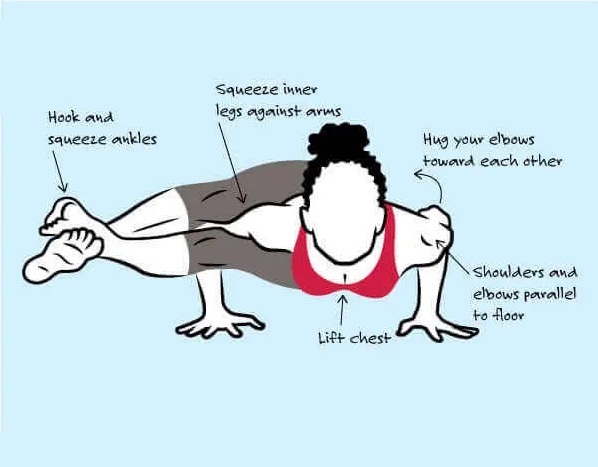
How To Do Astavakrasana (Eight Angle Pose): Step-by-Step
Astavakrasana (Eight Angle Pose) is an advanced pose characterized by its asymmetrical nature, requiring controlled body movements and a lateral twist. Thus, it is very crucial to perform this pose with delicacy and the right technique.
Step 1: Start With Dandasana (Staff Pose)
Dandasana (Staff Pose) is a foundational seated yoga posture practised in different yoga traditions, including Hatha and Ashtanga. Sit upright with your legs extended in front of you, your spine neutral and your hands resting beside your hips.
- Sit on your yoga mat.
- Extend both of your legs in front of you.
- Place your palms on the floor next to your hips.
- Keep your spine straight like a pole.
- Let your shoulders fall; breathe normally.
Step 2: Bring Your Right Leg Over Your Right Upper Arm
- Flex your right knee and bring your right foot in toward your body.
- Now slowly bring your right leg across your right upper arm.
- Keep in control and place your thigh as high on the arm as your body mobility allows.
Step 3: Place both hands on the mat
- Place both hands on the mat.
- Keep your hands approximately shoulder-width apart.
- Spread your hand’s fingers to create a stable base.
Step 4: Cross your ankles
- Bend your left knee.
- Bring your left ankle over your right ankle.
- Now cross your ankles.
- Keep your thighs engaged and maintain contact between your crossed ankles to help stabilise your legs.
Step 5: Shift your body weight forward
- To gently shift your body weight forward, engage your abdominal muscles.
- Lean your upper body forward.
- Slightly bend your elbow backward.
- Maintain a firm and stable position for your shoulders.
Step 6: Lift your hips and extend your legs
- Press both of your palms firmly.
- Gradually lift your hips off the floor.
- Keep your balance maintained during this.
- Press firmly through both palms, engage your core, and lift your hips off the mat. Gradually straighten both legs together towards your right side while keeping your ankles crossed.
- Don’t rush to the final position. Maintain that control while gradually moving your legs.
Step 7: Hold the Final Position
- Keep your gaze steady while continuing to breathe normally.
- Maintain your shoulders firm and active while keeping the abdominal muscles intact.
- Simply keep the alignment.
Step 8: Drop the pose
- Bend your knees slowly.
- Bring your hips down to the mat.
- Come back to Dandasana.
- Take a few breaths. Rest a little.
- When you are ready, repeat the same on the opposite side.
What Muscles Does Astavakrasana Work?
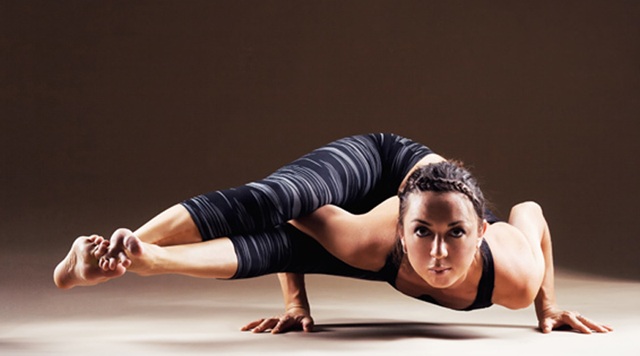
Astavakrasana involves muscle groups engaged together in a coordinated action.
| Muscle Group | Role in the pose |
| Triceps | Help stabilise the elbows and support the upper body during the arm balance. |
| Muscles of the abdomen | Help in raising and stabilizing the body |
| Thigh adductors | Keep your legs together |
| Hamstrings | Help with controlling leg extension |
| The muscles of the forearm | Stabilize the wrist and hand |
The major muscle groups are:
- Upper body: Arms, shoulders, chest, and forearms.
- Core: Abdominal muscles that help stabilize the body.
- Lower body: Thighs, hamstrings, and hip flexors (lower body)
Common Mistakes While Practising Astavakrasana
One of the common mistakes while practicing the Astavakrasana is having incorrect alignment, which can put unnecessary pressure on your joints. Here is a list of such common mistakes
- Placing hands too close while practicing the Astavakrasana.
- Not engaging the core. You can activate your abdominal muscles before lifting.
- Missing the contact between the crossed ankles.
- Putting excessive pressure while stretching the body.
The Benefits of Practicing Astavakrasana
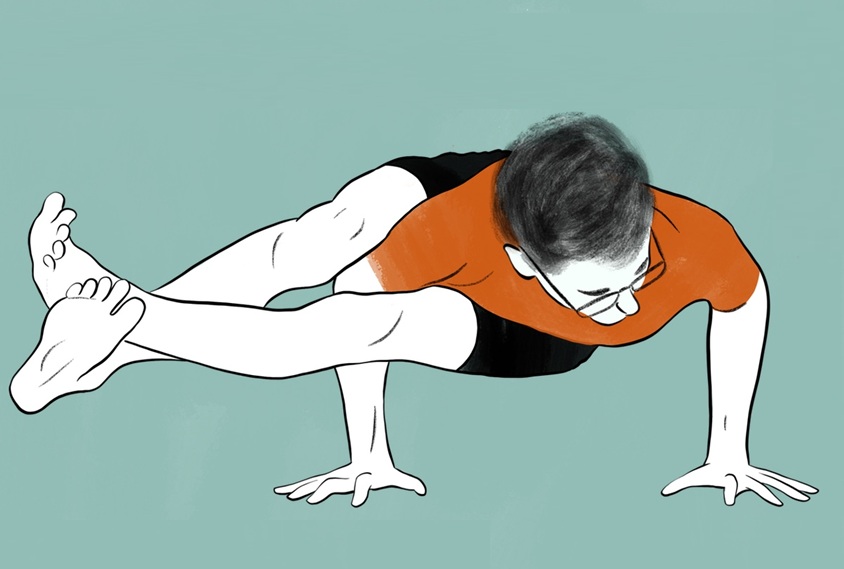
The regular practice of Astavakrasana provides physical strength, joint mobility, flexibility, and neurological focus. These are the primary benefits of practicing Astavakrasana.
1. Astavakrasana builds core strength:
Practitioners use their body weight on their hands, strengthening wrists, forearms, triceps, deltoids, and pectorals. The deep twist engages the core muscles which particularly engages the rectus abdominis and obliques.
2. Improves Hip and Hamstring Flexibility:
Threading and extending the legs high onto the shoulders requires deeper external rotation of the hip and lengthening in the hamstrings and groin.
3. Eight Angle Pose Enhances Body Balance and Proprioception:
Practising Eight-Angle Pose challenges your balance and coordination. Maintaining the posture requires awareness of body position, controlled movement, and consistent core engagement.
4. Stimulates Abdominal Organs:
The twisting position requires controlled movement and core engagement, helping practitioners develop greater awareness of body alignment and balance.
5. Cultivates Mental Focus and Confidence:
To perform the Astavakrasana correctly, the practitioner needs to overcome the fear of tipping forward. Maintaining Astavakrasana requires concentration, patience, and controlled breathing. Regular practice can help practitioners develop greater body awareness and confidence as they gradually improve their balance.
Who Should Not Practice Astavakrasana?
Astavakrasana is an advanced arm balance that places considerable weight on the wrists, elbows, and shoulders. People with existing injuries or conditions affecting these areas should avoid attempting the pose until they have received appropriate medical advice.
People with Wrist, Elbow, or Shoulder Injuries:
People recovering from shoulder surgery or experiencing carpal tunnel syndrome, tendonitis, or rotator cuff injuries should avoid this posture unless cleared by their healthcare professional.
Lower Back or Spinal Issues:
People who suffer from issues like sciatica or herniated discs or acute lower back pain should avoid Astavakrasana because it may worsen their condition due to deep spinal twists.
High Blood Pressure or Heart Conditions:
People with high blood pressure or cardiovascular conditions should consult a qualified healthcare professional before attempting this demanding arm balance. Avoid holding your breath during the practice.
Avoid During Pregnancy:
Astavakrasana is a demanding arm balance that places considerable pressure on the upper body and requires significant abdominal engagement. Pregnant practitioners should avoid attempting this advanced posture unless specifically advised and supervised by an appropriately qualified prenatal yoga professional.
Additional Precautions to be Taken before Practicing the Astavakrasana
- Use a stable yoga mat.
- Stop immediately if you feel any pain or joint strain.
- Consider consulting a doctor if you have a history of any medical condition.
- Seek expert guidance from a professional yoga teacher.
What is the difference between Astavakrasana and Bakasana?
Astavakrasana and Bakasana are advanced yoga postures involving arm balancing, but leg position and alignment differ. Both Astavakrasana and Bakasana are challenging arm-balancing yoga postures. Bakasana involves balancing the body with the knees resting near the upper arms, whereas Astavakrasana requires the legs to extend together towards one side. Practitioners should build the necessary strength, flexibility, and balance before attempting either posture.
| Comparison | Astavakrasana | Bakasana |
| English Name | Eight Angle Pose | Crow Pose |
| Leg Position | Crossed and extended on one side | Knees placed near the upper arms |
| Body Position | Extended sideways | Leaning Forward |
| Main challenges | Leg Positioning and sideways balance | Forward weight shifting |
| Muscle Engagement | Arms, shoulders, and inner thighs | Arms, shoulders, and cores |
Read More: Bakasana (Crow Pose): Steps, Benefits and Symbolism
Preparatory Exercises and Modifications for Astavakrasana
If you are a beginner who is still building upper body strength and mobility for the full expression, use these accessible progressions:
Use Yoga Blocks Under Your Hands
Place two sturdy yoga blocks beneath your palms. This will create extra clearance between your hips and the floor, making it much easier for you to lift off without rounding your spine.
Elephant’s Trunk Pose (Eka Hasta Bhujasana)
Beginners can start with the Eka Hasta Bhujasana, also known as Elephant’s Trunk Pose, by threading one leg over your shoulder, leaving the bottom leg extended straight forward on the mat and gradually pressing your palm just to lift your hips and straighten your legs.
Support your body with a Bolster
Place a firm cushion or bolster in front of your body to provide support while practising the forward weight shift. This can help reduce the fear of falling, but it does not replace proper supervision or safe technique.
Quick Recap and Key Takeaways
Astavakrasana (Eight-Angle Pose) is an advanced yoga posture that demands strength in the arms, shoulders, and core. Preparatory poses can help develop the required skills. The most important thing about the Eight-Angle Pose is not to hold the posture for a longer time but to perform the pose in correct alignment while maintaining balance.
The secret to mastering this posture is patience and constant practice of the Astavakrasana. Focus on building strength and learn more about your body’s limitations. Understanding your own body will help you maintain balance and achieve alignment within it.
Astavakrasana is an advanced yoga pose; it is not for beginners. If someone is genuinely interested in learning the yogic tradition, then a 300-hour teacher training in Rishikesh is the way to proceed. Rishikul Yogshala Rishikesh offers a valuable environment for its students to deepen their knowledge in traditional yoga. Rishikesh, with its long-standing yogic tradition, is a perfect place to learn yoga from one of the best teachers.
Frequently Asked Questions (FAQS)
Is Astavakrasana difficult for beginners?
Yes. Astavakrasana is an advanced arm-balancing posture that requires considerable upper-body strength, core stability, hip mobility and balance. Beginners should first practise preparatory poses under the guidance of an experienced yoga teacher.
What are the main benefits of Astavakrasana?
Astavakrasana helps develop upper-body strength, core stability, coordination and body awareness. It also challenges hip mobility and balance.
How long should you hold Astavakrasana?
There is no fixed holding duration for everyone. Practitioners should begin with a few controlled breaths and gradually increase the duration as their strength and stability improve.
Do I need strong arms to practise Astavakrasana?
Yes. Arm and shoulder strength are important for supporting the body’s weight. However, core engagement, balance, flexibility and correct alignment are equally important.
How can I prepare my body for Astavakrasana?
You can prepare by practising foundational poses such as Bakasana, Chaturanga Dandasana and Eka Hasta Bhujasana. Wrist mobility, shoulder strength and core exercises can also help.
Is Astavakrasana good for strengthening the core?
Yes. The posture requires significant core engagement to lift and stabilise the hips and legs while maintaining balance.
What is the best way to improve Astavakrasana?
Start with preparatory arm balances, improve hip flexibility and build upper-body strength. Practise under an experienced yoga teacher and focus on controlled movement rather than forcing yourself into the final position.
This article is for general information and is not medical advice. If you have a respiratory or heart condition, are pregnant, or are unsure whether these practices suit you, please speak to your doctor before beginning.

 +91-8433225327,
 Rishikul Yogshala Rishikesh, Narayan Kunj, Jonk Village, Ram Jhula, Swarg Ashram, Rishikesh, Uttarakhand 249304
 By Airway
 By Railway
 By Bus/Cabs