








Yama Yoga: Meaning, Types, Examples from Life and Tips to Practice
Table of Contents
- What is Yama Yoga?
- Yama Meaning and Definition
- The 5 Yamas of Yoga at a Glance
- Types of Yama
- The Five Yamas Explained
- 1. Ahimsa (Non-Violence)
- 2. Satya (Truthfulness)
- 3. Asteya (Non-Stealing)
- 4. Brahmacharya (Moderation)
- 5. Aparigraha (Non-Possessiveness)
- Yama in Ashtanga Yoga
- Yama and Asana: How the Ethics Show Up on the Mat
- How to Practise the Yamas in Daily Life
- Yamas and Niyamas: The Difference
- Final Thoughts
- FAQs
- What is yama in yoga?
- What does yama mean in Sanskrit?
- What are the 5 yamas of yoga?
- What is yama in Ashtanga yoga?
- How many types of yama are there?
- What is the difference between yama and niyama?
- Can you practise yama without doing asana?
What is Yama Yoga?
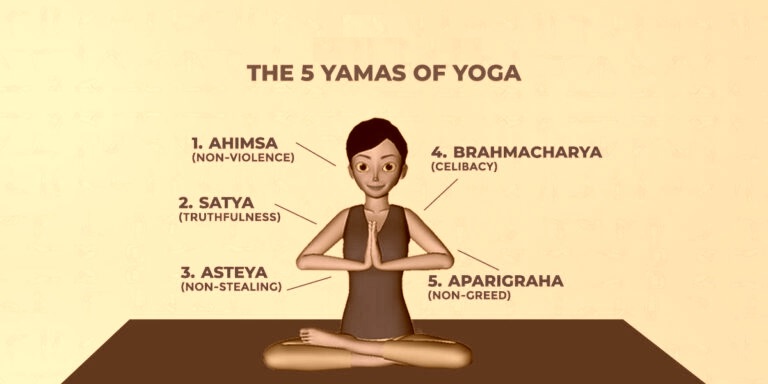
Yama in yoga means ethical restraint. It is the first of the eight limbs of yoga and covers five principles for how you treat others: ahimsa (non-violence), satya (truthfulness), asteya (non-stealing), brahmacharya (moderation), and aparigraha (non-possessiveness). Patanjali lists them in the Yoga Sutras, verse 2.30.
Long before yoga was poses on a mat, it was a way of living kindly with the world around us. The first of yoga’s eight limbs — the yamas — gathers five gentle guidelines for how we treat others: non-violence, truth, non-stealing, restraint, and non-attachment. They aren’t strict rules. They’re quiet questions to live with. In this guide, we’ll walk through each one with simple, everyday examples.
Yama Meaning and Definition
The word yama comes from Sanskrit and means restraint, control, or discipline. So the yama definition in a yoga context is straightforward: a set of self-imposed limits that keep your attention pointed where you want it.
Sage Patanjali described yama as putting some limitations on ourselves to stay concentrated on our efforts to reach our prime goal in life. It is similar to how a horse rider holds the reins to direct the horse in a chosen direction. A positive limitation, in other words, can turn out to be a boon; it builds the self-discipline needed to fulfil your life’s purpose.
The concept is old. Ideas of ethical restraint appear across many Indian texts, and more than fifty later works discuss yamas in some form. But the five that yoga students learn today come from a single source: Yoga Sutras 2.30, where Patanjali names them directly.
The 5 Yamas of Yoga at a Glance
| Sanskrit | Meaning | In one line |
| Ahimsa | Non-violence | Cause no harm in thought, word, or action |
| Satya | Truthfulness | Be honest, and be kind about how you are honest |
| Asteya | Non-stealing | Take only what is freely given |
| Brahmacharya | Moderation | Use your energy wisely rather than spending it carelessly |
| Aparigraha | Non-possessiveness | Hold things and people lightly |
Types of Yama
The five yamas above are the classical set from the Yoga Sutras, and they are what almost every teacher means by “the yamas.”
Other texts, however, list additional observances under the same heading. The Hatha Yoga Pradipika and several Upanishads extend the list to ten. These extra types of yama include:
- Ksama — forgiveness
- Daya — compassion
- Arjava — sincerity
- Dhrti — perseverance
- Mitahara — a measured, moderate diet
These are worth knowing, but if someone asks how many yamas there are, the answer they are looking for is five.
The Five Yamas Explained
1. Ahimsa (Non-Violence)
“Ahimsa Paramo Dharma” — non-violence is the highest duty.
The literal meaning of ahimsa is the inability to hurt or kill living beings. It asks that violence in all its forms be removed from our thoughts, actions, words, and feelings, and it sits close to the principles of compassion and kindness.
An everyday example. Wars are the obvious form of violence, and their cost to body and mind is plain enough. But ahimsa operates at a much smaller scale too — in how you speak to a colleague who has annoyed you, and in how you speak to yourself after a mistake. Most people find the second one harder.
2. Satya (Truthfulness)
“Satyameva Jayate” — truth alone prevails.
Satya means truth or truthfulness, and it applies to thought, emotion, speech, and action alike. Honesty is treated in the Sutras as a treasure — for yourself and for the people around you.
An everyday example. A student who cannot bend backward because of stiffness may puff the chest out to fake the shape of the posture. It looks like the pose. It isn’t. Satya asks the practitioner to work with the body they actually have today, not the one they would like to be seen having.
Satya is also held in tension with ahimsa, deliberately. A truth told cruelly breaks the first yama to satisfy the second. Where the two conflict, tradition places ahimsa first.
3. Asteya (Non-Stealing)
Asteya means non-stealing. Its root is the belief that there is not enough to go round — that if we want our needs met, we must take by dishonest means. Asteya treats that belief as the actual problem. Scarcity is the seed; taking is only what grows from it.
An everyday example. A practitioner may hold back in one pose, thinking there won’t be enough energy left for the next. But each pose generates the strength to carry itself. Holding back out of a sense of scarcity leaves every posture slightly incomplete.
Asteya also covers subtler things: taking credit, taking someone’s time without asking, taking attention that belongs to someone else in the room.
4. Brahmacharya (Moderation)
“Cultivate purity, conserve energy.”
Brahmacharya is often translated as celibacy, but the broader and more useful reading is the wise use of energy. Overindulgence in any pleasure dulls the senses, and this yama holds that moderation is what makes fulfilment possible.
In the Vedas, brahmacharya is the first ashrama, or stage of life, focused on study and self-restraint. In the yogic view, creative and sexual energy is powerful and worth directing rather than scattering.
An everyday example. Choosing what you watch, read and consume with some care. What you take in either preserves your energy or drains it, and most of us are much less deliberate about that than we imagine.
For a fuller treatment, see our guide to the benefits of brahmacharya.
5. Aparigraha (Non-Possessiveness)
“Embrace simplicity and let go of excess.”
Aparigraha means non-collection or non-attachment, holding possessions, outcomes, and people without grasping. Where asteya identifies scarcity as the root of taking, aparigraha identifies envy as the root of greed. Comparison makes us forget our own worth, and then we want what belongs to someone else.
An everyday example. A room full of practitioners, each one glancing sideways. The moment attention goes to someone else’s posture, the practitioner starts collecting imperfections in their own and perfections in others. Aparigraha turns the gaze inward, which is where it was supposed to be.
Yama in Ashtanga Yoga
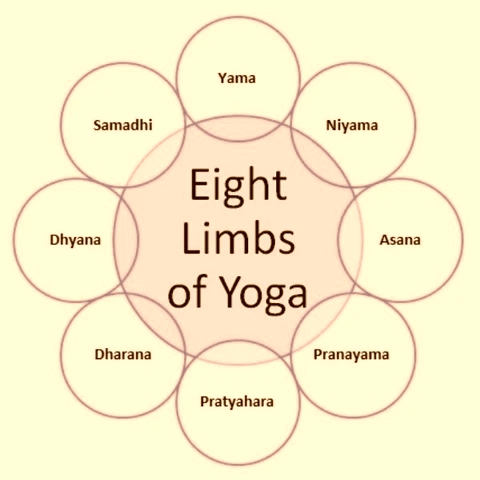
In Ashtanga yoga, yama is the first of the eight limbs (ashta = eight, anga = limb). The full sequence runs:
- Yama — ethical restraints towards others
- Niyama — personal observances towards yourself
- Asana — posture
- Pranayama — breath regulation
- Pratyahara — withdrawal of the senses
- Dharana — concentration
- Dhyana — meditation
- Samadhi — absorption
This ordering is the part most modern students find surprising. Asana — the physical practice that most people think of as yoga — is third. The two ethical limbs come before it.
Patanjali’s reasoning is practical rather than moralistic. The later limbs ask for a settled mind, and a mind occupied with dishonesty, resentment or grasping is not settled. The yamas clear the ground so the rest of the practice has somewhere to stand.
Worth noting: the eight limbs are not a staircase you climb once and leave behind. Nobody completes the yamas and graduates to asana. All eight are practised together, for as long as you practise.
Yama and Asana: How the Ethics Show Up on the Mat
The yamas can sound abstract until you notice them appearing during practice. Each one has a physical counterpart, and a pose that tends to expose it.
| Yama | Where it shows up in asana | A pose to notice it in |
|---|---|---|
| Ahimsa | Forcing a stretch, practising through pain | Sukhasana or Vajrasana — seated, grounded, nothing to force |
| Satya | Faking the shape of a pose your body can’t yet hold | Vrksasana — balance is honest about your strengths and limits |
| Asteya | Holding back energy in one pose to “save” it for the next | Any long hold — notice what you withhold |
| Brahmacharya | Burning yourself out in one session instead of practising sustainably | Nadi Shodhana — regulating rather than spending |
| Aparigraha | Looking sideways at the next mat | Utthita Parsvakonasana — opening the side body, releasing the grip |
This is the most useful way to work with yama and asana together. You do not need to set aside separate time for ethics. The mat surfaces all five within a week if you are watching.
How to Practise the Yamas in Daily Life
Ahimsa
- Avoid harming others or yourself — including through peer pressure and ego-driven choices.
- Avoid food and drink that damages the body.
- Make acceptance, kindness and forgiveness central.
- Move small creatures out of your home rather than killing them.
- Watch for negative thoughts and emotions, and don’t feed them.
Satya
- Accept your own truth and other people’s.
- Recognise that your perspective is shaped by emotion and expectation. “My friend didn’t text today” is true. “She is ignoring me” is a story you added.
- Stand up for what is right, where it is safe to do so.
- Ask for more information when things are unclear rather than filling the gap with assumption.
Asteya
- Do your best work and help others with theirs.
- Keep your promises.
- Keep deals fair without angling for the better side.
- Practise generosity — a gift, or simply a smile.
Brahmacharya
- Avoid addictive substances and habits.
- Prioritise health over eating for pleasure alone.
- Choose your entertainment with care; it either preserves your energy or drains it.
- Focus on needs before wants.
Aparigraha
- Ask before buying: do I actually need this?
- Reduce possessiveness in relationships and respect people’s boundaries.
- Don’t attach emotionally to the possessions you value most.
- Take care of what you own, and of what belongs to others.
Yamas and Niyamas: The Difference
The yamas are almost always taught alongside the niyamas, and the two are easy to confuse.
| Yamas | Niyamas | |
|---|---|---|
| Limb | First | Second |
| Sutra | 2.30 | 2.32 |
| Direction | Outward — how you treat others | Inward — how you treat yourself |
| The five | Ahimsa, Satya, Asteya, Brahmacharya, Aparigraha | Saucha, Santosha, Tapas, Svadhyaya, Ishvara Pranidhana |
The simplest way to hold it: yamas are about the world, niyamas are about you.
Final Thoughts
The five Yamas, Ahimsa, Satya, Asteya, Brahmacharya, and Aparigraha, remind us that yoga is not limited to physical postures or time spent on a mat. They encourage us to become more mindful of our thoughts, words, actions, relationships, and the way we respond to everyday situations. When practised consistently, these principles can bring greater awareness, balance, discipline, and harmony into daily life.
Understanding the Yamas is an important step toward experiencing yoga as a complete way of life. If you want to explore yoga philosophy alongside asana, pranayama, meditation, and traditional yogic practices, Yoga Teacher Training in Rishikesh at Rishikul Yogshala offers an opportunity to deepen your understanding and develop a more meaningful personal practice.
FAQs
What is yama in yoga?
Yama is the first limb of yoga and means ethical restraint. It covers five principles for how you treat others: ahimsa, satya, asteya, brahmacharya and aparigraha. Patanjali lists them in Yoga Sutras 2.30.
What does yama mean in Sanskrit?
Yama means restraint, control or discipline. In the Yoga Sutras it refers to self-imposed limits that keep the mind steady and directed.
What are the 5 yamas of yoga?
Ahimsa (non-violence), satya (truthfulness), asteya (non-stealing), brahmacharya (moderation) and aparigraha (non-possessiveness), in that order.
What is yama in Ashtanga yoga?
It is the first of Patanjali’s eight limbs, practised before niyama and asana. The order matters: the ethical limbs come before the physical practice, because the later limbs need a settled mind.
How many types of yama are there?
Five in the Yoga Sutras. Some later texts extend the list to ten, adding forgiveness, compassion, sincerity, perseverance and moderate diet. The classical answer is five.
What is the difference between yama and niyama?
Yamas govern how you treat others; niyamas govern how you treat yourself. Yamas are the first limb (Sutra 2.30), niyamas the second (Sutra 2.32).
Can you practise yama without doing asana?
Yes. The yamas are independent of physical practice and were placed before it deliberately. Many practitioners work with the yamas long before, or entirely without, a regular asana practice.
This article is for general information and is not medical advice. If you have a respiratory or heart condition, are pregnant, or are unsure whether these practices suit you, please speak to your doctor before beginning.

 +91-8433225327,
 Rishikul Yogshala Rishikesh, Narayan Kunj, Jonk Village, Ram Jhula, Swarg Ashram, Rishikesh, Uttarakhand 249304
 By Airway
 By Railway
 By Bus/Cabs