








Nadi Shodhana Pranayama: Meaning, Steps with Kumbhaka, and Benefits
Table of Contents
- What is Nadi Shodhana? (नाड़ी शोधन प्राणायाम क्या है)
- What Does “Shodhana” Mean?
- The Three Nadis: Ida, Pingala and Sushumna
- How Do Nadis Get Blocked?
- Nadi Shodhana Pranayama Steps (with Kumbhaka)
- Hand Position
- The Eight Steps
- The Ratios
- Cautions During Practice
- Nadi Shodhana Benefits
- The Four Main Benefits of Nadi Shodhan Pranayama
- Physical Benefits
- Mental Benefits
- Spiritual Benefits (as described in the tradition)
- Does Nadi Shodhana Activate Sushumna?
- Who Should Not Practise Nadi Shodhana?
- Are Nadi Shodhana and Anulom Vilom the Same?
- Which Should You Practise First?
- नाड़ी शोधन प्राणायाम: अर्थ, विधि और लाभ
- Final Takeaway
- Frequently Asked Questions
- What is Nadi Shodhana Pranayama?
- What is the difference between Nadi Shodhana and Anulom Vilom?
- What are the four benefits of Nadi Shodhan Pranayama?
- What is the correct ratio for Nadi Shodhana?
- How long should I practise Nadi Shodhana daily?
- Is Nadi Shodhana safe for everyone?
- Which mudra is used in Nadi Shodhana?
- Can I do Nadi Shodhana at night?
- Does Nadi Shodhana open the Sushumna nadi?
- Should I learn Anulom Vilom first?
Nadi Shodhana is closely related to alternate-nostril breathing, and the terminology can vary between yoga traditions. In many traditional approaches, Nadi Shodhana includes structured breathing and may involve kumbhaka (breath retention), while Anulom Vilom is often taught as alternate-nostril breathing without retention.
When kumbhaka is included, the practice requires more care than a simple alternate-nostril breathing practice. This guide covers the meaning, the traditional steps including kumbhaka, the ratios to work with, who should not practise it, and how it actually differs from Anulom Vilom.
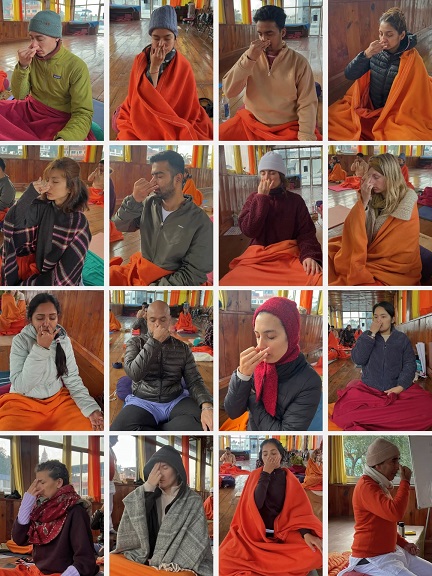
What is Nadi Shodhana? (नाड़ी शोधन प्राणायाम क्या है)
Nadi Shodhana is a traditional alternate-nostril pranayama in which the breath is guided through one nostril at a time. Depending on the tradition and level of practice, it may be performed with or without kumbhaka (breath retention), as well as with different breathing ratios.
The practice appears throughout classical hatha yoga literature as preparation for meditation and for the deeper pranayamas. In Patanjali’s eight-limbed path, pranayama is the fourth limb, sitting between asana and pratyahara.
What Does “Shodhana” Mean?
Shodhana (शोधन) is Sanskrit for purification, cleansing, or refining. Paired with nadi (channel), the compound describes the purpose of the practice rather than its mechanics. You will also see the practice called Nadi Shuddhi — shuddhi is a near-synonym meaning purity or cleanliness.
The Many Spellings
All of these refer to the same practice, and none is wrong; they are different romanisations of the same Sanskrit:
Nadi Shodhana · Nadi Shodhan · Nadi Shodana · Nadi Sodhan · Nadishodhana · Nadi Shuddhi · Nadi Suddhi
If you have seen it written differently elsewhere, you have not found a different technique.
The Three Nadis: Ida, Pingala and Sushumna
Yogic anatomy describes roughly 72,000 nadis, or energy channels, running through the body. Three matter for this practice: Ida, associated with the left nostril and cooling, lunar qualities; Pingala, associated with the right nostril and warming, solar qualities; and Sushumna, the central channel, said to open only when the other two are in balance.
- Ida (इडा) — left channel. Traditionally linked to mental and emotional activity, receptivity, and cooling. When described as blocked: low energy, heaviness, sluggish digestion, a congested left nostril.
- Pingala (पिंगला) — right channel. Linked to physical activity, heat, and outward drive. When described as blocked: irritability, heat, restlessness, a congested right nostril.
- Sushumna (सुषुम्ना) — the central channel between them. Classical texts describe it as opening only when Ida and Pingala are balanced, which is precisely what Nadi Shodhana is meant to achieve.
A note on how to read this. This is yogic anatomy, not physiology; the nadis are not structures you would find in a dissection. There is, however, a genuine physiological phenomenon underneath it: the nasal cycle, in which airflow alternates dominance between nostrils over a period that varies from person to person, typically somewhere between one and four hours. Yogic texts mapped that alternation long before it was formally described in the nineteenth century.
How Do Nadis Get Blocked?
In traditional terms: chronic stress, poor diet and accumulated toxins, physical or emotional trauma, and irregular lifestyle. Read this as the tradition’s framework for why you feel out of balance, rather than as a diagnostic claim.
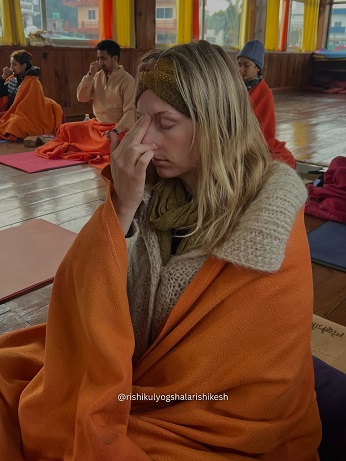
Nadi Shodhana Pranayama Steps (with Kumbhaka)
Sit upright and bring the right hand into Nasagra mudra. Close the right nostril and exhale fully through the left. Inhale through the left, then close both nostrils and hold. Release the right nostril and exhale. Inhale through the right, close both and hold, then exhale through the left. That is one round.
Hand Position
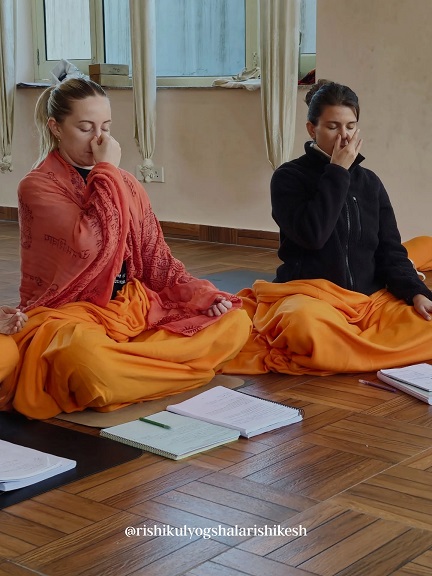
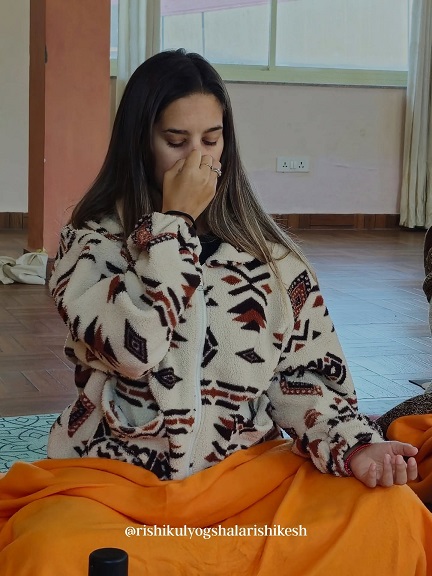
Fold the index and middle fingers of the right hand into the palm. The thumb closes the right nostril; the ring and little fingers close the left. This position is called Nasagra mudra, and you will also see it called Vishnu mudra or Mrigi mudra. Left hand rests on the left knee in Chin or Gyan mudra.
The Eight Steps
- Sit upright — Sukhasana, Padmasana, or a firm chair. Close your eyes. Let the breath settle for thirty seconds.
- Bring the right hand into Nasagra mudra. Close the right nostril with the thumb and exhale completely through the left.
- Inhale slowly through the left nostril.
- Close the left nostril too, so both are closed. Hold — this is antara kumbhaka.
- Release the thumb and exhale slowly through the right nostril.
- Inhale through the right nostril.
- Close both nostrils and hold again.
- Release the left and exhale through the left. That completes one round.
Nine to twelve rounds is a reasonable session. Always begin and end on the left.
The Ratios
The ratio is inhale: hold: exhale. Do not start at the traditional numbers.
| Level | Ratio | Example (seconds) |
|---|---|---|
| First month | 1 : 1 : 2, no hold at first | 4 : 0 : 8 |
| Introducing kumbhaka | 1 : 1 : 2 | 4 : 4 : 8 |
| Established | 1 : 2 : 2 | 4 : 8 : 8 |
| Traditional | 1 : 4 : 2 | 4 : 16 : 8 |
The 1:4:2 ratio is a destination, not a starting point. It appears in classical texts and gets repeated online as though it were a beginner instruction. It is not. Reaching it takes months of consistent practice, and attempting it early is how people end up light-headed and put off pranayama entirely.
If the exhale becomes strained, short, or ragged after a breath hold, reduce the length of the hold and return to comfortable breathing.
Cautions During Practice
- Never force or strain the breath. A hold should end before it becomes urgent.
- Breathe through the nose only, silently. No Ujjayi.
- Fingers rest lightly. No pressure on the nose or forehead.
- If you feel dull or start yawning afterwards, your exhale is too short relative to the inhale.
- Never practise while driving or operating anything.
Nadi Shodhana Benefits
Nadi Shodhana’s best-supported benefits are calming the nervous system, reducing stress and anxiety, and improving focus and sleep. Adding kumbhaka increases the parasympathetic effect but also increases the need for care. Traditional texts additionally describe it as purifying the nadis and preparing the mind for meditation.
The Four Main Benefits of Nadi Shodhan Pranayama
If you need a short answer — for an exam, or just to know what matters:
- Calms the nervous system — shifts the body toward parasympathetic activity, reducing stress and anxiety.
- Improves concentration and mental clarity — the practice is sustained attention training.
- Balances the Ida and Pingala nadis — restoring equilibrium between the body’s cooling and warming energies.
- Improves respiratory efficiency — slower, fuller, more controlled breathing over time.
Physical Benefits
Improved respiratory efficiency and lung capacity. Modest blood pressure reduction through the autonomic route. Better sleep. Some evidence for improved heart rate variability.
Mental Benefits
Reduced anxiety and stress. Sharper focus. A steadier baseline mood. Easier transition into meditation — which is the practice’s traditional purpose and, in our teaching experience, the benefit students notice most reliably.
Spiritual Benefits (as described in the tradition)
Classical texts describe Nadi Shodhana as purifying the nadis, balancing solar and lunar energies, and opening the Sushumna channel — the precondition, in that framework, for deeper meditative states and the awakening of dormant energy.
Does Nadi Shodhana Activate Sushumna?
According to traditional yogic teachings, Nadi Shodhana is practiced to balance Ida and Pingala, which is said to support the awakening or activation of Sushumna Nadi. In this traditional framework, Sushumna is associated with deeper states of meditation and spiritual practice. However, these are concepts from yogic philosophy and subtle-body traditions, not descriptions of a physiological process.
Who Should Not Practise Nadi Shodhana?
When Nadi Shodhana is practised with breath retention, additional precautions are needed because kumbhaka makes the practice more demanding.
Speak to a yoga teacher or doctor first if you have:
- High or low blood pressure, particularly if uncontrolled — retention transiently affects blood pressure
- A heart condition or any recent cardiac event
- Epilepsy or a seizure history
- Pregnancy — practise without any retention
- Glaucoma or raised intraocular pressure — retention can raise it further
- A hernia, or recent abdominal, chest or eye surgery
- Panic disorder — retention can trigger anxiety in some people
- Active respiratory infection or severe nasal blockage
Stop immediately if you experience chest pain, palpitations, severe dizziness, or breathlessness that doesn’t settle within a minute.
If in doubt, drop the hold. Alternate nostril breathing without retention — Anulom Vilom — gives you most of the calming benefit with almost none of the risk.
Are Nadi Shodhana and Anulom Vilom the Same?
Nadi Shodhana and Anulom Vilom are closely related alternate-nostril breathing practices, and in many yoga traditions the two names are used interchangeably. Both involve breathing through one nostril at a time in an alternating pattern and are generally practised in a comfortable seated position.
The main difference is not always breath retention. In some traditions, Nadi Shodhana may include structured breath ratios or kumbhaka (breath retention), particularly in more advanced practice, while Anulom Vilom is often taught as alternate-nostril breathing without retention. However, this distinction is not universal, so the technique can vary depending on the yoga tradition and teacher.
| Nadi Shodhana | Anulom Vilom |
|---|---|
| Often practised as alternate-nostril breathing | Commonly taught as alternate-nostril breathing |
| May include breath retention in advanced practices | Usually practised without breath retention for beginners |
| May use structured breathing ratios | Often uses a simple, comfortable breathing rhythm |
| Can be used as preparation for meditation and deeper pranayama | Commonly practised for relaxation, breath awareness, and mental calm |
| Advanced variations are best learned under proper guidance | Basic practice can be learned gradually with appropriate instruction |
Rather than focusing only on the names, it is more useful to understand how the practice is being performed. If a technique includes breath retention, longer ratios, or advanced pranayama methods, it is better to learn it from a qualified yoga teacher, especially if you are a beginner.
Which Should You Practise First?
If you are new to alternate-nostril breathing, it is generally better to begin with a simple version without breath retention. Once your breathing becomes steady and comfortable, kumbhaka can be introduced gradually under appropriate guidance.
New to alternate nostril breathing? Start with how to do Anulom Vilom and what its benefits actually are.
Related:Surya Bhedana Pranayama — right-nostril breathing only, warming rather than balancing.
नाड़ी शोधन प्राणायाम: अर्थ, विधि और लाभ
नाड़ी शोधन प्राणायाम में आप बारी-बारी से एक नासिका से सांस लेते हैं, सांस को कुछ क्षण रोकते हैं (कुम्भक), फिर दूसरी नासिका से छोड़ते हैं। “नाड़ी” का अर्थ है ऊर्जा वाहिका और “शोधन” का अर्थ है शुद्धिकरण। कुम्भक ही इसे अनुलोम-विलोम से अलग बनाता है।
नाड़ी शोधन प्राणायाम के चार मुख्य लाभ:
- तनाव और चिंता में कमी
- एकाग्रता और मानसिक स्पष्टता में सुधार
- इड़ा और पिंगला नाड़ियों का संतुलन
- श्वसन क्षमता में वृद्धि
विधि: सीधे बैठें। दाहिने अंगूठे से दाहिनी नासिका बंद करें और बाईं से पूरी सांस छोड़ें। बाईं से सांस लें, दोनों नासिकाएँ बंद करके रोकें, फिर दाहिनी से छोड़ें। अब दाहिनी से लें, रोकें, बाईं से छोड़ें — एक चक्र पूरा।
अनुपात: शुरुआत 4:4:8 से करें। पारंपरिक 1:4:2 (4:16:8) अनुपात महीनों के अभ्यास के बाद का लक्ष्य है, शुरुआत नहीं।
सावधानी: उच्च या निम्न रक्तचाप, हृदय रोग, मिर्गी, ग्लूकोमा, हर्निया या गर्भावस्था में कुम्भक न करें — पहले चिकित्सक या शिक्षक से सलाह लें।
Final Takeaway
Nadi Shodhana is a traditional pranayama practice that encourages slow, controlled breathing and a calm, focused state of mind. With regular practice, it may support relaxation, concentration, breathing awareness, and overall mental well-being. The practice should always be comfortable and steady rather than forced, especially for beginners.
Learning pranayama under proper guidance can help you understand its techniques, breathing patterns, precautions, and deeper yogic principles. At Rishikul Yogshala, students explore pranayama as an integral part of Yoga Teacher Training in India, with practices taught alongside traditional yoga philosophy, meditation, and asana.
If you want to understand Nadi Shodhana beyond simply following the steps, studying it as part of a structured yoga teacher training program can give you a stronger foundation for both personal practice and teaching.
Frequently Asked Questions
What is Nadi Shodhana Pranayama?
A pranayama in which you breathe alternately through each nostril, holding the breath after each inhale. The name means “channel purification.”
What is the difference between Nadi Shodhana and Anulom Vilom?
Nadi Shodhana includes breath retention (kumbhaka) after each inhale. Anulom Vilom does not. That is the whole difference.
What are the four benefits of Nadi Shodhan Pranayama?
Reduced stress and anxiety; improved concentration; balance between the Ida and Pingala nadis; improved respiratory efficiency.
What is the correct ratio for Nadi Shodhana?
Start at 4:4:8 (inhale : hold : exhale). Work toward 4:8:8, and only much later toward the traditional 1:4:2. Shorten the hold the moment your exhale becomes ragged.
How long should I practise Nadi Shodhana daily?
Five to ten minutes to begin, ten to fifteen once established. Nine to twelve rounds is a reasonable session.
Is Nadi Shodhana safe for everyone?
No. Because of the retention, avoid or modify it if you have high or low blood pressure, a heart condition, epilepsy, glaucoma, a hernia, or if you are pregnant. Practise without the hold instead.
Which mudra is used in Nadi Shodhana?
Nasagra mudra, also called Vishnu mudra or Mrigi mudra — index and middle fingers folded into the palm, thumb on the right nostril, ring and little fingers on the left.
Can I do Nadi Shodhana at night?
Yes. It is calming rather than stimulating and suits evening practice. Keep the retention short if you are practising close to sleep.
Does Nadi Shodhana open the Sushumna nadi?
In the tradition, yes — Sushumna is said to open when Ida and Pingala are balanced. This is a claim within yogic anatomy rather than a physiological finding.
Should I learn Anulom Vilom first?
Yes. Get comfortable with a 4:6 breath without retention before adding kumbhaka.
This article is for general information and is not medical advice. If you have a respiratory or heart condition, are pregnant, or are unsure whether these practices suit you, please speak to your doctor before beginning.


 +91-8433225327,
 Rishikul Yogshala Rishikesh, Narayan Kunj, Jonk Village, Ram Jhula, Swarg Ashram, Rishikesh, Uttarakhand 249304
 By Airway
 By Railway
 By Bus/Cabs