


Cobra Yoga Pose (Bhujangasana): Steps, Benefits and Modifications
Table of Contents
- What is Cobra Pose (Bhujangasana)?
- How to do Cobra Pose Step by Step?
- Benefits of Cobra Pose
- 1. Strengthens your back muscles
- 2. Opens a tight chest and front shoulders
- 3. Improves spinal flexibility
- 4. Stretches the abdomen
- 5. Builds posture awareness
- 6. Calms the mind when paired with slow breathing
- 7. A useful warm-up for deeper backbends
- Common Mistakes and How to Fix Them
- Cobra Pose Variations and Modifications
- Cobra vs Upward-Facing Dog vs Sphinx
- Who Should Avoid Cobra Pose, and Safety Tips
- How to fit Cobra Pose into your practice
- Conclusion
- Cobra Pose (Bhujangasana) FAQs
- What is Cobra Pose good for?
- How long should I hold Cobra Pose?
- How many times a day can I do Cobra Pose?
- Does Cobra Pose reduce belly fat?
- Is Cobra Pose good for back pain?
- What is the difference between Cobra Pose and Upward-Facing Dog?
- Can beginners do Cobra Pose?
- Which category of asana is Bhujangasana?
- Is Cobra Pose safe during pregnancy?
Cobra Yoga Pose (Bhujangasana) is a beginner-friendly yoga backbend. You lie face down, place your palms beside your lower ribs, and lift your head and chest using your back muscles while your pelvis and legs stay on the floor. Hold for 15–30 seconds (3–5 slow breaths) and repeat 2–3 times. Skip it during pregnancy, after recent abdominal surgery, or if it causes sharp pain.
Key takeaways
- Bhujangasana strengthens the muscles along the back of your spine and opens the chest and front of the shoulders.
- The lift should come from your back, not from pushing hard with your arms. Your elbows stay bent.
- It will not burn belly fat on its own, and it is not a treatment for back pain.
- Easier options include Sphinx Pose, Baby Cobra, and Cobra with hands hovering.
- Stop if you feel sharp pain, pinching in the lower back, numbness, or tingling.

What is Cobra Pose (Bhujangasana)?
Bhujangasana (bhu-jung-AH-sa-na) is a prone backbend, which means you practise it lying on your stomach. The name comes from Sanskrit: bhujanga means serpent or cobra, and asana means posture. In the pose, your raised head and chest look like a cobra with its hood spread. In Hindi, it is written भुजंगासन.
The posture is old. The Gheranda Samhita, a Hatha yoga text from around the 17th century, describes it in verses 2.42–43. Today it is taught in almost every beginner class and appears in many Sun Salutation (Surya Namaskar) sequences.
| At a glance | |
|---|---|
| Sanskrit name | Bhujangasana |
| English name | Cobra Pose |
| Type | Prone backbend (spinal extension) |
| Level | Beginner |
| Hold time | 15–30 seconds, or 3–5 breaths |
| Main muscles strengthened | Spinal extensors (back), upper-back muscles between the shoulder blades, glutes and back of the thighs (lightly) |
| Main areas stretched | Chest, front of the shoulders, abdomen |
| Good counter pose | Child’s Pose (Balasana) |
How to do Cobra Pose Step by Step?
Practise on a non-slip mat, on an empty or lightly fed stomach. Warm up first with a few rounds of Cat-Cow so your spine is ready to move.
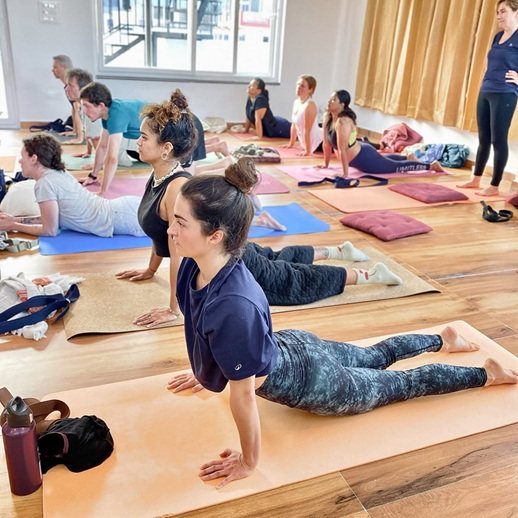
- Lie face down. Stretch your legs back, hip-width apart, with the tops of your feet on the mat. Rest your forehead on the floor.
- Place your hands. Put your palms flat on the mat under your shoulders, fingers pointing forward. Keep your elbows bent and hugging your ribs.
- Ground your lower body. Press the tops of your feet, your thighs and your pubic bone gently into the mat. Keep your thighs firm but do not clench your buttocks hard.
- Inhale and lift. Lift your head first, then your chest. Draw your shoulder blades back and down, away from your ears.
- Let your back do the work. Press lightly through your palms, but think of lifting your breastbone forward and up. Keep your navel on the mat or just barely off it.
- Keep your neck long. Look straight ahead or slightly down. Lift the chest, not the chin.
- Hold and breathe. Stay for 3–5 slow breaths (about 15–30 seconds). Keep your elbows bent and pointing back.
- Exhale and release. Lower your chest, then your head. Turn your head to one side and rest for a breath. Repeat 2–3 rounds, then rest in Child’s Pose.
Teacher’s check: at the top of the pose, lift your palms off the mat for a second. If you stay up, your back muscles are doing the work. If you drop, you were pushing with your arms and should lower the height.
How high should you lift? Only as high as your pubic bone and legs stay grounded and your lower back feels long, not pinched. In a good Cobra, the stretch is spread across the chest and upper back, not concentrated in one spot in the lower back.
Benefits of Cobra Pose
Cobra Pose strengthens the muscles along your spine, opens your chest and shoulders, and gently stretches your abdomen. These benefits come from how the pose loads the body. Few studies have tested Cobra Pose on its own, so we describe what it does physically and say plainly where the research is limited.
1. Strengthens your back muscles
When you lift your chest, the muscles running along your spine (the spinal extensors) and the muscles between your shoulder blades do the work. Held for a few breaths and repeated, this builds the endurance that helps you sit and stand tall for longer. Best result: lift with your back and keep your elbows bent, so your arms don’t take over.
2. Opens a tight chest and front shoulders
Hours at a desk or on a phone round the shoulders forward. Cobra stretches the chest and the front of the shoulders while strengthening the muscles that pull your shoulder blades back and down. It is a simple counter to that slumped position.
3. Improves spinal flexibility
Most daily movement bends the spine forward. Cobra moves it gently the other way, into extension. Done slowly, it helps the spine stay mobile, especially in the upper back.
4. Stretches the abdomen
The front of your torso lengthens as your chest rises. This is a stretch and light toning of the muscles around the belly, not fat loss.
5. Builds posture awareness
Lifting the breastbone while keeping the neck long teaches you what upright, open posture feels like. Many students find this carries over into how they sit and stand.
6. Calms the mind when paired with slow breathing
Inhale as you lift and exhale as you lower. Slow, steady breathing makes this a focused practice, and yoga as a whole is linked with lower stress. We don’t claim Cobra alone reduces stress, because that hasn’t been tested specifically.
7. A useful warm-up for deeper backbends
Cobra prepares your back, shoulders and chest for Upward-Facing Dog, Camel and Wheel. It is also a standard step in many Sun Salutation sequences.
Common Mistakes and How to Fix Them
| Mistake | Why it matters | Fix |
|---|---|---|
| Straightening the arms and pushing up high | Puts all the bend into the lower back | Keep elbows bent; lift lower |
| Shoulders creeping up to the ears | Tightens the neck and upper back | Roll the shoulders back and down |
| Jutting the chin forward | Crunches the back of the neck | Lengthen the back of the neck; lift the breastbone |
| Flaring the elbows out wide | Loses the support of the upper back | Hug the elbows toward your ribs |
| Gripping the buttocks hard | Can compress the lower back | Firm the thighs; keep the buttocks soft |
| Holding your breath | Adds tension | Breathe slowly through the nose |
| Lifting the pelvis and thighs | Turns the pose into a different one | Keep the pubic bone and thighs pressed down |
Cobra Pose Variations and Modifications
- Sphinx Pose (forearms down). Rest your forearms on the mat with elbows under your shoulders. This is the gentlest option and a good start if your lower back feels tight or your wrists are sore. It is also sometimes taught as Saral Bhujangasana, or Easy Cobra.
- Baby Cobra. Lift only a few inches, with your hands lightly on the mat or hovering above it. This builds back strength with very little compression.
- Cobra with hands hovering. Lift into Cobra, then float your palms just above the floor for a few breaths. It makes your back muscles do all the work.
- Cobra with support. If you feel squeezing in the lower back, place a thin folded blanket under your hips and widen your feet slightly. Make the lift smaller.
- Deeper Cobra. If your chest and shoulders are open and your back feels comfortable, you can straighten your elbows a little more and lift your breastbone higher. Keep your pubic bone down and your shoulders away from your ears. Do not force the depth.

Cobra vs Upward-Facing Dog vs Sphinx
| Cobra Pose | Upward-Facing Dog | Sphinx Pose | |
|---|---|---|---|
| Legs | On the floor | Lifted off the floor | On the floor |
| Arms | Bent or slightly bent | Straight | Forearms on the floor |
| Lift | Moderate | High | Low to moderate |
| Best for | Learning backbends | Active Sun Salutations, stronger practitioners | Tight backs, sore wrists, beginners |
Who Should Avoid Cobra Pose, and Safety Tips
Check with a doctor before practising if any of these apply:
- You are pregnant, because the pose presses the belly toward the floor.
- You have had abdominal or back surgery recently, or you have a hernia.
- You have a known spine problem such as a disc injury, spondylolisthesis or an active sciatica flare-up.
- You have a wrist, elbow or shoulder injury. Try Sphinx Pose instead.
- You have osteoporosis. Keep the lift very small.
Safety tips:
- Lift lower when in doubt. A small, controlled lift is better than a deep one.
- Stop at once if you feel sharp pain, pinching, numbness or tingling.
- Follow Cobra with Child’s Pose to release the back.
- Build up slowly, from 2 rounds to 3.
- Learn with a qualified teacher if you are new to backbends.

How to fit Cobra Pose into your practice
Cobra works well in the middle of a session. A simple 5-minute desk-break sequence:
- Cat-Cow for 1 minute to warm the spine.
- Plank Pose for a few breaths to wake the core.
- Cobra Pose, 3 rounds of 3–5 breaths.
- Child’s Pose for 5 slow breaths.
If you want to learn alignment with a teacher in person, our 200 hour yoga teacher training in Rishikesh covers backbends, safe adjustments, and anatomy in depth. You can also meet our instructors.
Conclusion
Cobra Pose (Bhujangasana) is one of the simplest ways to strengthen your back, open your chest, and undo some of the hunch that comes from sitting. Lift with your back muscles, keep your elbows bent, and stay within a comfortable range. Start with Sphinx Pose or Baby Cobra if you are new, and build up to 2–3 rounds of 3–5 breaths.
Cobra is a gentle strengthening and mobility pose, not a cure for back pain or a way to burn belly fat. If you have an injury, are pregnant, or feel sharp pain, speak to your doctor first. To learn safe alignment from experienced teachers in Rishikesh, explore our yoga teacher training or get in touch with us.
Cobra Pose (Bhujangasana) FAQs
What is Cobra Pose good for?
Cobra Pose strengthens the muscles along the spine, opens the chest and shoulders, and gently stretches the abdomen. It is often used to counter the hunched posture that comes from long hours of sitting. It is a general strengthening and mobility pose, not a medical treatment.
How long should I hold Cobra Pose?
Hold it for 3–5 slow breaths, about 15–30 seconds. Beginners can start with 10 seconds. Repeat 2–3 rounds and rest between them.
How many times a day can I do Cobra Pose?
Most people practise 2–3 rounds in a session, once or twice a day. Quality matters more than repetition. Reduce the number of rounds if your lower back feels tired or sore.
Does Cobra Pose reduce belly fat?
No pose can remove fat from one area. Cobra stretches and strengthens the muscles around the abdomen and back, but fat loss depends on overall diet, activity and sleep.
Is Cobra Pose good for back pain?
It depends on the cause. Research suggests yoga gives small benefits for chronic low back pain, and some people feel worse. If you have pain, speak to a doctor or physiotherapist first, and begin with Sphinx Pose or a low Baby Cobra.
What is the difference between Cobra Pose and Upward-Facing Dog?
In Cobra, your legs and pelvis stay on the floor and your arms are bent or only slightly straight. In Upward-Facing Dog, the arms are straight and the thighs lift off the floor. Upward Dog is more intense.
Can beginners do Cobra Pose?
Yes. It is one of the most beginner-friendly backbends. Start with Sphinx Pose or Baby Cobra, keep your elbows bent and lift only as high as feels comfortable.
Which category of asana is Bhujangasana?
Bhujangasana is a prone (face-down) backbend. In modern classification, it falls under spinal extension poses.
Is Cobra Pose safe during pregnancy?
No, it is usually avoided in pregnancy because it presses the abdomen toward the floor. Ask your doctor or a trained prenatal yoga teacher for safer alternatives.
This article is for general information and is not medical advice. If you have a respiratory or heart condition, are pregnant, or are unsure whether these practices suit you, please speak to your doctor before beginning.

 +91-8433225327,
 Rishikul Yogshala Rishikesh, Narayan Kunj, Jonk Village, Ram Jhula, Swarg Ashram, Rishikesh, Uttarakhand 249304
 By Airway
 By Railway
 By Bus/Cabs