








Padangusthasana (Big Toe Pose): Steps, Benefits, Contraindications & Modifications
Table of Contents
- What Is Padangusthasana?
- Where does the pose sit in practice?
- Three “Big Toe” Poses People Confuse
- How to Do Padangusthasana: Step by Step
- Warm up first
- The steps
- How long should you hold Padangusthasana?
- Why you should come up slowly
- Benefits of Padangusthasana
- 1. For the legs
- 2. For the spine and back
- 3. For the mind
- 4. For digestion
- Contraindications: Who Should Avoid Padangusthasana
- Props and Modifications
- Common Mistakes
- Preparatory Poses
- Follow-Up Poses
- Conclusion
- Frequently Asked Questions
- How long should you hold Padangusthasana?
- What is the difference between Padangusthasana and Padahastasana?
- Is Padangusthasana the same as Hand to Big Toe Pose?
- Can I bend my knees in Padangusthasana?
- What can I do if I cannot reach my toes?
- Who should not do Padangusthasana?
- Is Padangusthasana safe during pregnancy?
- Why does Padangusthasana make me dizzy?
- Where does Padangusthasana come in the Ashtanga sequence?
Padangusthasana, or Big Toe Pose, is a standing forward fold in which you hold each big toe with the first two fingers and thumb. You stand with the feet hip-width apart, fold forward from the hips, and take the toe grip. Hold for 5 to 10 breaths. It stretches the hamstrings and calves, lengthens the spine, and calms the mind. In the Ashtanga Primary Series, it is the first standing pose after the Sun Salutations.
Padangusthasana at a Glance
| Sanskrit name | पादाङ्गुष्ठासन (Pādāṅguṣṭhāsana) |
| English name | Big Toe Pose, Standing Forward Bend with Toe Grip |
| Word meaning | pada = foot, angustha = big toe, asana = pose |
| Pose type | Standing forward fold, mild inversion |
| Level | Beginner to intermediate |
| Hold time | 5–10 breaths (about 30–60 seconds) |
| Drishti (gaze) | Nasagra — the tip of the nose |
| Stomach | Empty — wait 3 to 4 hours after a meal |
| In Ashtanga | First standing pose of the Primary Series |
| Main target | Hamstrings, calves, lower back |
| Main caution | Disc injury, glaucoma, dizziness, late pregnancy |
What Is Padangusthasana?
Padangusthasana is a standing forward fold where the hands hold the big toes.
You stand with the feet about hip-width apart. You fold forward from the hips, not from the waist. Then you slide the first two fingers and thumb of each hand around the big toes and hold on. The grip is the whole point of the pose. It gives you something to pull against, and that pull is what teaches the spine to stay long instead of rounding.
The name is simple. Pada means foot. Angustha means big toe. Asana means pose.
It looks like an easy stretch. It is not. The toe grip changes the pose completely, because now you are actively drawing the chest forward rather than just hanging.
Where does the pose sit in practice?
In the Ashtanga Primary Series, Padangusthasana is the first standing pose after five rounds of Sun Salutation A and five of Sun Salutation B. It is held for five breaths, with the gaze at the tip of the nose. It is immediately followed by Padahastasana.
In hatha and vinyasa classes, it usually appears early in the standing sequence, once the body is warm.
Three “Big Toe” Poses People Confuse
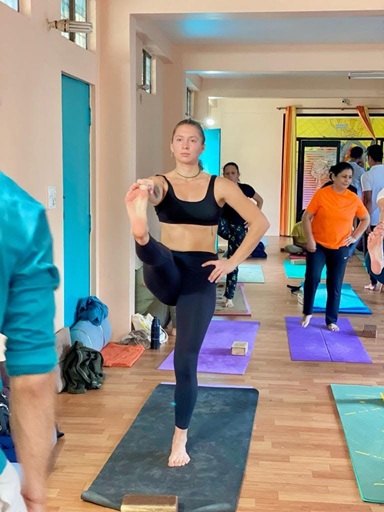
These three poses have similar names and get mixed up constantly, even on yoga websites.
| Padangusthasana | Padahastasana | Utthita Hasta Padangusthasana | |
|---|---|---|---|
| English | Big Toe Pose | Hand Under Foot Pose | Extended Hand-to-Big-Toe Pose |
| Position | Standing forward fold | Standing forward fold | Standing balance on one leg |
| Hands | Grip the big toes | Palms under the soles of the feet | Hold the big toe of the raised leg |
| Difficulty | Beginner to intermediate | Intermediate | Advanced |
They are not the same pose. If a source calls a one-legged standing balance “Big Toe Pose,” it has confused Padangusthasana with Utthita Hasta Padangusthasana.
How to Do Padangusthasana: Step by Step
Warm up first
Never fold deeply into cold hamstrings. Spend five minutes on:
- Sun Salutations — two or three rounds
- Cat-Cow — to wake up the spine
- Standing forward fold with bent knees — to introduce the shape gently
The steps
- Stand in Tadasana (Mountain Pose). Feet hip-width apart, outer edges parallel. Arms by your sides.
- Shift the weight slightly forward. Bring the weight towards the balls of the feet so the hips stack over the ankles. Most people lean back without noticing, and that alone blocks the fold.
- Inhale and lengthen the spine. Grow tall from the heels to the crown of the head.
- Exhale and hinge forward from the hips. Fold from the hip crease, not the waist. Keep the spine long as you come down.
- Bend the knees as much as you need. This is not cheating. A long spine with bent knees is far better than a rounded spine with straight legs.
- Take the toe grip. Slide the first two fingers and thumb of each hand around each big toe. Wrap the fingers underneath and hold firmly.
- Inhale and lift the chest halfway. Straighten the arms, look forward, and lengthen the front of the body. This is the important part of the pose — the flat-back lift.
- Exhale and fold. Bend the elbows out to the sides and draw the chest towards the shins. Pull gently against the toe grip. Let the head hang, and the neck soften.
- Hold for 5 to 10 breaths. Keep the weight forward. Let each exhale soften the hamstrings a little.
- Come out slowly. Inhale, lift halfway with a flat back. Release the toes. Bring the hands to the shins or the floor. Then rise to standing with the head coming up last.
How long should you hold Padangusthasana?
Hold for 5 to 10 breaths, roughly 30 to 60 seconds. In Ashtanga, it is held for exactly five breaths. Beginners can start with three breaths and build up.
If you feel the hamstrings shaking or the breath getting short, come out. Forward folds should not feel like a test.
Why you should come up slowly
Your head has been below your heart. Standing up fast can make you dizzy or lightheaded. Rise on an inhale, with the head last, and pause in Tadasana for two or three breaths before moving on.
Benefits of Padangusthasana
Padangusthasana stretches the hamstrings and calves, lengthens the spine, strengthens the thighs, and calms the nervous system. The toe grip lets you pull the chest forward, which trains the fold to happen at the hips rather than in the lower back. As a mild inversion, it also brings fresh blood to the head and quiets the mind.
1. For the legs
- Stretches the hamstrings. This is the main physical effect. The toe grip gives you leverage to lengthen rather than just hang.
- Lengthens the calves. Keeping the weight forward over the balls of the feet increases the stretch through the back of the lower leg.
- Strengthens the quadriceps. Drawing the kneecaps up engages the front of the thigh, which helps the hamstrings release. This is the pose teaching you something useful — muscles let go more easily when their opposite works.
2. For the spine and back
- Teaches hinging from the hips. Most back strain in forward folds comes from bending at the waist. The toe grip makes the correct pattern obvious, because you can only lift the chest if the hips fold properly.
- Decompresses the lower back. Letting the upper body hang creates gentle space between the lumbar vertebrae.
- Improves posture over time. Tight hamstrings pull the pelvis backwards, which flattens the lower back. Releasing them lets the pelvis sit more neutrally.
3. For the mind
- Calms the nervous system. Forward folds are naturally quieting. The head drops, the gaze turns inward, and the breath slows.
- Relieves mild mental fatigue. A short hold here is a genuine reset between more demanding poses.
- Builds patience. Hamstrings change slowly. This pose rewards regular practice and punishes forcing, which is a lesson worth more than the stretch.
4. For digestion
- The gentle compression of the belly in a deep fold supports normal digestive movement. Practise on an empty stomach so the fold stays comfortable.
Contraindications: Who Should Avoid Padangusthasana
| Condition | What to do |
|---|---|
| Herniated or slipped disc | Avoid deep forward folds. Get medical clearance first. |
| Sciatica | Approach carefully with bent knees. Stop if pain travels down the leg. |
| Hamstring tear or strain | Avoid until fully healed. Then return with bent knees and a strap. |
| Glaucoma or high eye pressure | Avoid. Head-below-heart positions increase pressure in the eyes. |
| Recent eye or ear surgery | Avoid until cleared. |
| Low blood pressure or frequent dizziness | Practise with the hands on the shins and come up very slowly. |
| Uncontrolled high blood pressure | Practise a supported version with hands on blocks. Avoid deep hanging folds. |
| Vertigo | Avoid, or keep the head above heart level. |
| Pregnancy (after the first trimester) | Avoid the deep fold. Stand with the feet wide and rest the hands on blocks or a chair. |
| Recent abdominal surgery | Avoid until fully healed. |
| Neck injury | Do not let the head hang loose. Keep a gentle length in the neck. |
Stop if you feel sharp pain, pinching in the lower back, tingling down the leg, or pressure behind the eyes. A stretching sensation is normal. These are not.
Props and Modifications
- Bend the knees. The single most useful modification. Almost everyone should. A long spine with bent knees beats a rounded spine with straight legs every time.
- Use a strap. If the toes are out of reach, loop a strap around the balls of the feet and hold one end in each hand. You get the same pull without the strain.
- Hands on blocks. Place a block under each hand instead of reaching the floor. Good for tight hamstrings, high blood pressure, and beginners.
- Hands on the shins. The gentlest version. Keeps the head higher, which suits anyone prone to dizziness.
- Feet wider apart. Taking the feet wider than hip-width makes room for the belly and reduces the hamstring intensity.
- Chair version. Sit on a chair, extend one leg, and fold forward over it. Useful for older practitioners and anyone who cannot stand for long.
Common Mistakes
- Leaning back into the heels. The most common error. If the weight sits in the heels, the hips move backwards and the fold stops. Shift forward over the balls of the feet.
- Rounding the lower back. The fold should happen at the hip crease. If the lumbar spine is doing the bending, bend the knees.
- Skipping the halfway lift. Step 7 is where the pose actually works. Going straight into the deep fold misses the point of the toe grip entirely.
- Locking the knees. Hyperextending strains the knee joint and the hamstring attachment. Keep a soft micro-bend.
- Yanking on the toes. The pull is gentle and steady, not a tug of war.
- Holding the breath. If the breath gets short, you have gone too deep.
- Standing up fast. The head has been below the heart. Rise slowly.
Preparatory Poses
- Tadasana— establishes the standing alignment
- Surya Namaskar A — warms the hamstrings and spine
- Uttanasana — the same fold without the toe grip
- Adho Mukha Svanasana — lengthens the whole back line
- Supta Padangusthasana — the reclined hamstring stretch, safest for tight legs
Follow-Up Poses
- Padahastasana — the traditional next pose, with the palms under the feet
- Utthita Trikonasana — opens the hips laterally after the forward fold
- Prasarita Padottanasana — a wide-leg fold that shares the same action
- Tadasana — always pause here for a few breaths before moving on
Conclusion
Padangusthasana looks like a simple stretch and is not. The toe grip is what separates it from an ordinary forward fold, because it gives you something to pull against — and that pull is what teaches the body to fold from the hips instead of collapsing at the waist.
Bend the knees. Shift the weight forward. Do not skip the halfway lift. Hamstrings change over months, not sessions, and this pose rewards patience more than effort.
Learning to work with the body you actually have — not the one you wish you had — is the part a full training gives you that an article cannot. Rishikul Yogshala Rishikesh has been running Yoga Teacher Training in India since 2010, with Yoga Alliance-certified 200 Hour and 300 Hour courses on the banks of the Ganga — covering Hatha, Ashtanga Vinyasa, alignment, anatomy, pranayama, and yoga philosophy.
Note: This article is for education only. It is not medical advice. If you are pregnant, have a spine, eye or blood pressure condition, or are recovering from surgery, speak to a doctor before practising this pose.
Frequently Asked Questions
How long should you hold Padangusthasana?
Hold for 5 to 10 breaths, roughly 30 to 60 seconds. In the Ashtanga Primary Series, it is held for exactly five breaths. Beginners can start with three breaths and build up gradually.
What is the difference between Padangusthasana and Padahastasana?
Both are standing forward folds. In Padangusthasana, you grip the big toes with your fingers. In Padahastasana, you slide the palms under the soles of the feet, so the hands are beneath the feet. Padahastasana is the deeper of the two and usually follows it.
Is Padangusthasana the same as Hand to Big Toe Pose?
No. Hand to Big Toe Pose usually means Utthita Hasta Padangusthasana, a standing balance where you hold one raised foot while balancing on the other leg. Padangusthasana is a two-legged forward fold. The names are similar, but the poses are different.
Can I bend my knees in Padangusthasana?
Yes, and most people should. A long spine with bent knees is far better than straight legs with a rounded back. Bending the knees is a legitimate version of the pose, not a shortcut.
What can I do if I cannot reach my toes?
Loop a yoga strap around the balls of your feet and hold one end in each hand. You can also place a block under each hand, or rest the hands on your shins. All three give the same lengthening action.
Who should not do Padangusthasana?
Avoid this pose with a herniated disc, glaucoma or raised eye pressure, vertigo, or a hamstring tear. Anyone with low blood pressure or dizziness should keep the hands on the shins and rise slowly. Avoid the deep fold after the first trimester of pregnancy.
Is Padangusthasana safe during pregnancy?
The deep fold is not suitable after the first trimester. A wide-legged standing fold with the hands on blocks or a chair is a safer alternative. Check with a prenatal yoga teacher first.
Why does Padangusthasana make me dizzy?
Because your head is below your heart, which is a mild inversion. Rise slowly on an inhale with the head coming up last, and pause in Tadasana before moving on. If dizziness continues, keep the hands on the shins so the head stays higher.
Where does Padangusthasana come in the Ashtanga sequence?
It is the first standing pose of the Primary Series, practised immediately after five rounds of Sun Salutation A and five of Sun Salutation B. It is held for five breaths with the gaze at the tip of the nose, then followed by Padahastasana.
This article is for general information and is not medical advice. If you have a respiratory or heart condition, are pregnant, or are unsure whether these practices suit you, please speak to your doctor before beginning.

 +91-8433225327,
 Rishikul Yogshala Rishikesh, Narayan Kunj, Jonk Village, Ram Jhula, Swarg Ashram, Rishikesh, Uttarakhand 249304
 By Airway
 By Railway
 By Bus/Cabs