








The Most Important Favorable Principles To a Yogi (Sadhaka Tattvas In Hatha Yoga)
Table of Contents
Sadhaka & Badhaka Tattvas in Hatha Yoga
In Hatha Yoga, chapter 1.15 verse, we have studied the impediments in Hatha Yoga. Now let us understand what the favourable principles are that help a Yogi to become Ekagra-Chitta, i.e., one-pointed mind, and thus attain the state of Niruddha, i.e., to stop and restrain the modification of the mind field/self-realization.

Hatha Yoga Pradipika Chapter 1.16 verse emphasized the principal practice before initiating the Sadhna of Hatha yoga i.e., Asana, Kriyas, Pranayama, Mudra, Bandha, and Nad-anusandhan. The term is used in the Hatha tradition: “Sadhaka & badhaka Tattva” (sadhak means favorable/ beneficial, and Tattva is to live with the principles/ habits/ elements).
In short, an aspirant who observes the given instructions and principles from the Guru’s, and scriptures that help a Yogi to attain the Nirruddha state of Raja Yoga is known as Sadhak & Badhaka Tattva.
The Components of Sadhak-Tattva In Hatha Yoga Are Given As Follow:
- Utsah – zeal
- Sahas – bravery
- Dhairya – patience
- Tattva-gyana – the understanding of Purusha and Prakruti (the Self and Non-Self)
- Dridh-nischay – positiveness
- Jansangha-parityag- public-abandonment
1. Utsah
Utsah means Zeal. In the beginning, when the student starts to study the subject of Yoga, most of them appear to possess a lot of zeal in them, and it is good for the reason that the subject
Includes various physical and mental practices; there are so many communities and gatherings for like-minded people. It’s an opportunity to become a life coach, gain name and fame, Joy, and Self-realization. Hence, I strongly believe that whatever we have been expecting from Yoga (Hatha Yoga), it has been fulfilling those expectations, and thus it all depends on our willingness and zeal.
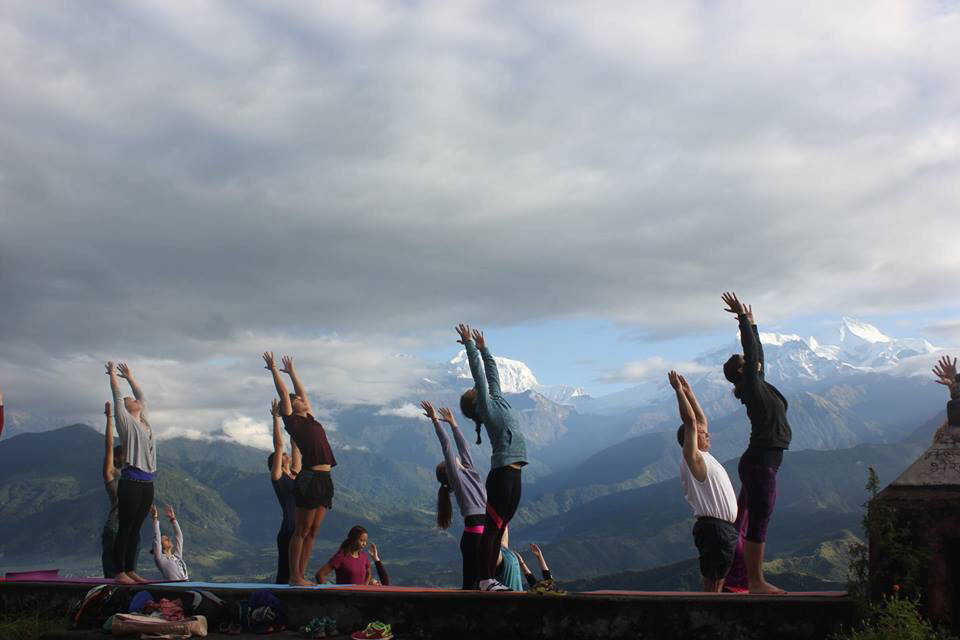
Do you know that in the olden days, to initiate
Hatha Yoga teachings and practices, the Guru used to check the previous background of the student, their lifestyle, work field, and curiosity, and then set the time period accordingly for the Karma-yoga, i.e., cleaning the Yogshala, handling the Ashram’s kitchen and feeding all the guests, gurus and students, and administration. Also other things like feeding the cows, cleaning the cowshed and milking them; and taking care of the needs of gurus so that they should remain concentrated on their Sadhna and teachings.
Being modern-minded, you also must know that it was not exploitation and slavery; the Guru never creates a differentiation, no matter if the aspirant belongs to a royal or farmer background; for him all are equal, and all must have to go through the test, and therefore only the study of yoga (hatha yoga) used to proceed.
The Upanishads and Yoga scriptures tell us that these tests were done to examine the amount of zeal a Sadhak possessed and for the reason of Chitta shuddhi (the purity of mind).
In short, the Guru used to create all kinds of atmospheres (easy and difficult). However, the Guru always intends to help and uplift the zeal of a sadhka get angry, feelings of jealousy, lusty feelings, excitement, terrible feelings, and so on.
That is the reason why we are so-called Gurus, and thus surrender to his lotus feet.
Although life will provoke you with many more tests and lessen the amount of zeal on the path, at that time keep remembering you are not alone; the Guru and God are within you all the time.
2. Sahas – Bravery
Sahas is Bravery; a spiritual aspirant must have faith in the master and master’s guidelines, and thus bravely follow them step by step. Bravery is principle practice to achieve success in Yoga, and Hatha Yoga thus allows the aspirant to go closer to the Guru, and therefore reveal and ask for untold secrets from them.
This is the Indian tradition that we serve a master for years and lifelong to win his heart and get his blessings. Here the blessing is to initiate the student with his Gupt-Vidhya, AtmaVidhya (the confidential information, the highest form of spiritual knowledge).
The second main reason is that it is also essential for the practice of yoga, which includes various aspects of Asanas, Kriyas and Pranayama, which influence the biological functions of the human body and the philosophy which influences our mind and living style in society; it also gives light for the higher Sadhna and so on.
To be fair with you, the Yoga (Hatha Yoga) subject sometimes drives the aspirant crazy, and thereafter it creates confusion, illusion, and myth.
The reason is that when an aspirant is not confident, and thus does not understand the subject and instructions.
In a nutshell, many times in our general life we misunderstand bravery and fragile ego, which leads to superior-inferior complexity in many of us, both have differences, when the bravery.
Honesty and introspection are merged in an action that leads to self-appreciation and surrendering to the divine feet, and therefore one does not get involved in duality, but fragile ego has a short life, and it’s born out of half-knowledge, fear, and jealousy, which always leads to a wrong idea, pain, and suffering at the end.
3. Dhairya – Patience
Dhairya is Patience; the quality of having patience in a spiritual aspirant is their uniqueness, and therefore he/she should be initiated into Sacred-Hatha Yoga-Sadhna.
The aspirant will have to begin simultaneously, with self-commitment, complete dedication to the learning (Hatha Yoga) understanding, and thereafter priority to achieve the goals by following the instructions from the competent Guru/Professor.
Today, millions of us want to learn philosophy and practice to teach other fellows how to do the yoga postures, awakening of Kundalini (psychic power), healing the Chakras (healers), controlling the Parana, and so on.

But to be honest with you, it is entertaining, only while listening, and demonstrating in front of innocent people, through doing and teaching difficult postures, sitting with eyes closed, then holding breath, feeling nice just for some hours because of meditative activities and claiming that to be Kundalini Yoga. Isn’t it just so funny in the name of Yoga?
It is not much knowledge to only know and teach to others.
(Hatha Yoga) Yoga is all about the science of Self, and thus, while and after learning, while and after practicing, you should ask yourself these questions to yourself that why you are doing this? What are the anatomical, physiological, spiritual benefits, and contraindications? What to do before and after?
Make sure that from whom you are learning the advanced Kundalini Kriyas, is His/ her Kundalini awakened or not, and so on?
All these Yogic practices require years of learning, self-practice, patience, and thus most important is experience. At the end of this topic, I would like to bring your attention to a special notice for learners and teachers: that is the ‘question and answers’.
It should have been between a learner and a competent master, to know each other well and set mutual trust, and thus proceed to the goal together! But do not forget to be respectful and confident with each other. It does not matter if he/ she (Master) will answer you or not, but you should not lose patience.
“The ordinary teacher will leave you with what you have done during the course and learning, but the competent teacher will leave you with sincerity, patience, and self-practice”.
4. Tattva- Gyana
Tattva- Gyana is a Sanskrit term; it is used in Hatha yoga and many other forms of Yoga, by various Indian Vedic texts. Let us break it down for interpretation and clear understanding:
Tat = that, Tavam = me, and Gyana is knowledge i.e. the knowledge of Mud, Mud-Pot, and the creator of Mud-Pot.
Steadily learning the preliminary science of Yoga, advanced scriptures from a Guru, and thus becoming firm in understanding the phenomenon of the Universe with individual-Self, thereby begins the practice of separation “the truth from Non-truth”, by entering into the Raja-Yoga Sadhna.
The tradition of Hatha Yoga strongly recommends the Tattva-Gyana for Raja-Yoga (Contemplation and Meditation), which is essential to embark on the journey, and thus following the sadhana (orderly instructions), unless the Truth, Liberation, Self-realization is attempted.
Another advantage for a sincere aspirant is to study the Tattva-Gyana, and for those who have considered themselves advanced in Yoga, but for some reason they have deviated from the path and feel demotivated.
They both will gain Shraddha and Vairagya (devoutness and asceticism) by steadily listening and practicing during their daily Sadhna.
“Philosophy without practice is rootless, and practice without philosophy is fruitless”.
5. Dridh-Nischay
Dridh-Nischay: the word Dridh means strong-willed, determined, positive, uncomplaining, and Nischay is decision, resolution, and commitment. We are well aware that before starting a new journey, the knowledge about the journey, setting goals, and possessing single-minded devotion to achieve it, is the essential principle to attain the goal.
Therefore, the moment we loosen up due to half-success, fragile ego, and get engaged in mundane activity, it will cause a barrier on the path. Let me remind you of a story, which is about Nachiketa’s conversation with lord Yamraja. This story is from the Kathopanishad, where Nachiketa’s strong-willed will leads him to attempt enlightenment.
In the olden days, there was a well-known sage Vajasrawas; he was conducting a VishvajeetYajna (sacrifice). In this sacrifice, the performer had to give away all his wealth and beloved possessions without any attachment. There were many guests, saints, and sages to be part of such a noble ceremony and chant the sacred mantras from the Vedas while offering to the holy fire.
The Rishi Vajasrawas started to donate his wealth (the cows were considered to be one of the most valuable possessions in ancient times), but at some point in the middle of the ceremony, he felt something, and thereafter he started donating the old cows to the needy.
Nachiketa (son of Vajasrawas) was in his teens; that is why his father was donating such cows, which could not bear calves in the future, were unable to stand up properly, and had been milking for a long time.
He went to his father and asked him, ” Oh dear father, why are you donating the old cows to the Brahmins? When you knew these cows are not useful for them and hard to take care of all these cows, you are well aware that the sacrifice donation must be useful for the needy. But if they take these cows with them, they could not afford to take care of them.
So don’t do this, oh father. Rishi Vajasrawas kept silent and did not reply to his son.
Then again Nachiketa humbly asked his father to stop donating cows and said, you know, if they did donate the cow and it does not work for the needy, it will make them a partaker of sin. Then why are you knowingly taking this sin, oh father? Rishi Vajasrawas started getting angry, but still did not reply.
In the third attempt, Nachiketa insisted and suggested to his father, “As I am also beloved to you, dear father, and you have taken a vow that you will not hesitate to sacrifice all your beloved wealth, so whom will I donate to? Then Vajasrawas patience broke, and he angrily replied, ‘I donate you to the Yamaraja’.
The term Yama is used for the lord of death, who takes out life and sends it to heaven or hell according to their deeds. It is also synonymous with the Guru, who kills the ignorance of his disciple and enlightens them, and Raja means the King; thus Yamaraja is known as the lord of death and justice.
Rishi Vajasrawas did not mean what he said. He had uttered these words in anger. No father would send their son away to the abode of death. Thereby Nachiketa accepted what his father said, and somehow he convinced his father to allow him to go and complete his promise as before their ancestors did it and followed the tradition.
Nachiketa left his home and then reached Yama-Loka (abode of the lord of death). He was stopped by the dwarpala (the gatekeepers) and told Nachiketa, ‘Oh innocent boy, return back your home; you cannot meet the lord of death without dying ’. Then Nachiketa replied, ‘My father has donated me to the lord of death.
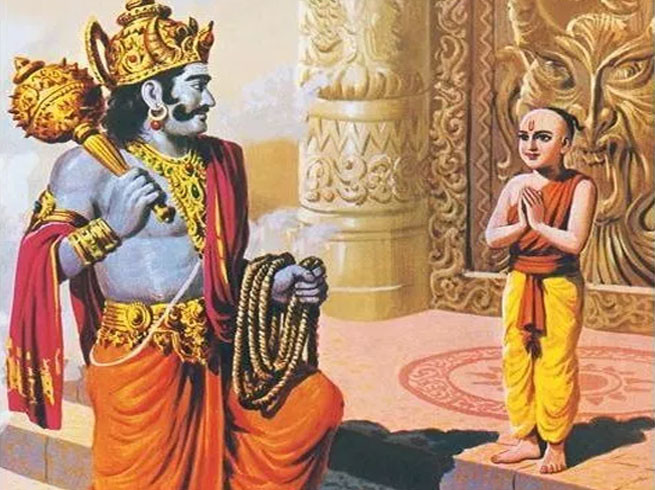
I must see and meet him’. The gatekeepers informed the lord and said that a miracle boy is insisting on meeting you, and he said that his father has donated him to you. The lord of death laughed and said that ‘he is an immature boy and send him back by arranging food with respect.
The gatekeeper asked Nachiketa to eat food with great love and requested that he must return back to home. Nachiketa said with love, ‘I will not return until I meet Yamraja, and nor will I take food and water; these are my vows’. He waited for Yamaraja at his abode for the next three days and nights.
Then somehow, Yamaraja came to know that the boy had been staying at his doorstep for three days and nights without eating and drinking. Yamaraja then realized his mistake and immediately met Nachiketa and granted him three boons in exchange for his sin, and he was happy with the devotion Nachiketa had.
Nachiketa asked for the first boon to end his father’s anger, and his father should love him like before. The lord granted what the young boy asked.
Nachiketa, revealing his desire for a second boon, spoke of knowing the secret of heaven. Nachiketa did not ask the second boon for himself, but for the welfare of entire mankind.
He wanted everyone to learn the secret knowledge and free themselves from all kinds of suffering. Yamaraja, pleased with the selfless feeling of the boy, told him all the Yajna (sacrifice) and methods so that man can attain heaven.
Yamaraja was pleased with him for another reason too: that at such a young age he had the power of spiritual thinking, and he remembered everything that Yamraja had told him. By being happy with the efficiency of his intellect, Yamraja gave him an extra boon that he would be known as Yajna as the second name to him.
In the third boon, Nachiketa asked, O Lord, there is no better person than you who can tell me the answer to this question; now tell me the secret after death?” Yama was unwilling to answer this question and said that these subjects are difficult and mysterious even to the gods.
Yama offered Nachiketa to ask for some other boon: the nymphs of heaven, live as long as you want, take the kingdoms, and enjoy the wealth, etc.
But Nachiketa said, with his reasoning, that all the worldly treasures and heavenly pleasures come to an end eventually. If tomorrow is not right, but at some time or other, worldly pleasures are bound to end.
He expressed his strong desire to the Lord, saying, “I have to know this knowledge, which is even difficult for God to know. Please teach me that super spirit knowledge”.
He reminded the Lord about the boon which was still left unfulfilled.
At this young age, seeing the intense desire to get enlightenment, and seeing the sacrifice of all happiness, Yamraja was pleased. He said Oh great Nachiketa You are entitled to this knowledge, knowing that you get freedom from the cycle of life and death.
Listen carefully, oh young boy. Know this Self as the master of the chariot, the body as the chariot itself, the discriminating intellect as the charioteer, the mind as the reins. Know the senses as the horses and the selfish desires as the roads they travel.
When the soul attaches itself to the body, senses, mind, and intellect, only then does it indulge in worldly pleasures and sorrow.
The knowledgeable men know the body, mind, and senses differently; they constantly practice to interview that Self through contemplation and meditation. O knowledgeable boy, you just know that this Soul is immortal and its knowledge is the ultimate knowledge.
Read More: Cooling Pranayama Practice for Summer: Beat the Heat Naturally
Thus, after receiving knowledge, Nachiketa was satisfied, and after saluting his Guru (Yamaraja), he attained enlightenment. In this narrative, we learnt that young Nachiketa, with his righteousness, courage, and strong-willed resolution, was tested by the great guru (lord of death), before giving him the supreme knowledge.
6. Jansangh Parityag
Jansangh Parityag is public abandonment; we have had the study of Jansangha in Badhaktattva as an impediment, and it is reminded to us in Sadhak tattva again why the mass public relations should be abandoned, and thus the tradition says, to avoid the obstacles created at the social and religious level.
The physical and mental energy is lost due to more public relations and thus not providing sufficient time to oneself. The sacrifice of public relations has been said to be necessary and beneficial for an intense aspirant of yoga.
Why does it not help if not understood well?
Public abandonment does not mean here to lock yourself in a room by force, avoiding family members, friends, and circumstances of stress/ depression, shamefulness, and so on. It means here a choice of being mindful, spending time with your seniors who can help you to progress, spending time on self-study in a peaceful atmosphere, being under the guidance of a competent teacher or professor, going out in society to attend socio-religion programs and learn, contemplate logically, never think that you are superior/ different than others, do not be judgmental so quick, and so on. It has been believed that if you follow Sadhak Tattva by heart and trust yourself, it will make your yogic journey more swift and fruitful.
Conclusion
The Sadhaka Tattvas in Hatha Yoga offer valuable principles for developing discipline, awareness, balance, and inner growth. They show that yoga is not limited to physical postures but is a holistic practice that helps cultivate a steady mind, mindful habits, and a deeper connection with oneself.
For those who want to explore these principles through traditional yogic teachings and practical experience, Rishikul Yogshala, a Yoga school in Rishikesh, offers Yoga Teacher Training in Rishikesh that combines asana, pranayama, meditation, yoga philosophy, and teaching methodology. The training provides an opportunity to deepen your personal practice while developing a stronger understanding of yoga and its teachings.

 +91-8433225327,
 Rishikul Yogshala Rishikesh, Narayan Kunj, Jonk Village, Ram Jhula, Swarg Ashram, Rishikesh, Uttarakhand 249304
 By Airway
 By Railway
 By Bus/Cabs