








Yoga for Weight Loss: 10 Poses, a Weekly Plan, and an Honest Answer
Table of Contents
- Does Yoga Really Help You Lose Weight?
- How Yoga Actually Helps You Lose Weight
- 1. It burns calories — how many depends on the style
- 2. It builds muscle
- 3. It lowers stress
- 4. It improves sleep
- 5. It teaches you to notice hunger
- 6. You will actually keep doing it
- Which Style of Yoga Burns the Most Calories?
- 10 Best Yoga Poses for Weight Loss
- 1. Surya Namaskar (Sun Salutation)
- 2. Utkatasana (Chair Pose)
- 3. Phalakasana (Plank Pose)
- 4. Vasisthasana (Side Plank)
- 5. Virabhadrasana II (Warrior II)
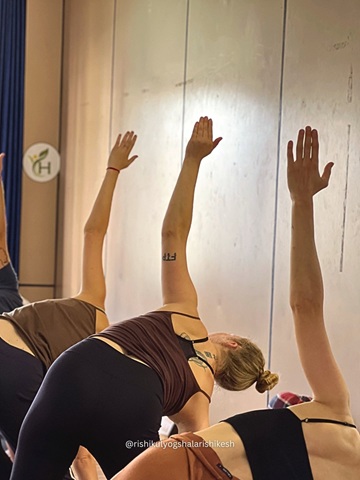
- 6. Utthita Parsvakonasana (Extended Side Angle)
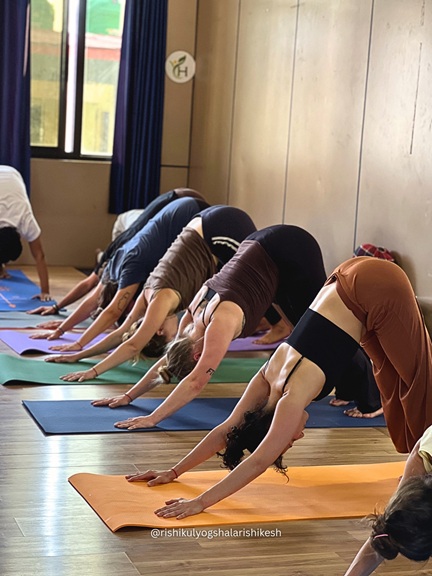
- 7. Adho Mukha Svanasana (Downward-Facing Dog)
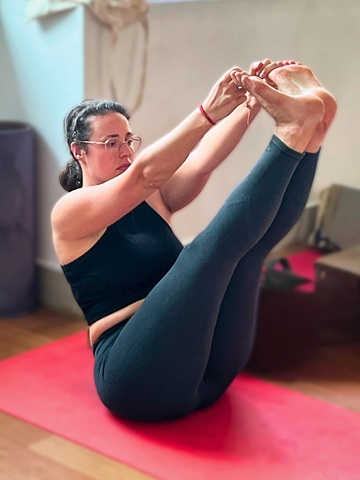
- 8. Navasana (Boat Pose)
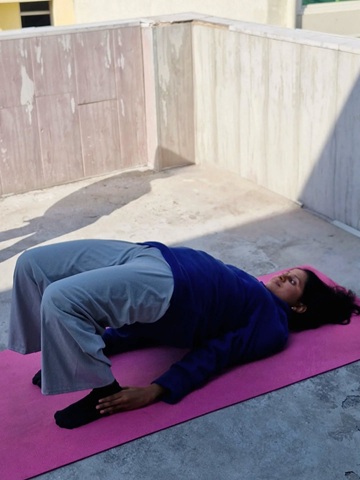
- 9. Setu Bandha Sarvangasana (Bridge Pose)
- 10. Trikonasana (Triangle Pose)
- A Simple 4-Week Beginner Plan
- What to Eat
- Yoga or Gym?
- How Long Before You See Results?
- Who Should Be Careful?
- The Bottom Line
- Frequently Asked Questions
- Can you lose weight with yoga alone?
- How many calories does one hour of yoga burn?
- Which yoga is best for weight loss?
- How many days a week should I do yoga to lose weight?
- How long does it take to lose weight with yoga?
- Does yoga reduce belly fat?
- Is yoga better than the gym for weight loss?
- Can I lose weight doing only Surya Namaskar?
- Is hot yoga better for weight loss?
- Should I do yoga on an empty stomach?
- Does yoga speed up metabolism?
- Can beginners and overweight people do these poses?
Key Takeaways
- Yoga alone will not cause fast weight loss. Anyone promising “instant” results is selling something.
- Diet does most of the work. Yoga supports it. It does not replace it.
- Style matters more than poses. A 45-minute Vinyasa flow burns two to three times what a gentle Hatha class burns.
- The real advantage is stickiness. People stay with yoga for years. That beats a hard workout you quit in three weeks.
- You do not have to choose yoga or the gym. Yoga plus two short strength sessions a week is the strongest combination.
Does Yoga Really Help You Lose Weight?
Yes — but let’s be clear about how much.
If you practise gentle yoga three times a week and change nothing else about how you eat, you will probably not lose much weight. That is the honest answer, and most articles will not give it to you.
What yoga does well is this: it builds muscle, it lowers stress, it improves sleep, and it makes you pay attention to your body. Those four things make losing weight much easier over months and years. They just do not show up on the scale in week one.
In general, weight loss occurs when your body uses more energy than it takes in over time. Yoga can support this process by contributing to physical activity, strength, stress management, sleep, and healthier lifestyle habits. No pose, no breathing technique, no detox. What yoga can do is help you eat less without feeling like you are fighting yourself, and help you keep moving on days when a gym feels like too much.
A note from teaching: In our teacher trainings in Rishikesh, students practise four to six hours a day. In our teacher training programmes in Rishikesh, students practise yoga for several hours a day and learn how asana, lifestyle, nutrition, sleep, and mindfulness can work together to support overall well-being.
How Yoga Actually Helps You Lose Weight
Six real reasons. No thyroid claims, no fat-melting poses.
1. It burns calories — how many depends on the style
A fast, flowing class burns a real amount of energy. A slow, restful class does not burn much. Both are useful, but they are not the same tool.
2. It builds muscle
Poses like Plank, Chair, and the Warriors make you hold your own body weight. That builds lean muscle. More muscle means your body uses slightly more energy all day, even at rest.
3. It lowers stress
Chronic stress can affect sleep, appetite, and eating habits. Yoga and mindful breathing may help some people manage stress, which can make it easier to maintain healthy lifestyle habits.
4. It improves sleep
Poor sleep raises hunger hormones and makes you crave junk food. Regular yoga practice may support better sleep for some people, particularly when it becomes part of a consistent and relaxing routine.
5. It teaches you to notice hunger
This is the quiet one, and probably the most powerful. Yoga trains you to feel what is happening in your body. Over time, many people start to notice the difference between real hunger and boredom, or stress, or habit. That noticing is what changes how much you eat.
6. You will actually keep doing it
Most people quit hard exercise programmes within a few months. Yoga has a very high stick rate, because it does not leave you wrecked. The workout you keep doing beats the harder one you quit. For weight loss over a year, consistency beats intensity every time.
Which Style of Yoga Burns the Most Calories?
Calorie expenditure varies considerably depending on body weight, practice intensity, duration, experience, and individual factors. The figures below are broad estimates rather than guaranteed calorie-burn values.
| Style | Calories per hour (approx.) | Good for |
|---|---|---|
| Power Yoga | 400–500 | Fat loss, strength, fitness |
| Ashtanga | 400–500 | Strength, discipline, fitness |
| Vinyasa Flow | 350–450 | Fat loss, all-round fitness |
| Hot Yoga / Bikram | 330–460 | Sweat and endurance (weight lost is mostly water) |
| Hatha (general class) | 175–250 | Learning alignment, beginners |
| Iyengar | 150–200 | Alignment, injury recovery |
| Yin / Restorative | 100–150 | Stress, sleep, recovery |
If your goal is to increase physical activity and energy expenditure, more dynamic styles such as Vinyasa, Power Yoga, or Ashtangamay be useful, provided they match your fitness level and experience.
About hot yoga: you will lose one to two kilos in a hot class. It is water. It comes back as soon as you drink. Hot yoga is a fine workout, but the scale after class is not telling you the truth.
10 Best Yoga Poses for Weight Loss
These are chosen for one reason: they make your muscles work. Each entry tells you how to do it and how long to hold it.
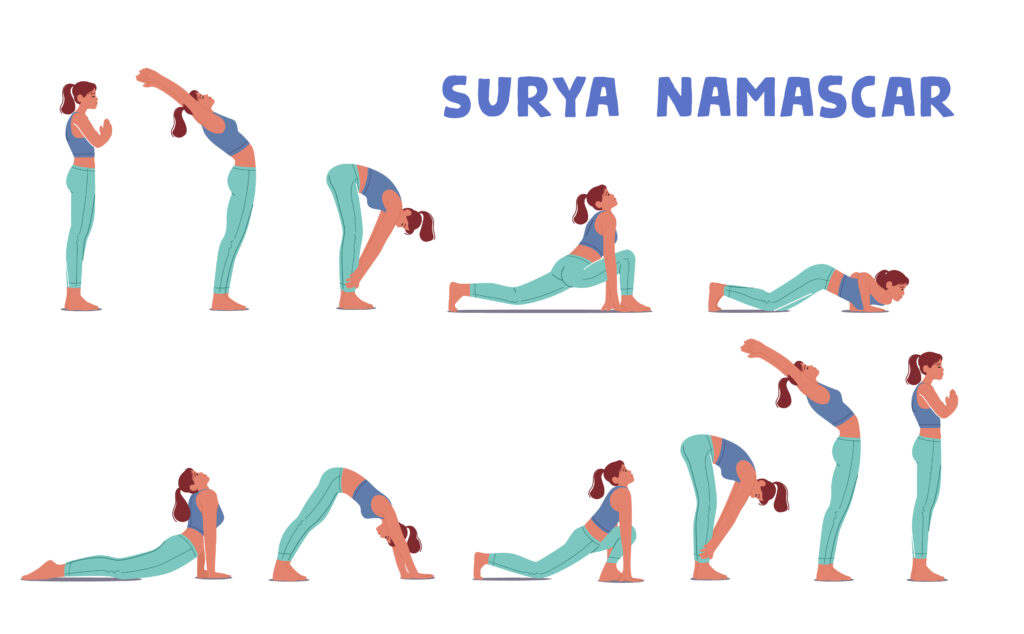
1. Surya Namaskar (Sun Salutation)
The single most useful thing on this list. It is not one pose but a flowing sequence of twelve, linked to your breath. It raises your heart rate, works your whole body, and warms you up for everything else.
How to do it: Follow the classic twelve steps, moving one breath per movement. Start with 5 rounds. Build to 12.
Hold: 5–12 rounds, 10–20 minutes.
Burns: A continuous Surya Namaskar practice can raise your heart rate and increase energy expenditure, although the amount varies considerably from person to person.
Tip: Speed is not the goal at first. Get the shape right, then go faster.
2. Utkatasana (Chair Pose)
Why it works: It loads your thighs, glutes, and core all at once. Your legs are the biggest muscles in your body, so working them costs the most energy.
How to do it: Stand with feet together or hip-width. Bend your knees and sit your hips back, as if lowering into a chair. Keep your weight in your heels, you should be able to see your toes. Reach your arms up beside your ears. Draw your lower ribs in so your back does not arch.
Hold: 30–60 seconds. 3 rounds.
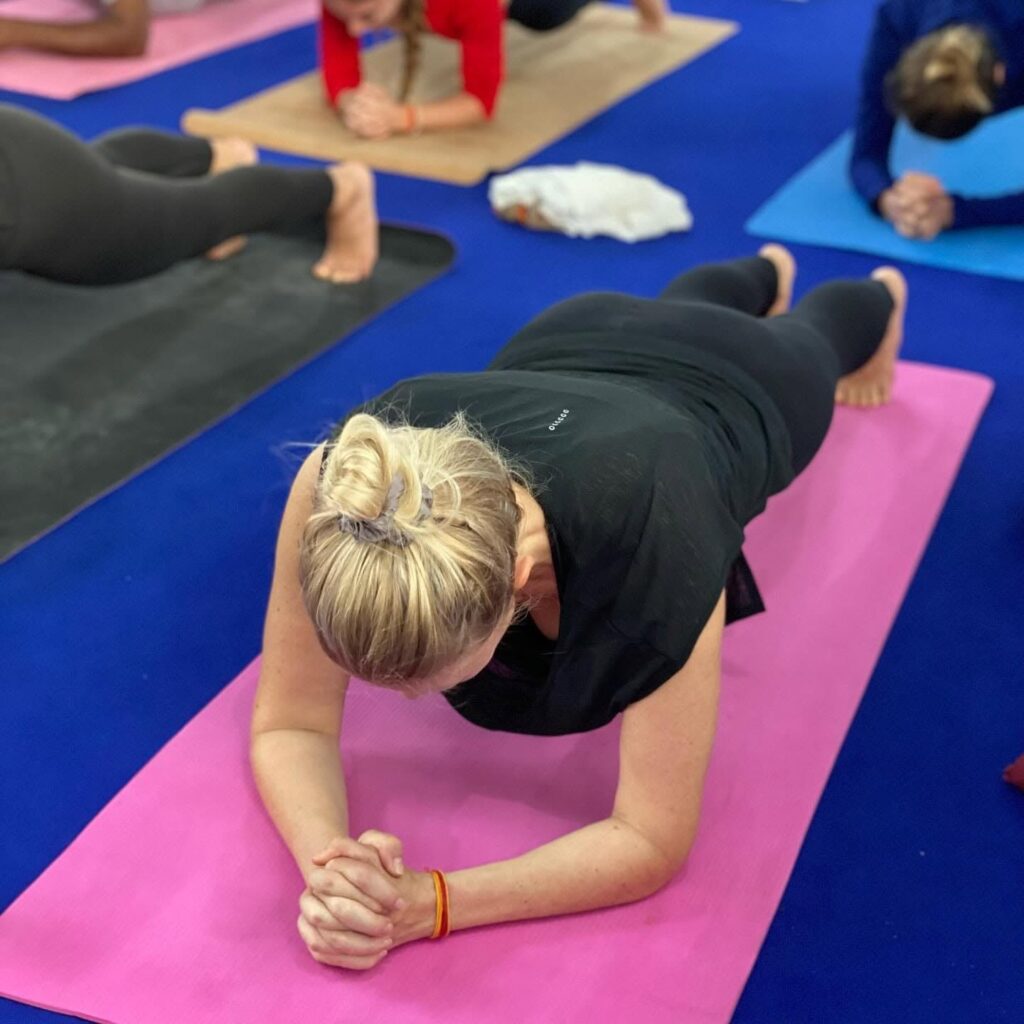
3. Phalakasana (Plank Pose)
Why it works: The best whole-body hold in yoga. Core, shoulders, arms, glutes and legs, all at the same time.
How to do it: From hands and knees, step both feet back. Wrists under shoulders. Body in one straight line from head to heels. Press the floor away so your upper back is wide. Squeeze your glutes. Do not let your hips sag or lift.
Hold: 20–60 seconds. 3 rounds.
Modification: Drop your knees. A 45-second knee plank is better than a 15-second sagging one.
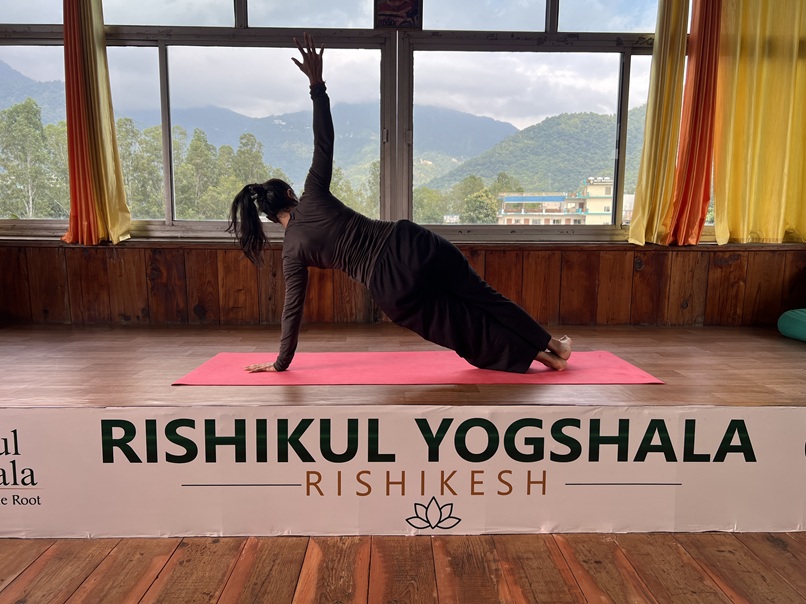
4. Vasisthasana (Side Plank)
Why it works: Targets the obliques — the side waist muscles — which most core work misses.
How to do it: From Plank, roll onto the outer edge of your right foot. Stack your left foot on top. Reach your left arm up. Keep your hips lifted and your bottom shoulder stacked over your wrist.
Hold: 20–40 seconds each side.
Modification: Bottom knee down on the mat.
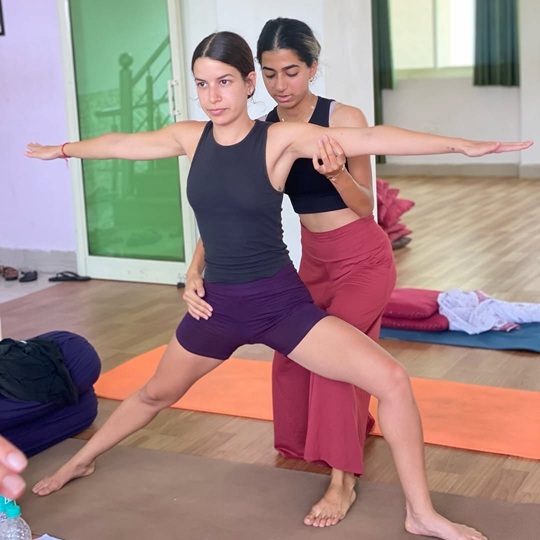
5. Virabhadrasana II (Warrior II)
Why it works: A long hold in a deep leg bend. Your quadriceps work hard the whole time, and your shoulders work to hold the arms up.
How to do it: Feet wide apart. Turn your right foot out 90 degrees, back foot in 15 degrees. Bend your front knee until it stacks over your ankle. Arms out at shoulder height. Gaze over your front hand.
Hold: 30–60 seconds each side.
6. Utthita Parsvakonasana (Extended Side Angle)
Why it works: Same leg work as Warrior II, plus a long stretch down the whole side of your body.
How to do it: From Warrior II, lower your front forearm onto your front thigh, or your hand to a block outside your front foot. Reach your top arm over your ear.
Hold: 30–45 seconds each side.
7. Adho Mukha Svanasana (Downward-Facing Dog)
Why it works: Builds shoulder and arm strength while stretching your hamstrings and calves. It is also the resting position in a flow — learning to breathe here is what lets you practise longer.
How to do it: From hands and knees, tuck your toes and lift your hips up and back. Press your hands down, lengthen your spine. Knees can stay bent. Straight legs matter far less than a long back.
Hold: 30–60 seconds. 3 rounds.
8. Navasana (Boat Pose)
Why it works: Deep core work, especially the hip flexors and lower abdominals.
How to do it: Sit with knees bent, feet on the floor. Lean back slightly and lift your feet so your shins are parallel to the floor. Reach your arms forward. Keep your chest lifted and your back long — do not slump.
Hold: 20–40 seconds. 3 rounds.
Modification: Hold the backs of your thighs, or keep toes lightly touching the floor.
9. Setu Bandha Sarvangasana (Bridge Pose)
Why it works: Strong glute and hamstring work, and it opens the front of your hips after sitting all day.
How to do it: Lie on your back, knees bent, feet flat and hip-width, heels near your fingertips. Press your feet down and lift your hips. Roll your shoulders under and clasp your hands. Keep your knees pointing forward.
Hold: 30–60 seconds. 3 rounds.
10. Trikonasana (Triangle Pose)
Why it works: Works the legs, opens the hips and chest, and teaches you to stay long in your spine while working hard.
How to do it: Feet wide. Front foot turned out 90 degrees. Keep both legs straight. Reach forward over your front leg, then lower your bottom hand to your shin or a block. Top arm reaches up. Turn your chest open to the side.
Hold: 30–45 seconds each side.
One thing Triangle does not do: it does not burn fat from your waist.
No pose burns fat from one specific place. Spot reduction is not real. Your body decides where fat comes off, and it does so from everywhere as your overall body fat drops.
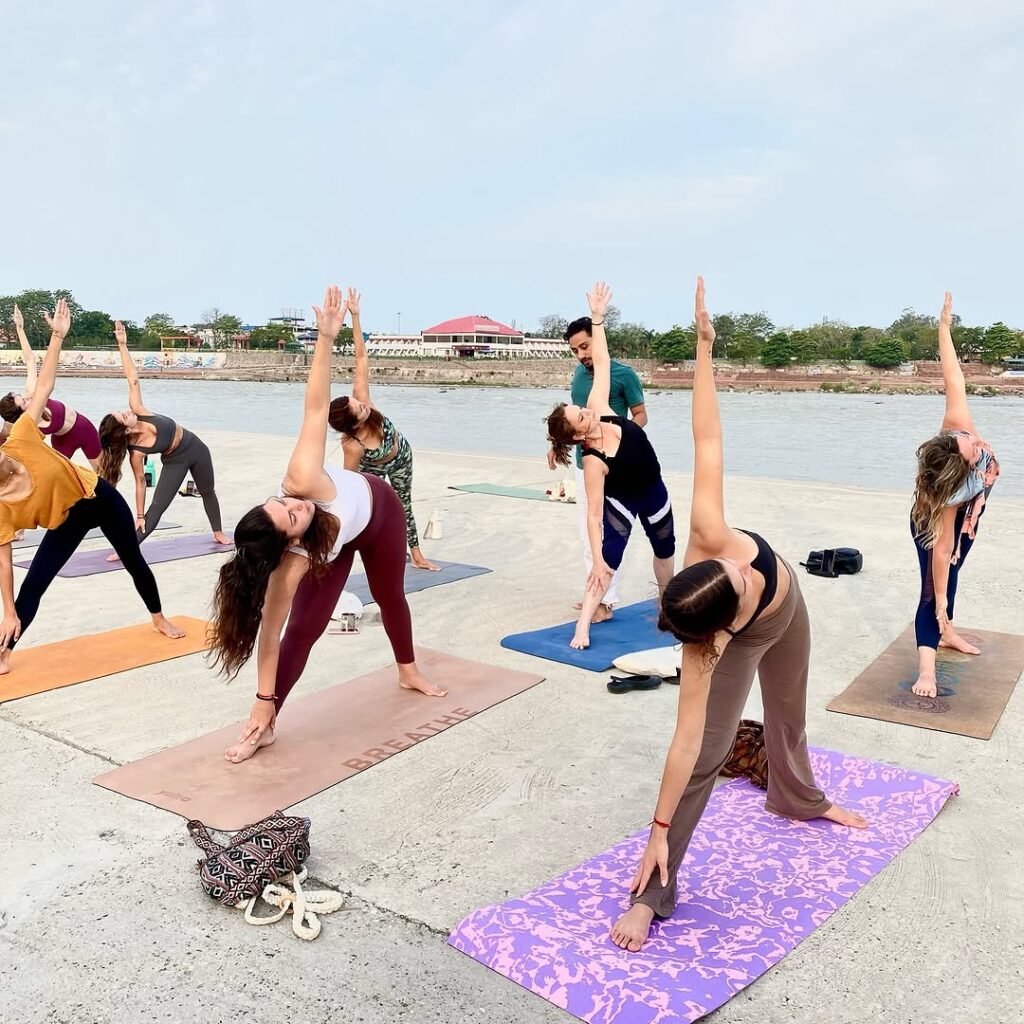
These yoga asanas are also practised and studied in depth during Yoga Instructor Teacher Training in Rishikesh, helping students develop proper alignment, adjustment, modification, sequencing, and teaching skills.
A Simple 4-Week Beginner Plan
Twenty to thirty-five minutes a day can be a practical starting point. With consistent practice, you may gradually notice improvements in strength, mobility, energy, and overall fitness.
| Day | Practice | Time |
|---|---|---|
| Monday | 8 rounds Surya Namaskar + Warrior II, Side Angle, Triangle | 25 min |
| Tuesday | Core day: Plank, Side Plank, Boat, Bridge — 3 rounds each | 20 min |
| Wednesday | Gentle Hatha or a walk | 30 min |
| Thursday | 10 rounds Surya Namaskar + Chair Pose, Downward Dog | 25 min |
| Friday | Strength: bodyweight squats, push-ups, rows — or the gym | 30 min |
| Saturday | Longer Vinyasa flow (a class or a video) | 35–45 min |
| Sunday | Yin or Restorative + 10 minutes of breathing | 25 min |
Then progress like this:
- Weeks 1–2: Learn the shapes. Hold each pose 20–30 seconds. Do not rush.
- Weeks 3–4: Add rounds of Surya Namaskar. Hold poses 45–60 seconds.
- Week 5 onward: Add a second strength day, or move to Power Yoga twice a week.
Practise in the morning on an empty stomach if you can. If not, leave 3 hours after a full meal and 1 hour after a snack. The best time is the time you will actually show up.
What to Eat
You cannot out-practise a poor diet. Here is the honest version, kept simple.
- Sustainable weight loss generally involves creating an appropriate energy deficit over time. The right calorie intake varies from person to person based on factors such as age, body size, activity level, and health.
- Protein protects your muscle. Aim for protein at every meal — dal, paneer, curd, eggs, tofu, beans, fish. Adequate protein can help support muscle maintenance while you are working toward weight loss, particularly when combined with resistance or strength-based exercise.
- Eat mostly whole food. Vegetables, fruit, whole grains, legumes. Not because they are “yogic,” but because they fill you up for fewer calories.
- Drink water. Two to three litres a day. Thirst is very often mistaken for hunger.
- Slow down at meals. This is where yoga genuinely transfers. Put the phone away. Chew properly. Stop at comfortably full, not stuffed. It sounds small. It is not.
Skip the detox teas, the fat-burner powders, and the “yogic cleanse” plans. None of them work, and some are harmful.
Yoga or Gym?
Many articles tell you to pick yoga over the gym. That is not good advice.
Strength training is one of the most effective things you can do for body composition. It builds and protects muscle while you lose fat. Yoga builds strength too, but a barbell or a set of dumbbells does it faster.
Yoga can support flexibility, mobility, body awareness, stress management, and recovery.
The best answer for most people: yoga four or five days a week, plus two short strength sessions. Twenty minutes of squats, push-ups, and rows twice a week is enough to make a real difference.
If you truly cannot get to a gym, that is fine. Power Yoga and Ashtanga, done consistently, will build meaningful strength on their own.
| Yoga | Gym/strength training | |
|---|---|---|
| Calories per hour | 150–500 depending on style | 300–500 |
| Builds muscle | Yes, moderately | Yes, faster |
| Lowers stress | Very well | Somewhat |
| Improves sleep | Yes | Yes, if not too late |
| Flexibility | Excellent | Limited |
| Cost | Very low | Membership needed |
| How many people stick with it | High | Lower |
How Long Before You See Results?
| Timeframe | What to expect |
|---|---|
| Week 1–2 | You may notice improved awareness, mobility or mood. |
| Week 3–4 | Poses may begin to feel more comfortable and controlled. |
| Month 2–3 | Consistent practice may contribute to improvements in strength, fitness and body composition. |
| Month 4–6 | Continued practice, combined with appropriate nutrition and physical activity, may support longer-term changes. |
Be careful with the scale. Muscle is denser than fat. In the first two months you can lose fat, look better, and see the scale barely move. Use a tape measure around your waist and how your clothes fit. Those tell the truth more often than the number.
Who Should Be Careful?
| Situation | What to do |
|---|---|
| High blood pressure | Avoid long overhead holds and inversions. Keep hands at heart level. Get medical clearance |
| Heart condition | Get clearance before fast flows or hot yoga |
| Knee or hip injury | Avoid deep Chair Pose and long Warrior holds. Use a chair or wall |
| Wrist pain or carpal tunnel | Do Plank on your forearms. Reduce Downward Dog time |
| Neck problems | Avoid Shoulderstand, Plow and Headstand entirely |
| Pregnancy | Avoid deep core work, belly-down poses and hot yoga. Work with a prenatal teacher |
| Very high body weight or new to exercise | Start with gentle Hatha and walking. Build up over 4–6 weeks before flowing |
| Diabetes on medication | Practise after eating, not fasted, unless your doctor advises otherwise |
Why Shoulderstand and Plow are not on our list: many weight-loss articles recommend them and claim they “boost metabolism” or “stimulate the thyroid.” They do not. They are advanced postures that require appropriate preparation, alignment, and supervision, particularly for beginners. They are advanced postures that need a teacher present. They do not belong in a beginner weight-loss routine.
Medical disclaimer: This is general information, not medical advice. If you have any health condition, are pregnant, are on medication, or are starting exercise after a long break, speak to your doctor before you begin.
The Bottom Line
Yoga can be a useful part of a healthy weight-management routine. It is unlikely to produce rapid results on its own, but regular practice can contribute to physical activity, strength, mobility, stress management, and healthier habits.
What it will do is give you a practice you can keep for the rest of your life, one that builds strength, calms your mind, helps you sleep, and slowly changes how you eat without you having to force it. Over a year, that beats any six-week programme.
Start with fifteen minutes tomorrow morning. Five rounds of Surya Namaskar and three long holds. Then do it again the next day. That is genuinely the whole method.
Want to go deeper? Our 200 Hour Yoga Teacher Training in Rishikesh covers asana, anatomy, yogic diet and sequencing, for people who want to understand the practice properly, whether or not they plan to teach.
Frequently Asked Questions
Can you lose weight with yoga alone?
Yoga can contribute to weight loss, but the results vary from person to person. Sustainable weight management usually involves a combination of physical activity, appropriate nutrition, sleep, and other lifestyle factors.
How many calories does one hour of yoga burn?
Roughly 150–250 for gentle Hatha and 350–500 for Vinyasa, Power Yoga or Ashtanga, for a 70 kg adult. Heavier bodies burn more. These are estimates, not exact figures.
Which yoga is best for weight loss?
Power Yoga, Ashtanga and Vinyasa Flow. They keep you moving continuously, which raises your heart rate and builds strength. Add one gentle or Yin session each week for recovery.
How many days a week should I do yoga to lose weight?
Four to six days. Aim for three active sessions of 30–45 minutes, one or two strength sessions, and one gentle day. Rest at least one day a week.
How long does it take to lose weight with yoga?
There is no fixed timeline because weight change depends on factors such as nutrition, activity level, sleep, starting weight, genetics, and consistency. Focus on sustainable habits rather than expecting a specific result within a set number of weeks.
Does yoga reduce belly fat?
Yoga cannot specifically target belly fat. Overall fat loss occurs across the body and depends on factors such as nutrition, physical activity, genetics, and energy balance. Yoga can be one component of an active lifestyle.
Is yoga better than the gym for weight loss?
Neither is better on its own. The gym builds muscle faster. Yoga is better for stress, sleep, flexibility, and long-term consistency. The best results come from doing both.
Can I lose weight doing only Surya Namaskar?
It is a genuinely good workout. Twelve rounds burn roughly 150–200 calories and work your whole body. But doing only Surya Namaskar every day will stop producing results after a few months. Add strength work and vary your practice.
Is hot yoga better for weight loss?
No. You sweat far more, so the scale drops after class — but that is water, and it returns as soon as you drink. Hot yoga is a good workout. It is not a better fat-loss tool than regular Vinyasa.
Should I do yoga on an empty stomach?
Morning practice on an empty stomach is traditional and comfortable for most people. Otherwise, leave 3 hours after a full meal, or 1 hour after a light snack. If you feel dizzy or weak, eat a banana first.
Does yoga speed up metabolism?
Only indirectly, by building muscle. More muscle means slightly higher energy use at rest. Claims that specific poses “boost metabolism” or “stimulate the thyroid” are not supported by evidence.
Can beginners and overweight people do these poses?
Yes. Start with gentle Hatha, use a chair or wall, and drop your knees in Plank. Build up over 4–6 weeks before moving to faster flows. Every pose above has a modification.
This article is for general information and is not medical advice. If you have a respiratory or heart condition, are pregnant, or are unsure whether these practices suit you, please speak to your doctor before beginning.

 +91-8433225327,
 Rishikul Yogshala Rishikesh, Narayan Kunj, Jonk Village, Ram Jhula, Swarg Ashram, Rishikesh, Uttarakhand 249304
 By Airway
 By Railway
 By Bus/Cabs