








Virabhadrasana I (Warrior Pose I): A Gentle Guide to Steps, Benefits, and Variations
Table of Contents
- Virabhadrasana at a Glance
- What is Virabhadrasana?
- Warrior I, II and III: What’s the Difference?
- How to Prepare for Virabhadrasana?
- Virabhadrasana Steps: How to Do Warrior Pose I
- Common Mistakes in Warrior I and How to Fix Them
- The Best Time to Practise Virabhadrasana
- 8 Benefits of Virabhadrasana (Warrior Pose I)
- What Muscles Does Virabhadrasana Work?
- Advised Practice
- Contraindications and Precautions for Virabhadrasana
- Virabhadrasana During Pregnancy
- Not a Contraindication: Breath Awareness
- Conclusion
- Frequently Asked Questions
- What is the benefit of Veerabhadra asana?
- What is the Veerbhadrasana series?
- What are the steps of Virabhadrasana?
- How long should you hold Warrior I?
- Is Warrior I good for beginners?
- Why do my hips not square forward in Warrior I?
- What is the difference between Warrior I and Crescent Lunge?
Warriors in most cultures stand for steady strength rather than aggression, and that is exactly the quality Virabhadrasana asks for. It is a standing pose that works the legs hard, opens the chest, and quietly tests whether your breath can stay slow while your body is under load.
In our yoga instructor courses at Rishikul Yogshala in Rishikesh, Warrior I is usually the pose where students first notice the gap between doing a shape and holding a shape. The legs are willing. The breath is what gives out. That is the real practice here.
This guide covers what Virabhadrasana is, how to prepare for it, the full step-by-step method, its eight main benefits, the mistakes we correct most often, and who should be careful with it.
Virabhadrasana at a Glance
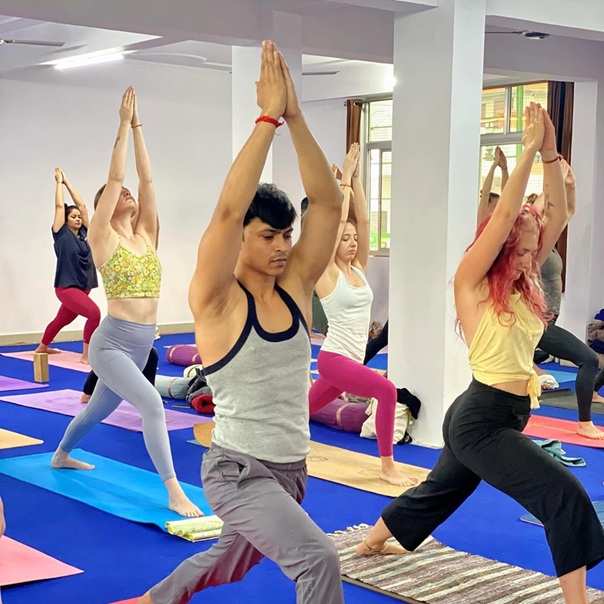
Virabhadrasana, or Warrior Pose, is a family of three standing yoga postures that build strength in the legs, hips, and shoulders while training balance and steady breathing. The name comes from the Sanskrit vira (warrior), bhadra (auspicious or good) and asana (pose), after Virabhadra, the fierce warrior Shiva created from a lock of his own hair. This guide covers Virabhadrasana I, the first and most commonly taught of the three.
| Sanskrit name | Virabhadrasana I (वीरभद्रासन) |
| Pronunciation | veer-ah-bah-DRAHS-anna |
| Also spelled | Veerbhadrasana, Virbhadrasana |
| English name | Warrior Pose I, Warrior 1 |
| Pose type | Standing, strengthening, mild backbend |
| Level | Beginner to intermediate |
| Hold time | 30 seconds to 1 minute per side; 3–4 rounds |
| Best time | Early morning, on an empty stomach |
| Preparatory poses | Surya Namaskar, Malasana, Ashta Chandrasana, Utthita Ashwa Sanchalanasana |
| Counter poses | Uttanasana, Balasana, Adho Mukha Svanasana |
| Main muscles worked | Quadriceps, glutes, hamstrings, hip flexors, calves, shoulders, upper back |
| Avoid if you have | Recent hip, knee, back or shoulder surgery; spinal disorders; balance problems; high blood pressure (arms overhead) |
What is Virabhadrasana?
Virabhadrasana, commonly called the Warrior Pose, is a group of standing asanas in modern yoga. It takes its name from Virabhadra, the warrior Shiva created to confront Daksha, the father of Sati.
Veerbhadrasana is not only about physical power. It asks you to stand firm, to stay stable when things are difficult, and to keep some steadiness of mind while the legs are burning. That is the part of the pose that carries over into ordinary life.
Virabhadrasana has three forms:
- Virabhadrasana 1
- Virabhadrasana 2
- Virabhadrasana 3
Unlike poses that chase flexibility, the Warrior series is built around balance, alignment, and stability. It asks you to anchor the body and stay present rather than to go deeper.
Warrior I, II and III: What’s the Difference?
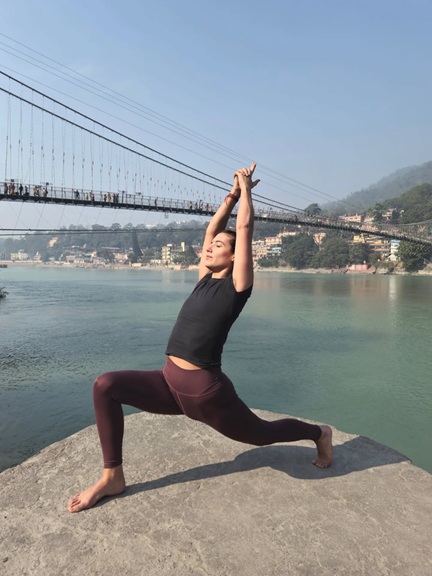
The three Warrior poses differ mainly in hip position and arm placement: Warrior I squares the hips forward with arms overhead, Warrior II opens the hips to the side with arms extended horizontally, and Warrior III balances on one leg with the body horizontal. They are often practised as a sequence, moving from I to II to III.
| Warrior I | Warrior II | Warrior III | |
|---|---|---|---|
| Hips | Square to the front | Open to the side | Square to the floor |
| Arms | Overhead, palms facing | Extended front and back | Forward or alongside body |
| Gaze (drishti) | Forward or up at thumbs | Over the front hand | Down at the floor |
| Back foot | Turned in 45–60° | Turned in 90° | Lifted off the floor |
| Main challenge | Hip and shoulder mobility | Leg endurance | Balance and core control |
| Difficulty | Beginner–intermediate | Beginner | Intermediate–advanced |
Learn Warrior I first. It teaches the grounding through the back foot that the other two depend on.
How to Prepare for Virabhadrasana?
Warrior I is a standing balance as much as a strength pose, so the legs need warming and the hips and shoulders need to be awake before you start. These four are what we use in class:
- Surya Namaskar – general warmth and body awareness through the whole system
- Malasana – opens the hip flexors and ankles, which Warrior I depends on
- Utthita Ashwa Sanchalanasana (Low Lunge Vinyasa) – moving in and out of the lunge dynamically eases the knees and hamstrings before you hold a static shape
- Ashta Chandrasana (Crescent Lunge) – both a preparation and a natural transition into Warrior I
Five to ten minutes of this is enough. Going straight into Warrior I from a cold body is how the front knee ends up taking strain that belongs in the thigh.
Virabhadrasana Steps: How to Do Warrior Pose I
- Stand tall at the front of your mat with the feet hip-width apart and the arms relaxed at your sides. Take a few slow, even breaths and let the mind settle.
- Step the feet wide apart, roughly three to four feet, into a long stance.
- Turn the right foot out to 90 degrees so the toes point to the short edge of the mat, and turn the left foot in to about 45 degrees. Keep the back leg straight and strong.
- Line up the right heel with the arch of the left foot. Then turn the hips and chest to face the right, over the front leg.
- Inhale and raise the arms overhead, shoulder-width apart, palms facing each other. Let the shoulder blades widen and lift slightly. Gaze forward. If your shoulders allow it comfortably, bring the palms together and look up at the thumbs.
- Exhale and bend the right knee until the right thigh moves toward parallel with the floor. You should feel the work in the front thigh and the stretch across the back hip.
- Stack the right knee directly above the right ankle. Do not let it travel past the toes. Keep the outer edge of the back foot pressing down and the back leg straight.
- Hold for five to ten breaths. If it feels stable, lengthen the spine and allow a small lift through the chest. Keep the lower ribs drawing in rather than flaring.
- Inhale to straighten the front knee. Exhale and lower the arms.
- Repeat on the other side, holding for the same length of time.
Common Mistakes in Warrior I and How to Fix Them
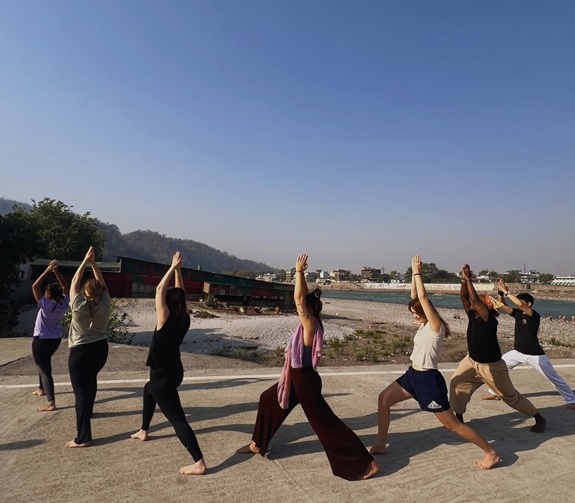
These are the four corrections we give most often on the mat.
| Mistake | Why it’s a problem | The fix |
|---|---|---|
| Front knee drifting past the ankle | Shifts load from the thigh into the knee joint | Shorten your stance or bend less deeply until the knee stacks over the ankle |
| Front knee collapsing inward | Twists the knee against its hinge | Point the knee toward the second and third toes; press the big toe mound down |
| Back heel lifting off the floor | Loses the ground the whole pose is built on | Turn the back foot in more, or shorten the stance |
| Ribs flaring and lower back compressing | Turns a mild chest opening into a lumbar crunch | Draw the lower ribs in and lift through the sternum, not the front ribs |
One more: many students force the hips to square forward and end up straining the back hip. Some hip rotation is normal in Warrior I. Aim for the hips to face forward, but let anatomy have the final say.
The Best Time to Practise Virabhadrasana
Early morning is the best time to practise Virabhadrasana. The body is rested, the mind is not yet cluttered, and standing poses feel more available. Evening practice works too, as long as your stomach is empty. Leave three to four hours after a full meal.
How long to hold: beginners should hold for 30 seconds to 1 minute per side, then build gradually. Three to four rounds per session is enough.
Read More – Virabhadrasana 2 (Warrior II Pose): Benefits, Steps, Key Tips & Contraindications
8 Benefits of Virabhadrasana (Warrior Pose I)
Virabhadrasana I strengthens the legs and glutes, opens the chest and shoulders, improves posture and balance, and builds the kind of focus that comes from holding a demanding shape while breathing calmly. Practised regularly, it is one of the most complete standing poses in Hatha Yoga.
1. Strengthens and stretches. The bent front leg works the quadriceps, glutes, hamstrings and inner thighs, while the back leg and hip flexors get a long stretch. Few poses load and lengthen this evenly.
2. Opens the chest and diaphragm. Lifting the arms overhead expands the chest and gives the diaphragm more room. Holding that while breathing steadily is what makes the pose feel harder than it looks.
3. Supports the lungs and nasal passages. The slow, aware breathing the pose demands encourages fuller gas exchange and better air circulation, which many practitioners find helps keep the nasal passages clearer.
4. Builds focus and awareness. The pose is named after a warrior for a reason. Staying in it develops resilience, stamina and a steadier kind of self-confidence.
5. Improves mobility. Regular practice increases hip flexibility and strengthens the legs, ankles and feet. That mobility becomes the foundation for more advanced standing and balancing poses later.
6. Teaches posture and alignment. Warrior I is one of the best poses for learning how knee and ankle alignment actually work. Where you place the back foot changes the stability of the whole pose and how far the pelvis can turn.
7. Energising and releasing. Extending the arms overhead shares the stretch through the shoulders and neck, easing the stiffness that builds up there. Most people come out of the pose feeling lighter than they went in.
8. Steadies balance and emotions. Holding the pose forces attention onto the breath and onto muscles you do not normally notice. That shift is what quiets mental chatter, and it is why Warrior I often appears near the start of a class.
Note: yoga is widely reported to support strength, posture, mobility and stress levels. Virabhadrasana is not a treatment for any medical condition. Treat these as the benefits of a consistent practice, not as medical outcomes.
What Muscles Does Virabhadrasana Work?
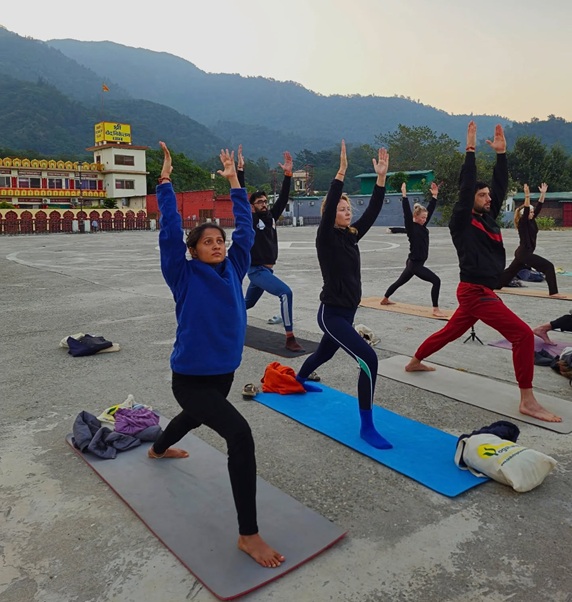
Warrior I strengthens the quadriceps, glutes, hamstrings and calves of the front leg while stretching the hip flexors, psoas and calf of the back leg. The shoulders, upper back and core work to hold the arms overhead with a lifted chest.
Strengthened: quadriceps, gluteus maximus and medius, hamstrings, calves, deltoids, trapezius, core stabilisers.
Stretched: hip flexors and psoas of the back leg, back calf and Achilles, chest and front shoulders, abdomen.
Advised Practice
- Repeat the pose for 3–4 rounds per session, taking breaks as needed.
- If you are new to it, hold for around 1 minute per side, increasing the time as the pose becomes comfortable.
- Come out gently the moment you feel discomfort, numbness or shaking that you cannot breathe through.
- Follow it with Uttanasana, Balasana or Adho Mukha Svanasana to release the legs and lower back.
Contraindications and Precautions for Virabhadrasana
Virabhadrasana should be approached carefully by anyone with a spinal disorder, recent hip, knee, back or shoulder surgery, or balance difficulties. It is a familiar pose, which sometimes makes people assume it is a gentle one. Held properly, it is demanding.
1. Spinal disorders or recent chronic illness. Avoid the pose if you have a spinal condition or are recovering from a chronic illness. If you want to include it, practise only with your doctor’s clearance and under an instructor’s eye.
2. Injury or recent surgery. Anyone who has recently had hip, knee, back or shoulder surgery, or who has balance difficulties, should wait for their physician’s permission.
3. Digestive upset. Avoid Virabhadrasana if you are recovering from diarrhoea or acute stomach trouble.
4. High blood pressure, shoulder or neck problems. Keep the arms at shoulder height or on the hips instead of overhead, and do not look up at the thumbs.
5. Knee pain. Shorten the stance and bend the front knee less. Never allow the knee to travel past the ankle.
Virabhadrasana During Pregnancy
Virabhadrasana can be practised during pregnancy only by those who already had an established practice before becoming pregnant, and only under a qualified prenatal yoga teacher. Do not begin Warrior I for the first time while pregnant.
If you are practising it:
- Take a shorter, wider stance for a stable base
- Use a wall or chair for support
- Keep the arms at shoulder height rather than overhead if you feel any dizziness
- Avoid the backbend element entirely
- Stop at any point you feel breathless, unsteady or compressed
Always consult your doctor or midwife before practising yoga during pregnancy.
Not a Contraindication: Breath Awareness
The original list included “insufficiency of body-breath connection” as a reason to avoid the pose. It is not a medical contraindication. It is simply the skill Warrior I develops. If your breath falls apart in the pose, hold it for less time rather than skipping it.
This article is educational and does not constitute medical advice. If you have any medical condition, consult a qualified healthcare professional before practising Virabhadrasana.
Read More – Virabhadrasana 3 (Warrior III Pose): Benefits, Steps, Key Tips & Contraindications
Conclusion
Virabhadrasana is one of those poses that gives back more the longer you stay with it. It builds strength through the legs, opens the chest, improves how you stand and walk, and teaches something harder to name: how to stay steady when the body is working, and the mind wants to leave.
Learn it properly before making it a daily habit. Almost every problem we see with Warrior I comes from a stance that is too long or a knee that has drifted forward, and both are easy to correct with an experienced eye on you.
If this pose has made you curious about the anatomy and alignment behind the asanas, that curiosity is usually where a deeper practice begins. A structured yoga instructor certification is where a personal practice turns into real understanding, and where you learn not only to hold a pose but to teach it safely to someone else. At Rishikul Yogshala Rishikesh, on the banks of the Ganga, our Yoga Alliance-certified 200 Hour Yoga Teacher Training in Rishikesh is built for exactly that step.
Frequently Asked Questions
What is the benefit of Veerabhadra asana?
Virabhadrasana strengthens and tones the arms, legs, hips and lower back, opens the chest and shoulders, and improves posture and balance. Practised regularly, it also builds stamina and focus, and many practitioners find it eases the mental restlessness they arrive on the mat with.
What is the Veerbhadrasana series?
Virabhadrasana is a series of three standing warrior poses: Virabhadrasana 1, Virabhadrasana 2 and Virabhadrasana 3. Each has its own stance, arm position and emphasis. They are frequently taught as a flowing sequence, moving from Warrior I through Warrior II into Warrior III.
What are the steps of Virabhadrasana?
Step the feet three to four feet apart, turn the front foot out 90 degrees and the back foot in 45 degrees, and square the hips forward. Inhale and lift the arms overhead, palms facing each other. Exhale and bend the front knee until it stacks over the ankle. Hold for five to ten breaths, then repeat on the other side.
How long should you hold Warrior I?
Beginners should hold Virabhadrasana I for 30 seconds to 1 minute on each side, for three to four rounds. As strength and breath control improve, the hold can extend to 1–2 minutes. Quality of alignment matters far more than duration.
Is Warrior I good for beginners?
Yes. Virabhadrasana I is one of the most beginner-friendly standing poses, provided the stance is shortened and the front knee stays over the ankle. Beginners with tight shoulders should keep the arms shoulder-width apart rather than pressing the palms together overhead.
Why do my hips not square forward in Warrior I?
Because the back foot is turned in and the leg is straight, most bodies cannot fully square the hips in Warrior I. Aim the hips forward without forcing them. If you feel strain in the back hip or lower back, turn the back foot in slightly more or shorten the stance.
What is the difference between Warrior I and Crescent Lunge?
In Warrior I, the back heel is grounded, and the back foot is turned in at an angle. In Ashta Chandrasana (Crescent Lunge), the back heel stays lifted with the toes pointing forward. Crescent Lunge is often easier on the hips, which is why it is commonly taught as a preparation for Warrior I.
This article is for general information and is not medical advice. If you have a respiratory or heart condition, are pregnant, or are unsure whether these practices suit you, please speak to your doctor before beginning.

 +91-8433225327,
 Rishikul Yogshala Rishikesh, Narayan Kunj, Jonk Village, Ram Jhula, Swarg Ashram, Rishikesh, Uttarakhand 249304
 By Airway
 By Railway
 By Bus/Cabs