








Anulom Vilom Pranayama: Benefits, Steps, Precautions & How to Practice
Table of Contents
- What is Anulom Vilom?
- How to Do Anulom Vilom: Step-by-Step
- Where To Sit and How?
- Which Hand and Which Fingers To Use?
- The Seven Steps
- The Breath Ratio For Beginners
- Five Common Mistakes
- What is the Best Time to Do Anulom Vilom?
- Can You Do Anulom Vilom After Eating?
- How Long Should You Practise Anulom Vilom?
- What Happens If You Practise Anulom Vilom for One Hour?
- Anulom Vilom Benefits: What the Evidence Actually Shows?
- 1. For Stress and Anxiety
- 2. For the Lungs and Breathing
- 3. For Blood Pressure and the Heart
- 4. For Sleep and Snoring
- 5. For Focus and Concentration
- 6. For Digestion
- 7. For Weight Loss
- 8. For the Skin
- 9. For the Eyes
- 10. For Men and for Women
- Side Effects and Who Should Avoid It
- Normal Sensations When Starting
- Stop Immediately If You Experience
- Who Should Speak to a Yoga Teacher or Doctor First
- The One Rule That Matters Most
- Anulom Vilom vs Nadi Shodhana
- अनुलोम विलोम प्राणायाम
- Final Takeaway
- Frequently Asked Questions
- What is Anulom Vilom in simple words?
- Which hand and fingers should I use for Anulom Vilom?
- Can I do Anulom Vilom after eating?
- How many minutes of Anulom Vilom should I do daily?
- Can I do Anulom Vilom at night or before sleeping?
- Is Anulom Vilom the same as Nadi Shodhana?
- Can Anulom Vilom be done during pregnancy?
- Does Anulom Vilom help with weight loss?
- What are the side effects of Anulom Vilom?
- Can Anulom Vilom be done lying down?
Anulom Vilom is usually the first pranayama a beginner is taught, and there is a good reason for that. You sit, close one nostril, breathe in, close the other, breathe out. There is nothing to force and nothing to hold. Within a few rounds most people notice the breath settling into a rhythm of its own.
It is also one of the most misexplained practices online. A lot of guides quietly teach you to hold the breath, which turns it into a different and more advanced practice altogether. This guide covers the technique as it is actually taught — the hand position, the ratio, how long to sit, what it does and does not do, and who should check with a teacher before starting.
What is Anulom Vilom?
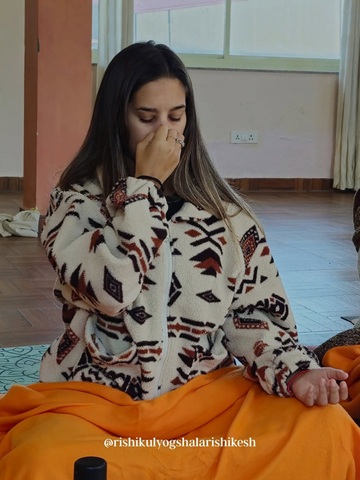
Anulom Vilom is a breathing practice in which you inhale through one nostril and exhale through the other, alternating sides, using your fingers to close each nostril in turn. In Sanskrit, anuloma means “with the natural order,” and viloma means “against” it. In English, it is called alternate nostril breathing. It is practised without breath retention, which is what makes it suitable for beginners.
The practice appears across the classical yogic texts, the Hatha Yoga Pradipika, the Gheranda Samhita, the Shiva Samhita and the Puranas, where alternate-nostril breathing is described as a preparation for deeper pranayama rather than an end in itself. In yogic tradition, pranayama is attributed to Shiva; that is a devotional account rather than a datable historical one, and it is worth keeping the two apart.
There is also a physiological detail worth knowing. In most healthy people, airflow is not equal through both nostrils at any given moment. One side dominates, then the other takes over, cycling roughly every couple of hours. Physiologists call this the nasal cycle, and it was formally described in the nineteenth century. Yogic texts had mapped the same alternation much earlier through the language of ida and pingala. Anulom Vilom works directly with that alternation.
Related Reading:Why Breath Matters in Yoga
How to Do Anulom Vilom: Step-by-Step
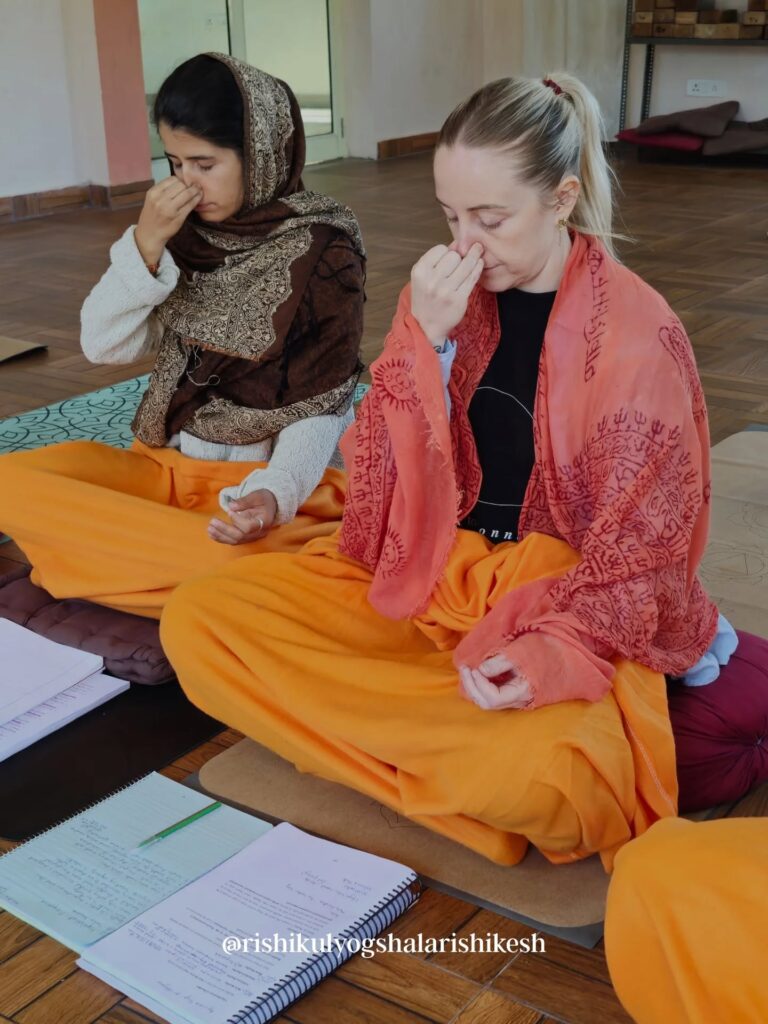
Sit upright, rest your left hand on your knee, and bring your right hand to your nose in Nasagra mudra. Close your right nostril with the thumb and inhale through the left. Close the left with your ring and little fingers, release the thumb, and exhale through the right. Inhale right, then exhale left. That is one full round. There is no breath holding at any point.
Where To Sit and How?
Choose Sukhasana, Padmasana, or Vajrasana, or a firm chair with both feet flat on the floor, if sitting cross-legged is uncomfortable. The only requirements are an upright spine, relaxed shoulders, and a position you can hold without fidgeting for a few minutes.
Close your eyes. Let the breath settle on its own for thirty seconds before you begin. Rest the left hand on the left knee, palm up, in Gyan mudra if you like.
Which Hand and Which Fingers To Use?
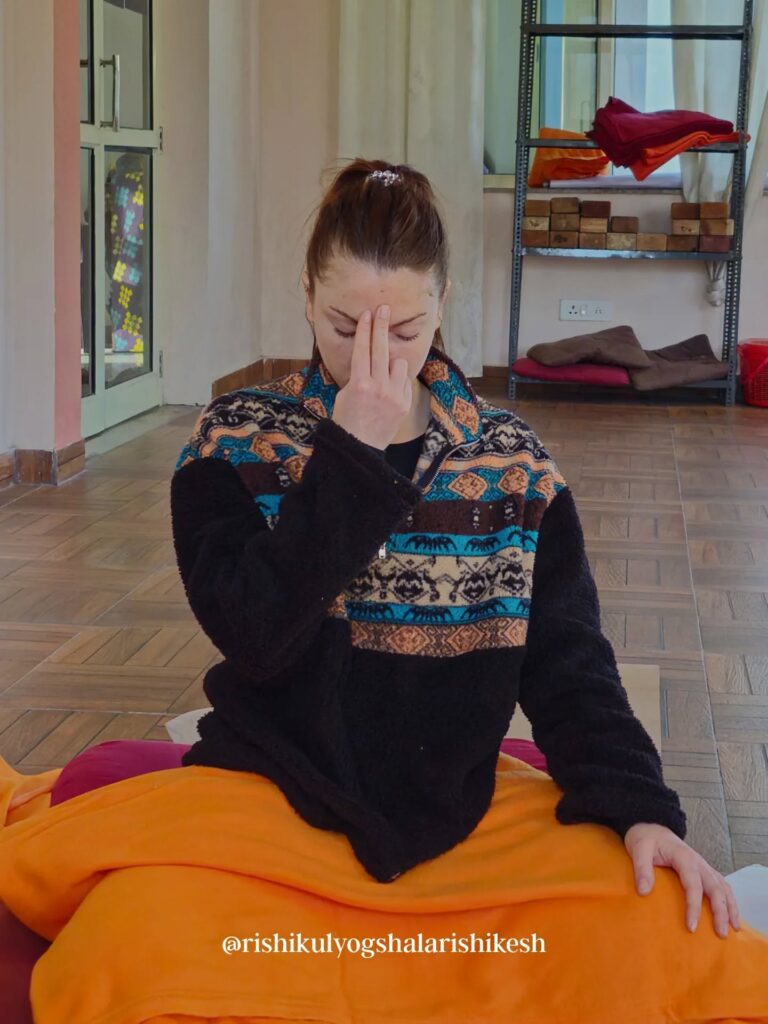
Use the right hand, regardless of whether you are right- or left-handed.
- Fold the index and middle fingers in toward the palm (or rest them lightly between the eyebrows)
- The thumb closes the right nostril
- The ring and little fingers close the left nostril
This hand position is called Nasagra mudra, sometimes Vishnu mudra. Pressure should be light — enough to close the airway, not enough to push the nose out of shape or leave a mark.
The Seven Steps
- Sit upright and close your eyes. Bring the right hand into Nasagra mudra.
- Close the right nostril with your thumb. Inhale slowly through the left nostril.
- Close the left nostril with your ring and little fingers, and release the thumb.
- Exhale slowly and completely through the right nostril.
- Keeping the left closed, inhale through the right nostril.
- Close the right with the thumb, release the left, and exhale through the left.
- That completes one round. Continue for the number of rounds or minutes you have chosen.
The breath should be quiet. If you can hear it, you are pulling too hard.
The Breath Ratio For Beginners
Start with an even count: inhale for 4, exhale for 4. Once that feels effortless, lengthen the exhale rather than the inhale: inhale 4, exhale 6, and later 4 and 8. A longer exhale is what makes the practice calming.
Do not add breath retention. Holding the breath after the inhale turns this into Nadi Shodhana, which is a more advanced practice with its own precautions. If you want to work with retention, learn it with a teacher watching you.
Five Common Mistakes
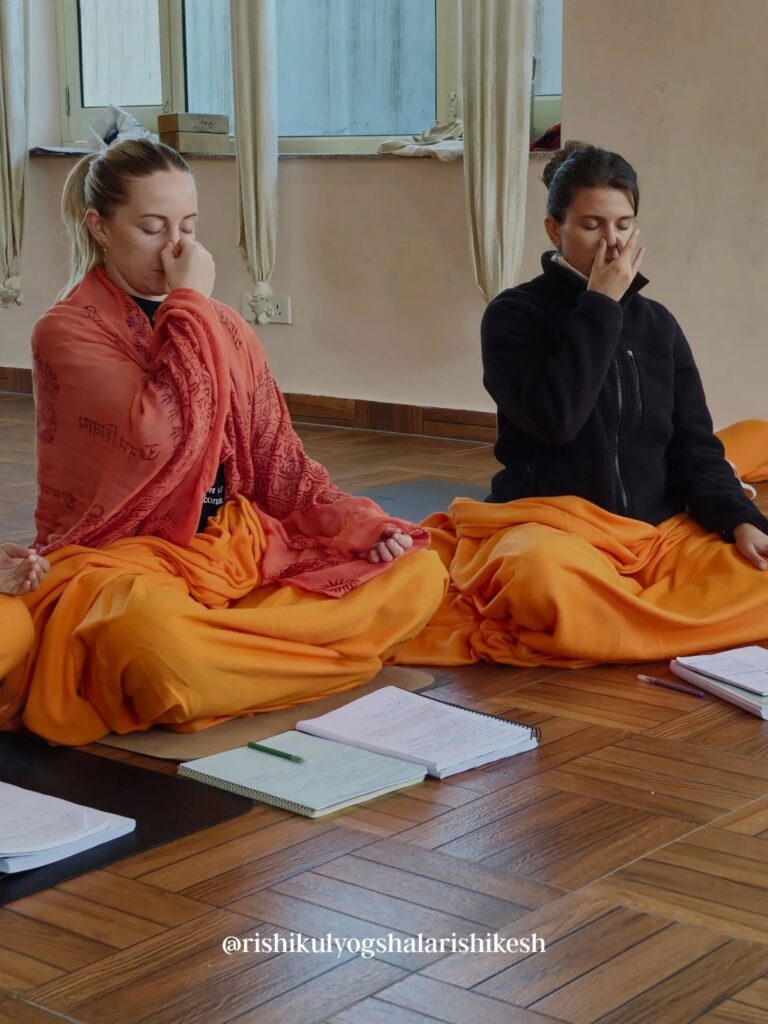
- Holding the breath. The most frequent error, and the one that changes the practice entirely.
- Pressing too hard on the nostril. Light contact is enough.
- Breathing into the chest. The belly and lower ribs should move; the shoulders should not lift.
- Practising on a full stomach. See timing below.
- Starting too long. Five minutes done well beats twenty minutes forced.
What is the Best Time to Do Anulom Vilom?
Early morning on an empty stomach is the traditional and most effective time to practise Anulom Vilom. Evening before dinner works well too. Because the practice is calming rather than stimulating, it is also safe at night — many people find it helps them fall asleep.
- Morning — the air is fresher, the stomach is empty, and the mind has not yet filled with the day. Practising before your asana session or before work sets a steadier baseline.
- Evening — practised before dinner, it helps unwind the nervous system after a working day.
- Night — unlike Kapalbhati or Bhastrika, Anulom Vilom does not energise you. Practising it in bed, even lying down, is a reasonable way to settle a busy mind before sleep.
Can You Do Anulom Vilom After Eating?
Wait two to three hours after a full meal. After something light, fruit, tea, a small snack, thirty to sixty minutes is enough. Practising on a full stomach makes diaphragmatic breathing physically harder and can cause discomfort, nausea, or reflux.
This applies to any pranayama, not just Anulom Vilom. If you only have a short window and you have eaten recently, either wait, or sit for a shorter, gentler practice without lengthening the breath.
The same rule covers tea, coffee and water: liquids are fine shortly before practice, but a heavy meal needs the full gap. Practising Anulom Vilom immediately after food is the most common reason beginners feel nauseous mid-session.
How Long Should You Practise Anulom Vilom?
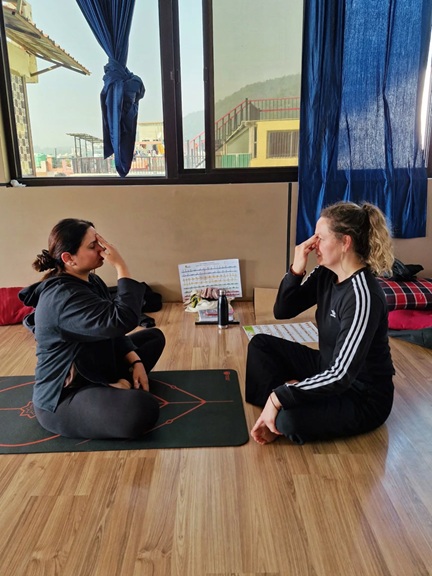
Five minutes a day is enough to begin. Most regular practitioners settle at ten to fifteen minutes. Longer sessions are an advanced practice, built up gradually over months — not something to attempt in the first week.
| Stage | Duration | Ratio | Rounds (approx.) |
|---|---|---|---|
| First week | 3–5 minutes | 4:4 | 10–15 |
| Weeks 2–4 | 5–10 minutes | 4:4 → 4:6 | 15–30 |
| Regular practice | 10–15 minutes | 4:6 | 30–50 |
| Experienced | 20–30 minutes | 4:6 → 4:8 | 50+ |
Consistency does more than duration. Ten minutes every morning will do more for you than an hour once a week.
What Happens If You Practise Anulom Vilom for One Hour?
An hour of continuous alternate nostril breathing is a serious practice, usually undertaken in a retreat or intensive setting under supervision — not a daily target for someone who started last month.
Practitioners who build up to long sessions typically report deep mental stillness and a meditative quality that shorter sittings do not reach. That is consistent with what we see in students during extended practice at the school.
It is worth being straight about the evidence, though: most published research on alternate nostril breathing uses sessions of five to thirty minutes, not sixty. Claims about what one hour specifically does are drawn from practitioner experience and tradition, not from clinical trials. Anyone telling you an hour a day produces specific medical outcomes is going beyond what has actually been measured.
If you want to work toward longer sessions, add five minutes every couple of weeks and stop the moment the breath starts to feel forced.
Anulom Vilom Benefits: What the Evidence Actually Shows?
Anulom Vilom is best supported as a practice for calming the nervous system — reducing stress and anxiety, steadying heart rate variability, and supporting better sleep. Evidence for lung function and blood pressure is promising but limited. Claims about weight loss, skin, and eyesight are traditional rather than clinically demonstrated.
We have separated these by how much support each one actually has. Most articles on this topic do not, and we think that is a mistake — the practice is good enough that it does not need overselling.
1. For Stress and Anxiety
This is the best-supported benefit. Slow, controlled breathing with a lengthened exhale shifts the autonomic nervous system toward parasympathetic activity — the “rest and digest” state. Studies on alternate nostril breathing have found measurable improvements in perceived stress and anxiety scores, and changes in heart rate variability consistent with reduced sympathetic arousal.
2. For the Lungs and Breathing
Several small trials have reported improvements in pulmonary function measures — such as peak expiratory flow — in people who practised alternate nostril breathing over a period of weeks. The studies are generally small and short, so this should be read as encouraging rather than settled.
If you have asthma or another respiratory condition, treat this as a supportive practice alongside your prescribed treatment, never as a replacement for it.
3. For Blood Pressure and the Heart
Slow breathing practices have been associated with modest reductions in blood pressure in some studies, likely through the same autonomic mechanism described above.
An important clarification: Anulom Vilom does not “purify the blood” or clear arterial blockages. That claim appears widely online and it is not physiologically accurate. If you are being treated for hypertension or heart disease, continue your medication and speak to your doctor before adding a new breathing practice.
4. For Sleep and Snoring
The calming effect makes Anulom Vilom a reasonable pre-sleep practice, and many practitioners find it shortens the time it takes to fall asleep.
On snoring specifically, the evidence is thin. Clearing nasal congestion may help some people breathe more easily at night, but snoring often has structural or weight-related causes that breathing exercises will not address. If snoring is loud, persistent, or accompanied by daytime sleepiness, get assessed for sleep apnoea rather than relying on pranayama.
5. For Focus and Concentration
Regular practice supports attention, and the practice itself is a form of attention training — you are tracking the breath continuously. Research on breathing practices and cognitive performance is mixed but broadly positive on measures of sustained attention.
6. For Digestion
Diaphragmatic breathing gently mobilises the abdominal organs and lowers stress-related tension, both of which can support digestive comfort. This is a plausible mechanism rather than a proven clinical effect.
7. For Weight Loss
Anulom Vilom does not directly cause weight loss. No pranayama burns a meaningful number of calories, and the “boosts metabolism, burns calories” claim you will find on most yoga sites is not supported.
Where it can genuinely help is indirectly and is still worth having: lower stress means lower cortisol, better sleep, and less stress-driven eating. Those are real contributors to weight management. But it works alongside diet and movement, not instead of them.
8. For the Skin
There is no direct clinical evidence that alternate nostril breathing improves skin. The traditional explanation — better oxygenation and circulation — is plausible, and better sleep and lower stress do affect skin over time. But this is a secondary effect at best, and we would not recommend taking up pranayama primarily for your complexion.
9. For the Eyes
We could not find credible evidence that Anulom Vilom improves eyesight or treats eye conditions. If you have a vision problem, see an ophthalmologist.
10. For Men and for Women
The physiological effects of Anulom Vilom are the same regardless of sex. Some sources claim sex-specific benefits; we are not aware of research supporting them. Women may find the practice particularly useful during menstruation or menopause for stress and sleep, which follows from the general calming effect rather than from anything specific to the practice.
Side Effects and Who Should Avoid It
Anulom Vilom is safe for most healthy adults when practised gently and without breath retention. Mild dizziness or tingling in the first few sessions is common and usually means you are breathing too deeply or too fast. Stop if you feel faint, breathless, or anxious.
Normal Sensations When Starting
- Light-headedness or tingling in the hands and face — usually from over-breathing. Shorten the breath and return to a natural rhythm.
- Mild restlessness — common in the first week as the nervous system adjusts.
Both should settle within a few sessions. If they do not, reduce the duration and check your technique with a teacher.
Stop Immediately If You Experience
- Sharp chest pain or palpitations
- Breathlessness that does not resolve within a minute of stopping
- Severe dizziness or feeling like you might faint
- A sudden headache
Who Should Speak to a Yoga Teacher or Doctor First
- Pregnancy — Anulom Vilom without retention is generally considered safe, but tell your obstetrician and work with a prenatal-trained teacher. Avoid any retention or forceful breathing entirely.
- Uncontrolled high or low blood pressure
- Heart conditions, including recent cardiac events
- Epilepsy or a history of seizures
- Recent abdominal, chest, eye, or ear surgery
- Active respiratory infection, severe nasal blockage, or a significantly deviated septum — if you cannot breathe freely through one nostril, do not force it
- Panic disorder — breath-focused practices occasionally trigger anxiety in some people; introduce slowly
The One Rule That Matters Most
Never force the breath. Pranayama is not an endurance exercise. If it feels like effort, you have gone past the point where it is doing you good.
Anulom Vilom vs Nadi Shodhana
The key difference is breath retention. Nadi Shodhana includes a hold (kumbhaka) after the inhale; Anulom Vilom does not. This makes Anulom Vilom the beginner practice and Nadi Shodhana the more advanced one.
| Anulom Vilom | Nadi Shodhana | |
|---|---|---|
| Breath retention | None | Kumbhaka after inhale |
| Typical ratio | 4:6 (inhale: exhale) | 4:16:8 or similar, with hold |
| Level | Beginner | Intermediate to advanced |
| Primary aim | Calming and balancing the breath | Purifying the nadis (energy channels) |
| Supervision | Can be self-taught with care | Best learned with a teacher |
In practice, the two names are often used interchangeably, including by experienced teachers, which is where most of the confusion comes from. If a guide tells you to hold the breath, it is describing Nadi Shodhana, whatever it calls it.
Surya Bhedana is sometimes confused with both. It is different again: you inhale only through the right nostril and exhale through the left, and it is warming and energising rather than balancing.
Read next:Nadi Shodhana
अनुलोम विलोम प्राणायाम
अनुलोम-विलोम एक प्राणायाम है जिसमें आप एक नासिका से सांस लेते हैं और दूसरी से छोड़ते हैं। इसमें सांस रोकनी नहीं होती, इसलिए इसे शुरुआती साधकों के लिए सिखाई जाने वाली सरल प्राणायाम तकनीकों में से एक माना जाता है।
अनुलोम विलोम कैसे करें: सीधे बैठें और आँखें बंद करें। दाहिने हाथ के अंगूठे से दाहिनी नासिका बंद करें और बाईं नासिका से धीरे-धीरे सांस लें। अब अनामिका और कनिष्ठा उंगलियों से बाईं नासिका बंद करें, अंगूठा हटाएँ और दाहिनी नासिका से सांस छोड़ें। फिर दाहिनी से सांस लें और बाईं से छोड़ें। यह एक चक्र पूरा हुआ।
मुख्य लाभ: तनाव और चिंता में कमी, बेहतर नींद, एकाग्रता में सुधार, और श्वसन तंत्र को सहारा।
सावधानियाँ: खाली पेट अभ्यास करें — भारी भोजन के 2–3 घंटे बाद। सांस को कभी ज़बरदस्ती न रोकें। गर्भावस्था, उच्च रक्तचाप, हृदय रोग या मिर्गी की स्थिति में अभ्यास शुरू करने से पहले चिकित्सक से सलाह लें।
कितनी देर करें: शुरुआत में 5 मिनट, धीरे-धीरे बढ़ाकर 10–15 मिनट प्रतिदिन।
Final Takeaway
Anulom Vilom rewards patience rather than effort. A few quiet minutes each morning, done without straining, will give you more than a long forced session ever will. Get the hand position right, keep the exhale a little longer than the inhale, and leave the breath holding for later.
If you want to go deeper into pranayama, including Nadi Shodhana, Bhastrika and Kapalbhati, and the theory behind them, that work forms a core part of the 200 Hour Yoga Teacher Training in Rishikesh at Rishikul Yogshala.
Frequently Asked Questions
What is Anulom Vilom in simple words?
Anulom Vilom is alternate nostril breathing. You close one nostril, breathe in through the other, then swap sides and breathe out. You keep alternating. There is no breath-holding, which is what makes it the usual starting point for pranayama.
Which hand and fingers should I use for Anulom Vilom?
Use your right hand regardless of which hand you write with. Fold the index and middle fingers into the palm. The thumb closes the right nostril; the ring and little fingers close the left. This is called Nasagra mudra.
Can I do Anulom Vilom after eating?
Wait two to three hours after a full meal, or thirty to sixty minutes after something light. A full stomach restricts the diaphragm and can cause nausea or reflux during practice.
How many minutes of Anulom Vilom should I do daily?
Five minutes is enough when you are starting. Ten to fifteen minutes daily suits most regular practitioners. Consistency matters more than length.
Can I do Anulom Vilom at night or before sleeping?
Yes. Anulom Vilom is calming rather than stimulating, so it works well before bed. You can even practise it lying down if sitting upright is uncomfortable at that hour.
Is Anulom Vilom the same as Nadi Shodhana?
No. Nadi Shodhana includes breath retention after the inhale; Anulom Vilom does not. The names are often used interchangeably, but the practices differ, and Nadi Shodhana is the more advanced of the two.
Can Anulom Vilom be done during pregnancy?
Generally yes, without retention and without forcing the breath — but tell your obstetrician first and work with a prenatal-trained teacher.
Does Anulom Vilom help with weight loss?
Not directly. It burns almost no calories. It can support weight management indirectly by lowering stress, improving sleep, and reducing stress-driven eating, but it works alongside diet and exercise rather than replacing them.
What are the side effects of Anulom Vilom?
Most people have none. Mild dizziness or tingling when starting usually means you are breathing too deeply — shorten the breath. Stop and seek advice if you get chest pain, palpitations, or breathlessness that does not settle.
Can Anulom Vilom be done lying down?
Anulom Vilom is traditionally practised in a comfortable seated position with an upright spine. If sitting is uncomfortable, a modified position may be used under guidance. For beginners, seated practice is generally preferable.
This article is for general information and is not medical advice. If you have a respiratory or heart condition, are pregnant, or are unsure whether these practices suit you, please speak to your doctor before beginning.

 +91-8433225327,
 Rishikul Yogshala Rishikesh, Narayan Kunj, Jonk Village, Ram Jhula, Swarg Ashram, Rishikesh, Uttarakhand 249304
 By Airway
 By Railway
 By Bus/Cabs