








Ardha Matsyendrasana (Half Lord of the Fishes Pose): Benefits, Steps, Variations & Precautions
Table of Contents
- What is Ardh Matsyendrasana?
- What Are the Benefits of Ardha Matsyendrasana?
- 1. Benefits for the spine
- 2. Benefits for the hips and shoulders
- 3. Benefits for Digestion
- 4. Benefits for the mind
- How Do You Do Ardh Matsyendrasana (Half Spinal Twist Pose)?
- How Can You Prepare For This Asana?
- Steps to do Ardh Matsyendrasana (Half Spinal Twist Pose)
- How Long Should You Hold Ardha Matsyendrasana?
- Breathing in the Pose
- How to Come out Safely
- Key Alignments in Ardha Matsyendrasana
- Props and Modifications
- Common Mistakes
- Ardh Matsyendrasana Precautions: What You Need to Know
- Ardha, Purna and Supta Matsyendrasana Compared
- What to Practise After Ardha Matsyendrasana
- Conclusion
- Frequently Asked Questions:
- How long should you hold Ardha Matsyendrasana?
- What is the difference between Ardha and Purna Matsyendrasana?
- Can beginners do Ardha Matsyendrasana?
- Who should not do Ardha Matsyendrasana?
- Is Ardha Matsyendrasana the same as Half Lord of the Fishes Pose?
- Which side should you twist first?
- What should you do if your knee hurts in this pose?
- Does Ardha Matsyendrasana help with back pain?
- When is the best time to practise Ardha Matsyendrasana?
- Is Ardha Matsyendrasana safe during pregnancy?
Ardha Matsyendrasana, or Half Lord of the Fishes Pose, is a seated spinal twist in hatha yoga. You sit with one leg crossed over the other, place one hand on the floor behind you, hook the opposite arm outside the raised knee, and turn the upper body to one side. Hold for 30 to 60 seconds on each side. It improves spine mobility, opens the hips and shoulders, and supports digestion. It is the accessible half version of Matsyendrasana and suits most beginners.
Ardha Matsyendrasana is one of the most famous variations of Matsyendrasana because of its numerous benefits. This half-twist posture will guide you through a series of bends to learn the proper technique and explore its many benefits; we can unlock its potential for improving flexibility, relieving stress, and promoting emotional clarity.
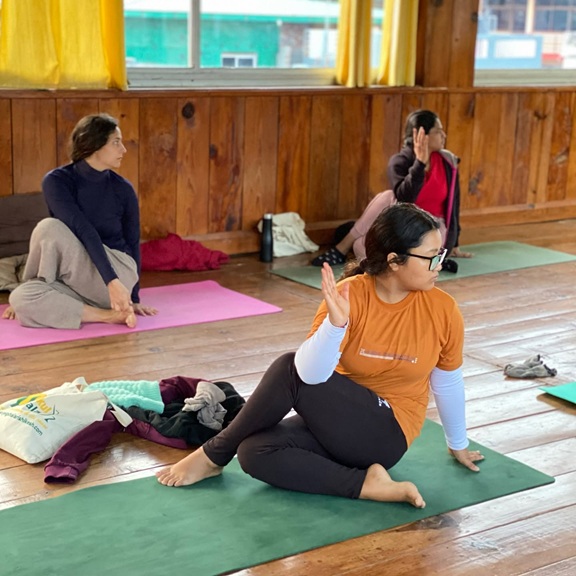
| Sanskrit name | अर्ध मत्स्येन्द्रासन (Ardha Matsyendrāsana) |
| English name | Half Lord of the Fishes Pose, Half Spinal Twist |
| Word meaning | Ardha = half, Matsyendra = lord of the fishes, asana = pose |
| Pose type | Seated twist |
| Level | Beginner to intermediate |
| Hold time | 30–60 seconds each side |
| Stomach | Empty — wait 4 hours after a meal |
| Named after | Sage Matsyendranath |
| Full version | Purna Matsyendrasana (advanced) |
| Main caution | Pregnancy, disc injury, recent abdominal surgery |
What is Ardh Matsyendrasana?
Ardha Matsyendrasana is a classical seated twisting posture from the Hatha Yoga tradition. The pose is traditionally associated with the great yogi Matsyendranath, whose teachings are closely connected with the development of Hatha Yoga.
The name Ardha Matsyendrasana comes from Sanskrit: Ardha means “half,” Matsya means “fish,” and Indra can mean “lord” or “king.” The name is therefore commonly translated as “Half Lord of the Fishes Pose.” In this posture, the torso is gently rotated while the hips remain grounded, creating a controlled twist through the spine.
The twisting movement engages the muscles around the spine and abdomen. In traditional yoga practice, such twists are also associated with stimulating the abdominal region and supporting healthy digestion. Many practitioners use Ardha Matsyendrasana to work on spinal mobility, release general stiffness, and develop greater awareness of posture and breath.
The pose should be practised gradually and without forcing the twist. People with spinal disc problems, recent back injuries, or other spinal conditions should seek guidance from a qualified healthcare professional or experienced yoga teacher before practising deep spinal twists.
What Are the Benefits of Ardha Matsyendrasana?
Ardha Matsyendrasana improves spinal mobility, opens the outer hips and shoulders, strengthens the oblique muscles, and supports digestion. Holding the twist with slow breathing also calms the nervous system. It is one of the few poses that rotates the spine through its full range, a movement most people never make in daily life.
1. Benefits for the spine
- Restores rotation. Sitting, walking, and most exercise move the spine forwards and backwards. Almost nothing rotates it. This twist works the one direction the spine loses first.
- Releases the muscles along the back. The long muscles either side of the spine get compressed on one side and lengthened on the other. Many students feel this most in the lower back and between the shoulder blades.
- Supports better posture. A spine that can still rotate is a spine that sits and stands more easily. Over time, this matters more than flexibility in any single direction.
2. Benefits for the hips and shoulders
- Opens the outer hip. Crossing one leg over the other stretches the outer hip and the muscles around the hip joint, including the piriformis. This is useful for anyone who sits for long hours.
- Opens the chest and shoulders. Turning and reaching the arm stretches the front of the shoulder and across the chest.
- Stretches the side of the neck. Turning the head at the end of the twist lengthens the neck on one side. Do this gently.
3. Benefits for Digestion
- Compresses and releases the abdomen. The twist presses the belly, then lets go. This squeeze-and-release affects the area around the stomach, liver, spleen, and the ascending and descending colon.
- Many practitioners find that regular twisting supports comfortable digestion. This is a supportive practice, not treatment. If you have a digestive condition, see a doctor.
4. Benefits for the mind
- Calms the nervous system. Holding a twist while breathing slowly encourages the body’s rest-and-digest response. The pose is asking you to stay steady in a shape that is mildly demanding, which is why the breath matters so much here.
- Improves focus and body awareness. You have to track the sit bones, the spine, the shoulders, and the breath at the same time. That is a concentration exercise as much as a stretch.
- Balances the two sides. One side of the body is almost always tighter than the other. An asymmetrical pose makes that difference obvious, and practising both sides evenly slowly reduces it.
How Do You Do Ardh Matsyendrasana (Half Spinal Twist Pose)?
Ardha Matsyendrasana is the half version of Matsyendrasana. You sit on the floor, cross one leg over the other, and turn the upper body to one side. The spine rotates, the outer hip stretches, and the shoulders open. It is simpler than the full pose and suits most healthy practitioners. A short warm-up still helps.
How Can You Prepare For This Asana?
Ardha Matsyendrasana is a beginner to intermediate pose. It is the accessible half version of the full twist. Even so, a warm spine and open hips make it far more comfortable, so spend a few minutes on these preparations first.
- Lower Back Flexibility: Knowing about lower back flexibility is necessary for this asana. Backbend poses like camel pose, cobra pose, locust pose, and forward bends like seated forward fold and standing forward fold are extremely helpful to practice Ardha Matsyendrasana. The stretch will be more profound once your flexibility is better over time. You can also practice simpler spinal twists in the beginning.
- Strength: Core strength is essential for practicing Ardha Matsyendrasana; it will help you maintain this posture longer. Regularly practicing asanas like the triangle pose, warrior series, and plank is also necessary.
- Shoulder Flexibility & Mobility: Ardha Matsyendrasana greatly benefits from improving shoulder flexibility and mobility. A few other asanas are helpful, such as the puppy pose, cow face pose, upward-facing dog pose, and bow pose.
After practicing these poses and gathering all the strength and flexibility, you can move further to Ardha Matsyendrasana.
Read Also – Matsyendrasana (Lord of the Fishes Pose): Steps, Benefits, Variations & Who Should Avoid It
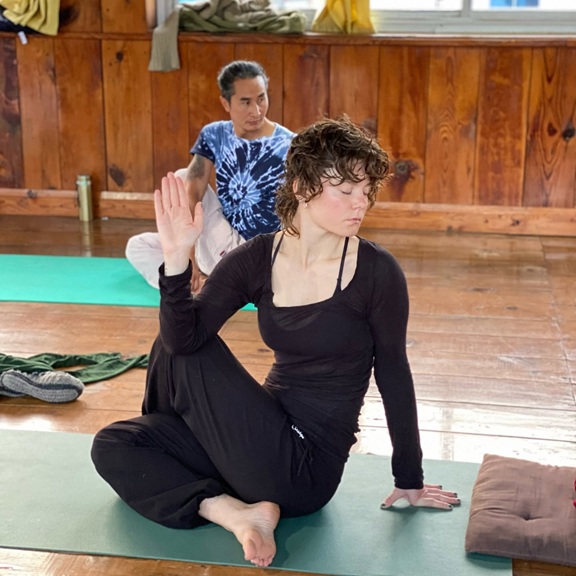
Steps to do Ardh Matsyendrasana (Half Spinal Twist Pose)
The steps for Ardha Matsyendrasana are straightforward. When done correctly, this yoga can transform one’s body and mind.
- Sit with your legs stretched straight before you, keeping your feet together and your spine erect.
- After that, bend your left leg and place the heel of your left foot beside your right hip, or you can hold your left leg straight.
- Cross your right leg over the left knee.
- Put the left hand on the right knee and your right hand behind you.
- Twist your waist, shoulders, and neck in this line to the right and look over your right shoulder.
- Try to keep your spine vertical.
- Hold this position gently, and take long breaths in and out.
- As you breathe out, release your right hand first and the hand behind you, then your waist, chest, and neck. Then, sit up, relaxed yet straight.
- Repeat to the other side.
- Breathe out as you come back to the front and relax.
How Long Should You Hold Ardha Matsyendrasana?
Hold for 30 to 60 seconds on each side, or about 5 to 10 slow breaths. Beginners can start with 15 to 20 seconds and build up over time. Always practise both sides for the same length of time, even though one side will feel tighter than the other.
Breathing in the Pose
Inhale to lengthen the spine upward. Exhale to twist a little further. Never deepen a twist on an inhale — the ribs need room to expand. If the breath becomes short or you find yourself holding it, ease out slightly.
How to Come out Safely
Unwind in reverse order. Release the hands first. Bring the head back to centre. Then untwist the chest and waist. Then release the legs. Sit in Dandasana for two or three breaths before changing sides. Coming out quickly can strain the lower back.
Key Alignments in Ardha Matsyendrasana
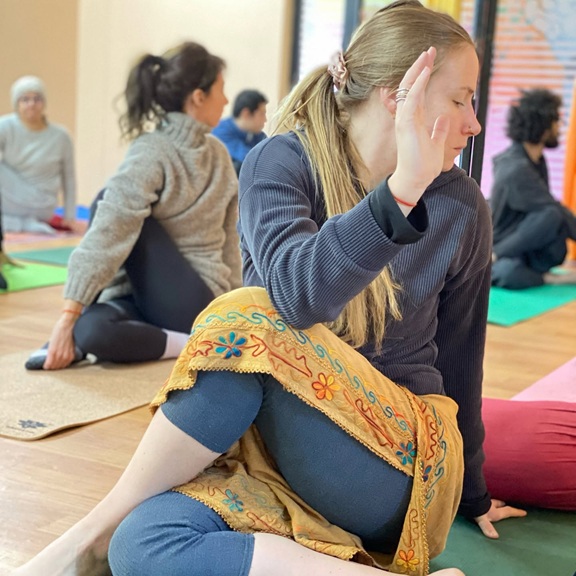
- When performing the Ardha Matsyendrasana, ensure the chest is open and not curving. The spine should remain straight.
- Do not let the shoulders lift towards the ears or round forward. Keep them level and drawn down.
- The back should be straight to get the full pressure of the spinal twist.
- The shoulders and raised knee should be in a straight line. This might be difficult for beginners, but with enough practice, the twisting will deepen, making it easier to achieve.
Props and Modifications
- Fold a blanket under the hips. The most useful prop for this pose. It lifts the pelvis so the lower back does not round. Use it if you cannot sit upright comfortably.
- Keep the bottom leg straight. Instead of folding the bottom foot beside the hip, leave that leg extended along the floor. This removes all pressure from the knee and works just as well.
- Skip the deep twist. Place the back hand on the floor behind you and simply hug the raised knee with the opposite arm, rather than hooking the elbow outside it.
- Use the elbow gently. The upper arm rests against the outside of the raised knee for light leverage. It is not there to lever your body around.
- Chair version. Sit sideways on a chair and twist towards the backrest, holding the sides of the chair back. Good for stiff hips, older practitioners, pregnancy-safe alternatives, and desk breaks.
- Wall support. Sitting with the back near a wall helps beginners feel when the spine is upright.
Common Mistakes
- Twisting from the neck. Turning the head hard while the spine stays still feels like a deep twist but achieves very little. Turn the spine first, head last.
- Lifting one sit bone. Very common. It makes the twist look deeper while the spine actually rotates less. Press both sit bones down into the floor.
- Rounding the lower back. If the pelvis tips backwards, the twist happens in the wrong place. Sit on a folded blanket.
- Pushing hard against the knee. The arm gives leverage, not force. Levering yourself around compresses the spine.
- Holding the breath. People stop breathing in twists without noticing. If the breath stops, back off.
- Forcing the tighter side. One side always turns more easily. Give the tighter side the same time, not more effort.
Read Also – Purna Matsyendrasana: Step-by-Step Instructions, Benefits and Contraindications
Ardh Matsyendrasana Precautions: What You Need to Know
Ardha Matsyendrasana is safe for most healthy practitioners, but it is not right for everyone. Read this section before you practise.
| Condition | What to do |
|---|---|
| Pregnancy | Avoid closed twists. Deep abdominal compression is not safe. Use gentle open twists or the chair version with guidance from a prenatal teacher. |
| Herniated or slipped disc | Avoid. Get medical clearance before any loaded twisting. |
| Recent abdominal or chest surgery | Avoid until fully healed and cleared by a doctor. |
| Hernia | Avoid. The abdominal pressure is too strong. |
| Knee injury or replacement | Keep the bottom leg straight. Do not fold it beside the hip. |
| Spinal fusion or spinal rods | Avoid. Consult a yoga therapist. |
| Sciatica | Approach carefully. Stop if pain travels down the leg. |
| Peptic ulcer or IBS flare-up | Avoid during a flare. |
| Neck injury | Do the twist but keep the head facing forward. Do not turn the neck. |
| High or low blood pressure | Practise gently, keep the breath steady, come out slowly. |
Stop immediately if you feel sharp pain, pinching in the lower back, or tingling down a leg. Stretch discomfort is normal. Sharp pain is not.
Ardha, Purna and Supta Matsyendrasana Compared
| Supta Matsyendrasana | Ardha Matsyendrasana | Purna Matsyendrasana | |
|---|---|---|---|
| English | Reclined Twist | Half Lord of the Fishes | Full Lord of the Fishes |
| Position | Lying on the back | Seated | Seated |
| Level | Beginner | Beginner to intermediate | Advanced |
| Bottom leg | Extended | Straight or folded beside hip | Half lotus |
| Bind | None | Not needed | Full arm bind |
| Hold | 5–10 breaths | 30–60 seconds | 30–60 seconds |
| Suits | Rest, evening practice | Most practitioners | Open hips, flexible knees |
Most students practise Ardha Matsyendrasana for years, and many never move on to the full pose. That is completely normal. Ardha gives nearly all the same benefits with far less risk to the knee and lower back.
What to Practise After Ardha Matsyendrasana
A deep twist should be followed by something that neutralises the spine.
- Dandasana (Staff Pose) — sit tall for a few breaths to let the spine settle.
- Paschimottanasana (Seated Forward Fold) — lengthens both sides evenly after the asymmetry of the twist.
- Setu Bandhasana (Bridge Pose) — a gentle counter-movement for the lower back.
- Supta Matsyendrasana — a softer reclined twist to release anything still holding.
- Shavasana — always close the practice here.
Avoid going straight from a deep twist into a strong backbend. Give the spine a neutral pose in between.
Conclusion
Ardha Matsyendrasana is a valuable yoga posture for developing spinal mobility, improving body awareness, and creating a deeper connection between movement and breath. When practised with proper alignment and mindful breathing, this seated twist can become an effective part of a balanced yoga practice.
For those who want to understand yoga beyond individual postures, learning under experienced teachers can provide a deeper understanding of alignment, breathing, anatomy, and traditional yogic practices. A Yoga Teacher Training in Rishikeshoffers an opportunity to explore these aspects in a more structured way while experiencing the traditional roots of yoga. With consistent practice and proper guidance, Ardha Matsyendrasana can support a stronger, more flexible, and more mindful yoga journey.
Note: This article is for education only. It is not medical advice. If you are pregnant, have a spine or knee condition, or are recovering from surgery, speak to a doctor before practising this pose.
Frequently Asked Questions:
How long should you hold Ardha Matsyendrasana?
Hold for 30 to 60 seconds on each side, or about 5 to 10 slow breaths. Beginners can start with 15 to 20 seconds and build up. Always practise both sides for the same length of time, even though one side will feel tighter than the other.
What is the difference between Ardha and Purna Matsyendrasana?
Ardha means half and Purna means full. In Ardha Matsyendrasana the bottom leg stays straight or folds loosely beside the hip, and no bind is needed. In Purna Matsyendrasana the bottom foot comes into half lotus and both arms bind around the body. Ardha suits most students.
Can beginners do Ardha Matsyendrasana?
Yes. It is one of the more accessible seated twists. Beginners should keep the bottom leg straight instead of folding it, and sit on a folded blanket so the lower back does not round. If the hips feel very tight, start with a reclined twist instead.
Who should not do Ardha Matsyendrasana?
Avoid this pose during pregnancy, with a herniated or slipped disc, with a hernia, or after recent abdominal or chest surgery. People with knee injuries should keep the bottom leg straight. Anyone with a diagnosed spine condition should get medical clearance before practising twists.
Is Ardha Matsyendrasana the same as Half Lord of the Fishes Pose?
Yes. Ardha Matsyendrasana and Half Lord of the Fishes Pose are the same posture. It is also called the Half Spinal Twist or the Seated Half Twist. The pose is named after Sage Matsyendranath, whose name means “lord of the fishes.”
Which side should you twist first?
Most traditions teach twisting to the right side first, then the left. The reasoning is that this follows the direction of the colon and supports digestion. What matters more is doing both sides for equal time, so the body stays balanced.
What should you do if your knee hurts in this pose?
Come out at once. Knee pain in a twist usually means the hip is not open enough, so the knee absorbs the rotation instead. Keep the bottom leg straight, sit on a folded blanket, and work on hip openers such as Baddha Konasana before folding the leg again.
Does Ardha Matsyendrasana help with back pain?
It can ease general stiffness and muscular tension along the spine. It is not suitable for disc problems, and it can irritate sciatica in some people. Anyone with a diagnosed back condition should speak to a doctor before adding twists to their practice.
When is the best time to practise Ardha Matsyendrasana?
Practise on an empty stomach, with at least four hours since your last meal. Morning is ideal. Within a class, place it after the body is warm, usually in the middle or towards the end of a sequence, never as the first pose.
Is Ardha Matsyendrasana safe during pregnancy?
No. Closed twists compress the abdomen and are not recommended during pregnancy. Gentle open twists, where the torso turns away from the bent leg rather than towards it, may be suitable with guidance from a qualified prenatal yoga teacher.
This article is for general information and is not medical advice. If you have a respiratory or heart condition, are pregnant, or are unsure whether these practices suit you, please speak to your doctor before beginning.

 +91-8433225327,
 Rishikul Yogshala Rishikesh, Narayan Kunj, Jonk Village, Ram Jhula, Swarg Ashram, Rishikesh, Uttarakhand 249304
 By Airway
 By Railway
 By Bus/Cabs