








Matsyendrasana (Lord of the Fishes Pose): Steps, Benefits, Variations & Who Should Avoid It
Table of Contents
- What Is Matsyendrasana?
- How to Do Matsyendrasana: Step by Step
- Warm up first
- The Steps
- How Long Should You Hold Matsyendrasana?
- How To Come Out Safely?
- Benefits of Matsyendrasana
- For the body
- For the mind
- Contraindications: Who Should Avoid Matsyendrasana
- The Three Main Variations
- Supta Matsyendrasana (Reclined Twist)
- Ardha Matsyendrasana (Half Lord of the Fishes Pose)
- Purna Matsyendrasana (Full Lord of the Fishes Pose)
- Preparatory Poses
- Common Mistakes
- Props and Modifications
- Conclusion
- Frequently Asked Questions
- Is Matsyendrasana the same as Matsyasana?
- What is the difference between Ardha and Purna Matsyendrasana?
- How long should you hold Matsyendrasana?
- Can beginners do Matsyendrasana?
- Is Matsyendrasana safe during pregnancy?
- Does Matsyendrasana help with back pain?
- When is the best time to practise Matsyendrasana?
- What should you do if your knee hurts in this pose?
Matsyendrasana, or Lord of the Fishes Pose, is a deep seated spinal twist in hatha yoga. You sit with one foot placed near the opposite thigh, the other foot crossed over the knee, and turn the torso fully to one side. It is named after Sage Matsyendranath and is described in the Hatha Yoga Pradipika (1.26–27). Hold it for 30 to 60 seconds on each side. It improves spine flexibility, opens the hips and shoulders, and supports digestion.
Matsyendrasana at a Glance
| Sanskrit name | मत्स्येन्द्रासन (Matsyendrāsana) |
| English name | Lord of the Fishes Pose, Full Spinal Twist |
| Named after | Sage Matsyendranath, founder of the Nath tradition |
| Pose type | Seated, twist, hip opener |
| Level | Advanced (the half version, Ardha Matsyendrasana, is for beginners) |
| Hold time | 30–60 seconds on each side |
| When to practise | Middle or end of a session, after the body is warm |
| Stomach | Empty — wait 4 hours after a meal |
| First textual mention | Hatha Yoga Pradipika 1.26–27 (15th century) |
| Main benefit | Full rotation of the spine, hip and shoulder opening |
| Main caution | Pregnancy, spine injury, recent abdominal surgery |
What Is Matsyendrasana?
Matsyendrasana is a seated twist that turns the spine as far as it can safely go.
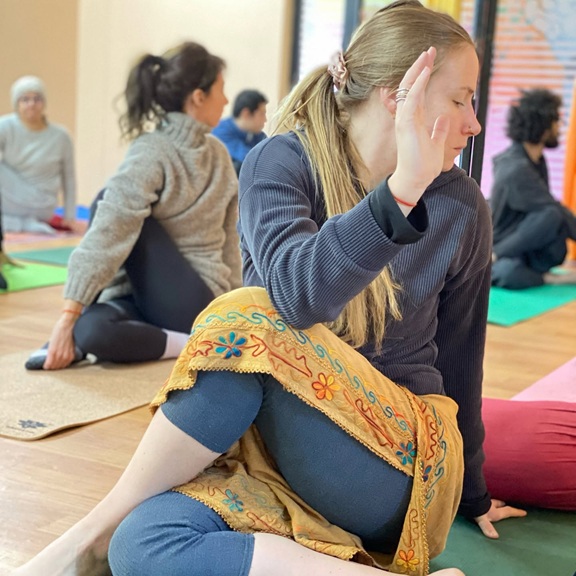
You sit on the floor. One leg folds in. The other foot crosses over the folded knee and rests flat on the floor. Then you twist the whole upper body to one side, wrap the arms around the legs, and look over the shoulder. The pose twists the spine from the base all the way to the neck.
It is one of the few asanas named in the old hatha yoga texts. That tells you something. Out of thousands of postures, the classical writers chose to describe this one.
The full version is hard. It needs open hips, flexible knees, mobile shoulders, and a spine that can rotate freely. Most students work with the half version, Ardha Matsyendrasana, for years before the full pose becomes possible. There is no rush. The half pose gives most of the same benefits.
How to Do Matsyendrasana: Step by Step
Warm up first
Never twist a cold spine. Spend five to ten minutes on:
- Cat-Cow to wake up the spine
- Baddha Konasana (Bound Angle) to open the hips
- Gomukhasana legs to open the outer hips
- Ardha Matsyendrasana as a gentler first twist
The Steps
- Sit in Dandasana (Staff Pose). Legs straight in front. Spine tall. Palms on the floor beside the hips.
- Fold the left leg in. Bring the left foot to the base of the right thigh, sole facing up, close to the hip crease. If the knee hurts, stop here and practise the half version instead.
- Cross the right foot over the left knee. Place the whole sole flat on the floor, outside the left knee. The right knee points up at the ceiling.
- Sit level. Press both sit bones down. Most people lift one side without noticing. Sit on a folded blanket if the lower back rounds.
- Inhale and lift the left arm up. Grow tall through the spine first. The length comes before the twist.
- Exhale and turn to the right. Bring the left arm across and down, so the left shoulder rests against the outside of the right knee.
- Take the bind. Reach the left hand down to hold the outer edge of the right foot. Then wrap the right arm behind the back and reach for the left thigh or shin.
- Turn the head last. Look over the right shoulder. Keep the neck soft. The twist comes from the spine, not the neck.
- Breathe. Inhale to lengthen the spine. Exhale to twist a little deeper. Never force on an inhale.
- Hold for 30 to 60 seconds. Then release slowly and repeat on the other side.
How Long Should You Hold Matsyendrasana?
Hold for 30 to 60 seconds on each side, or about 5 to 10 slow breaths. Beginners should start with 15 to 20 seconds. Always do both sides for the same length of time.
How To Come Out Safely?
Unwind in reverse order. Release the arms first. Then bring the head back to centre. Then untwist the torso. Then release the legs. Sit in Dandasana for a few breaths before switching sides. Coming out fast can strain the lower back.
Benefits of Matsyendrasana
For the body
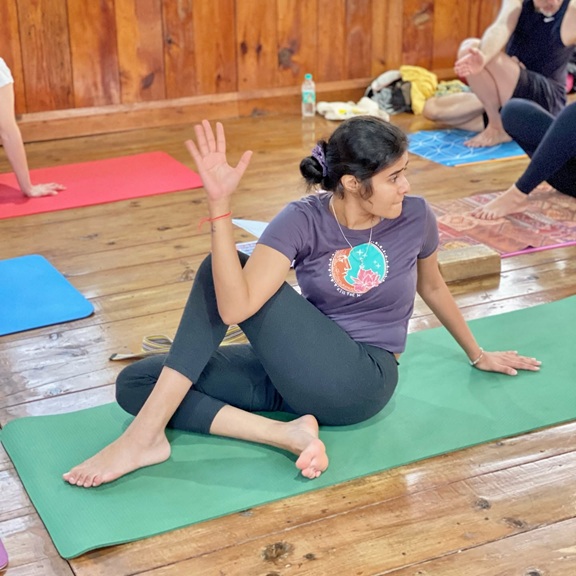
- Improves spine flexibility. The pose rotates the spine through its full range. This is a movement most people never do in daily life.
- Opens the hips and outer glutes. The crossed leg gives a deep stretch to the outer hip and the piriformis.
- Opens the shoulders and chest. The bind stretches the front of the shoulder and the chest.
- Releases tension in the back and neck. Twisting helps release tight muscles along the spine.
- Supports digestion. The twist compresses the abdominal organs and then releases them. This gentle squeeze-and-release supports gut movement and blood flow to the digestive organs.
- Strengthens the core and obliques. Holding the twist works the side abdominal muscles.
- Improves posture. Regular twisting helps keep the spine mobile, which makes sitting and standing tall easier.
For the mind
- Calms the nervous system. Slow breathing in a held twist encourages the parasympathetic “rest and digest” response.
- Improves focus. The pose needs attention on breath, alignment and balance all at once. That is a concentration exercise.
- Traditionally linked to Manipura chakra. The solar plexus centre, connected in yogic thought with willpower and confidence, sits in the area the twist compresses.
Contraindications: Who Should Avoid Matsyendrasana
This is a strong pose. Skip it or modify it in these cases.
| Condition | What to do |
|---|---|
| Pregnancy | Avoid closed twists completely. Deep abdominal compression is not safe. Use gentle open twists instead, with guidance. |
| Herniated or slipped disc | Avoid. Loaded rotation can worsen disc problems. Get medical clearance first. |
| Recent abdominal or chest surgery | Avoid until fully healed and cleared by a doctor. |
| Hernia | Avoid. The abdominal pressure is too strong. |
| Knee injury or knee replacement | Do not fold the bottom leg. Keep it straight and practise Ardha Matsyendrasana. |
| Spinal fusion or rods | Avoid the full pose. Ask a yoga therapist. |
| Peptic ulcer or IBS flare-up | Avoid during a flare. The compression can irritate. |
| Neck injury | Do the twist but keep the head facing forward. Do not turn the neck. |
| Sciatica | Approach with care. Twisting can help some people and irritate others. Stop if pain travels down the leg. |
| High or low blood pressure | Practise gently, keep breathing steady, and come out slowly. |
Stop immediately if you feel any sharp pain, pinching in the lower back, or tingling down a leg. Discomfort in a stretch is normal. Sharp pain is not.
The Three Main Variations
| Supta Matsyendrasana | Ardha Matsyendrasana | Purna Matsyendrasana | |
|---|---|---|---|
| English | Reclined Twist | Half Lord of the Fishes | Full Lord of the Fishes |
| Position | Lying on the back | Seated | Seated |
| Level | Beginner | Beginner to intermediate | Advanced |
| Hold | 5–10 breaths | 30–60 seconds | 30–60 seconds |
| Best for | Rest, evening practice, back tension | Everyday practice, most students | Experienced practitioners with open hips |
| Bind needed | No | No | Yes |
Supta Matsyendrasana (Reclined Twist)
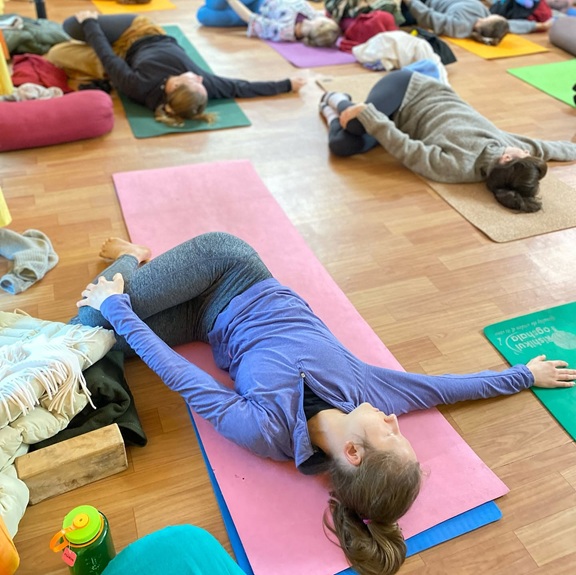
The gentlest version. Lie on your back, arms out to the sides. Draw the right knee to the chest, then let it cross over to the left. Turn the head to the right. Hold for 5 to 10 breaths and switch. Good before sleep and safe for most people.
Ardha Matsyendrasana (Half Lord of the Fishes Pose)
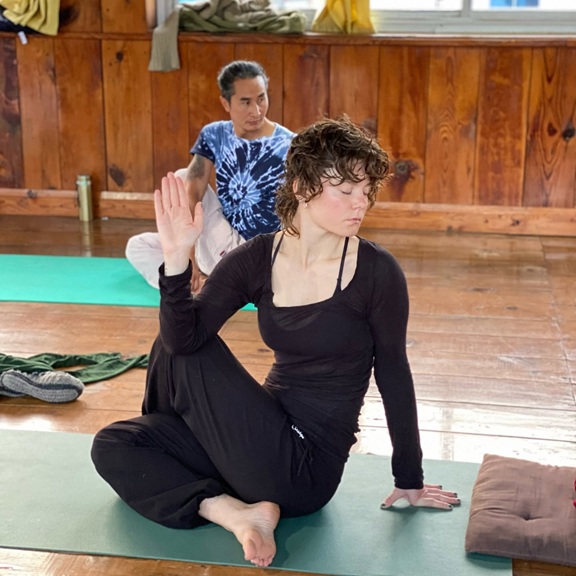
The version taught in most classes. The bottom leg either stays straight or folds so the foot rests beside the opposite hip. The top foot crosses over the knee. One hand goes behind for support, the other hooks the raised knee. This is the pose worth mastering. It gives nearly all the benefits of the full twist with far less risk.
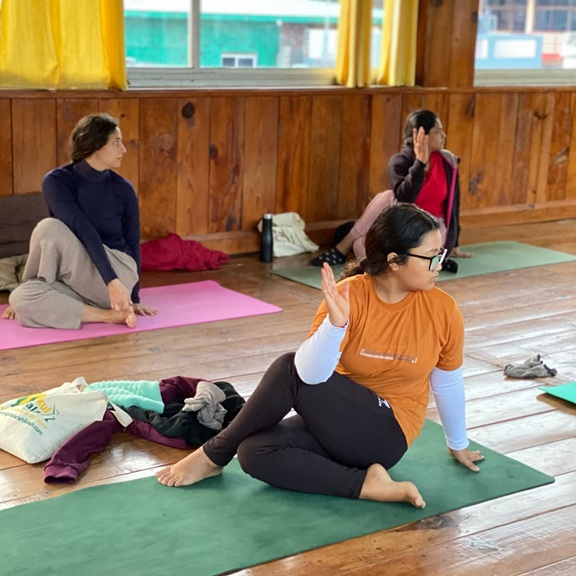
Full instructions: Ardha Matsyendrasana: Steps, Benefits and Precautions
Purna Matsyendrasana (Full Lord of the Fishes Pose)
The complete pose described above, with the bottom foot in half lotus and a full bind. It combines balance, deep twist, hip and knee flexion, and a shoulder bind all at once. Most students need years of preparation. Attempt it only with a teacher watching.
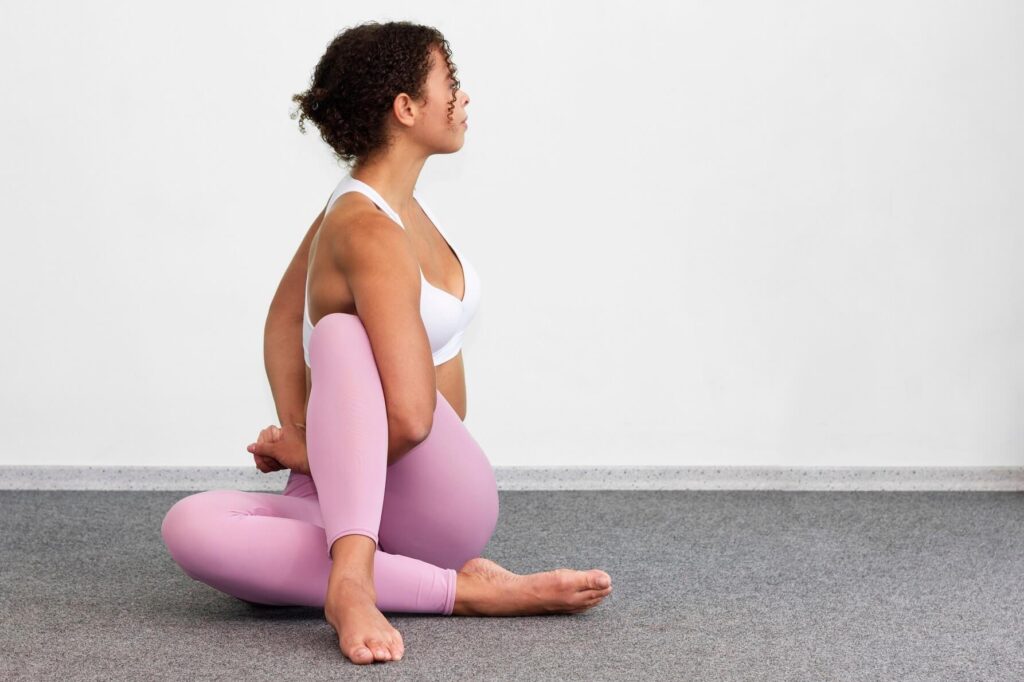
Full instructions: Purna Matsyendrasana: Steps, Benefits and Contraindications
Preparatory Poses
Work on these before attempting the full twist:
- Bharadvajasana — a gentle seated twist with both knees down
- Marichyasana C — a seated twist with one leg straight
- Ardha Matsyendrasana — the direct half version
- Baddha Konasana — opens the inner hips for the folded leg
- Gomukhasana (legs only) — opens the outer hips
- Virasana — prepares the knees for deep folding
- Gomukhasana (arms only) — prepares the shoulders for the bind
If Ardha Matsyendrasana still feels tight, the full pose is not ready yet. That is normal, not a failure.
Common Mistakes
- Twisting from the neck. Turning the head hard while the spine stays still gives the feeling of a twist without the benefit. Turn the spine first, head last.
- Lifting one sit bone. Very common. It makes the twist look deeper while the spine actually rotates less. Press both sit bones down.
- Rounding the lower back. If the pelvis tips backwards, sit on a folded blanket to lift the hips.
- Forcing the bind. The bind is the last step, not the goal. Reaching for it too early collapses the chest.
- Pushing hard against the knee. The arm rests against the knee for leverage, not to lever the body around.
- Holding the breath. People stop breathing in twists without noticing. If the breath stops, back off.
- Uneven sides. The body twists more easily one way. Give the tighter side the same time, not more force.
Props and Modifications
- Folded blanket under the hips — the single most useful prop. Lifts the pelvis so the spine can stay tall.
- Keep the bottom leg straight — removes all pressure from the knee. Safe and effective.
- Skip the bind — place the back hand on the floor behind you and hook the front elbow outside the raised knee.
- Use a strap — hold one end in each hand behind the back to work towards the bind gradually.
- Sit against a wall — helps beginners feel when the spine is upright.
- Chair twist — sit sideways on a chair and twist towards the backrest. Good for stiff hips, older practitioners, and office breaks.
Conclusion
Matsyendrasana is one of the few poses the old texts singled out by name. It rotates the spine fully, opens the hips and shoulders, and gives the digestive organs a firm squeeze and release. That combination is rare in a single posture.
But the full pose is not a beginner’s pose, and there is no prize for rushing it. Ardha Matsyendrasana gives most of the same benefits with a fraction of the risk, and many experienced practitioners never move past it. Warm up first, sit level, twist from the spine rather than the neck, and stop the moment anything feels sharp.
Learning a pose like this properly — the alignment, the preparation, the safety checks, and the philosophy behind it — is what a full training gives you that an article cannot. Rishikul Yogshala Rishikesh has been running Yoga Teacher Training in India since 2010, with Yoga Alliance-certified 100 Hour, 200 Hour, 300 Hour and 500 Hour courses on the banks of the Ganga — covering Hatha, Ashtanga Vinyasa, alignment, anatomy, pranayama and yoga philosophy.
Frequently Asked Questions
Is Matsyendrasana the same as Matsyasana?
No. Matsyendrasana is Lord of the Fishes Pose, a seated spinal twist. Matsyasana is Fish Pose, a backbend done lying on the back. The names are similar, but the poses are completely different. Matsyendrasana is named after Sage Matsyendranath; Matsyasana is named after the fish.
What is the difference between Ardha and Purna Matsyendrasana?
Ardha means half and Purna means full. In Ardha Matsyendrasana, the bottom leg stays straight or folds loosely, and no bind is needed. In Purna Matsyendrasana, the bottom foot comes into half lotus, and both arms bind around the body. Ardha is suitable for most students; Purna is advanced.
How long should you hold Matsyendrasana?
Hold for 30 to 60 seconds on each side, or about 5 to 10 slow breaths. Beginners can start at 15 to 20 seconds. Always practise both sides for equal time.
Can beginners do Matsyendrasana?
Beginners should start with Supta Matsyendrasana, the reclined twist, then move to Ardha Matsyendrasana. The full pose needs open hips, flexible knees, and mobile shoulders. Trying it too early usually strains the knee or the lower back.
Is Matsyendrasana safe during pregnancy?
No. Closed twists compress the abdomen and are not recommended during pregnancy. Gentle open twists, where the torso turns away from the bent leg, may be safe with guidance from a prenatal yoga teacher.
Does Matsyendrasana help with back pain?
It can help with general stiffness and muscular tension in the back. It is not suitable for disc problems, and it can worsen sciatica in some people. Anyone with a diagnosed spine condition should get medical clearance first.
When is the best time to practise Matsyendrasana?
Practise on an empty stomach, ideally in the morning, with at least four hours since your last meal. Within a class, place it after the body is warm — usually in the middle or near the end of a sequence.
What should you do if your knee hurts in this pose?
Come out at once. Knee pain in a twist usually means the hip is not open enough, so the knee is taking the rotation instead. Keep the bottom leg straight, sit on a folded blanket, and work on hip-opening poses before returning to it.
This article is for general information and is not medical advice. If you have a respiratory or heart condition, are pregnant, or are unsure whether these practices suit you, please speak to your doctor before beginning.

 +91-8433225327,
 Rishikul Yogshala Rishikesh, Narayan Kunj, Jonk Village, Ram Jhula, Swarg Ashram, Rishikesh, Uttarakhand 249304
 By Airway
 By Railway
 By Bus/Cabs