








Best Yoga Teacher Training Courses in India
Table of Contents
- Which Yoga Teacher Training Course Is Best In India in 2026?
- Rishikul Yogshala Rishikesh — The Course in Full
- At a glance
- The Credentials, Checked
- Is This Course Right For You?
- What You Will Study?
- A Day at the Rishikul Yogshala
- Workshops and Excursions
- Accommodation and Meals
- Your Teachers
- Fees and Exactly What They Cover
- Certification and the Yoga Alliance pathway
- After the Yoga Course
- What Students Say?
- Other Yoga Schools and Yoga Teacher Training Courses in India
- 1. Yogadarshanam — Srirangapatna, Mysore
- 2. Tattvaa Yogashala — Ram Jhula, Rishikesh
- 3. Vinyasa Yoga Academy — Laxman Jhula, Rishikesh
- 4. Samadhi Yoga Ashram — Laxman Jhula, Rishikesh
- 5. Goa Yogashala — Agonda, South Goa
- Comparison Table
- Which City Is Best For Yoga Teacher Training in India?
- Rishikesh
- Goa
- Mysore
- How Much Does Yoga Teacher Training Cost in India in 2026?
- Yoga Teacher Training In India for International Students
- Red Flags: How To Spot a School Worth Avoiding
- Making The Decision
- Frequently Asked Questions
- Is a 200-hour course beginner-friendly?
- Is 200 hours enough to start teaching?
- Is a certification from India recognised in Europe, the USA and Australia?
- What is the difference between RYT 200 and YTT 200?
- Is a 100-hour or 200-hour course better?
- Is a 300-hour course worth it?
- How physically demanding is it?
- Can I do the course if I am not flexible, or over 50?
- Can I practise during my period?
- What is the best time of year to train in Rishikesh?
We are Rishikul Yogshala, a Yoga Alliance-registered school in Rishikesh, teaching since 2010. Most school listings give you a paragraph and a price for yoga teacher training courses in India. This one gives you our full curriculum, our daily timetable, exactly what the fee covers and what it does not, and five other established Indian schools worth considering. Verified August 2026.
Which Yoga Teacher Training Course Is Best In India in 2026?
There is no single best yoga school for everyone. The right choice depends on your goals, preferred teaching style, location, course format, budget, and the kind of training experience you want. For a first 200-hour certification, residential courses in India commonly run for around 3–4 weeks, with prices varying depending on the school, accommodation, meals, and certification included. Rishikesh is one of India’s most established destinations for international yoga students, Mysore is particularly well known for Ashtanga Yoga, and Goa is popular with students looking for a more relaxed, coastal setting.
The useful question is not which school is best overall, but which of five things matters most to you: the style you want to learn, the setting, the batch size, the credentials behind the certificate, and your budget. Answer those, and the list narrows fast.
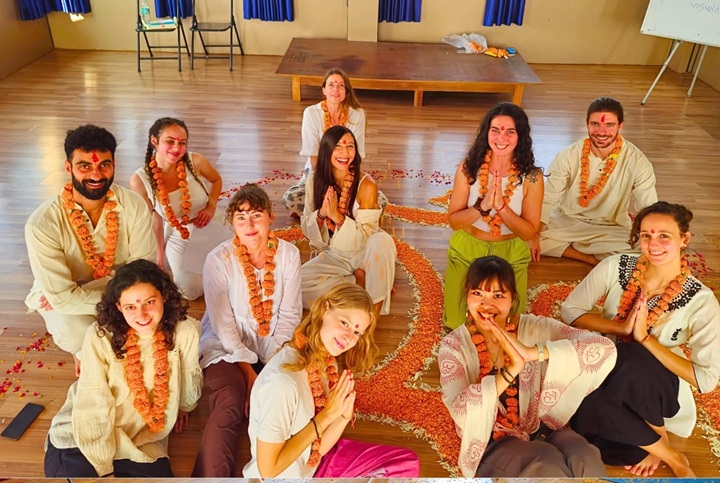
Rishikul Yogshala Rishikesh — The Course in Full
We have set out our own course in complete detail below, so you can measure it against those seven checks yourself rather than take our word for anything.
Founded 2010 · Narayan Kunj, Jonk Village, Ram Jhula, Swarg Ashram, Rishikesh
At a glance
| 200-hour duration | 23 days, fully residential |
| Certification | Yoga Alliance USA — RYT 200 |
| Styles taught | Hatha Yoga and Ashtanga Vinyasa |
| Batch size | 20–25 students |
| Level | Beginner to intermediate; no prior experience required |
| Language | English |
| Batches | Every month, all year — starts 7th, ends 30th |
| Fees | $1,200 shared room · $1,350 private room |
| Running since | 2010 — sixteen years of uninterrupted monthly batches |
| Students certified | 25,000+ from 80+ countries |
The Credentials, Checked
Most Rishikesh schools hold Yoga Alliance registration. Rishikul holds three separate credentials:
- Yoga Alliance USA Registered Yoga School, which is what makes your certificate registrable as RYT 200
- Ministry of AYUSH recognition, Government of India
- ISO certification
Each of those is audited by someone other than us, which is the point. You can verify the Yoga Alliance listing in their public directory before you contact us.
Is This Course Right For You?
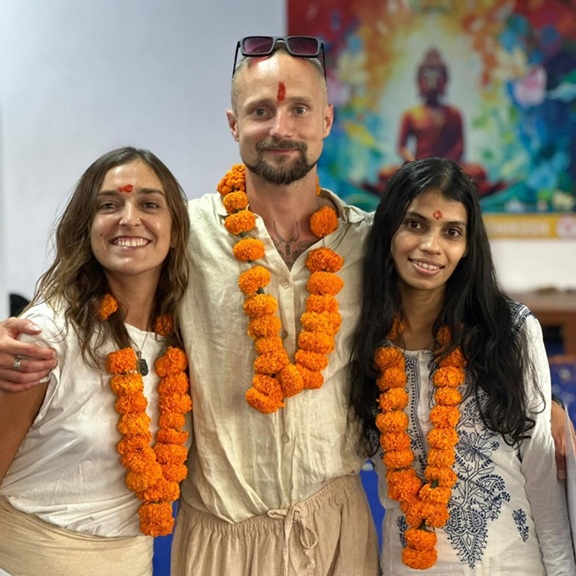
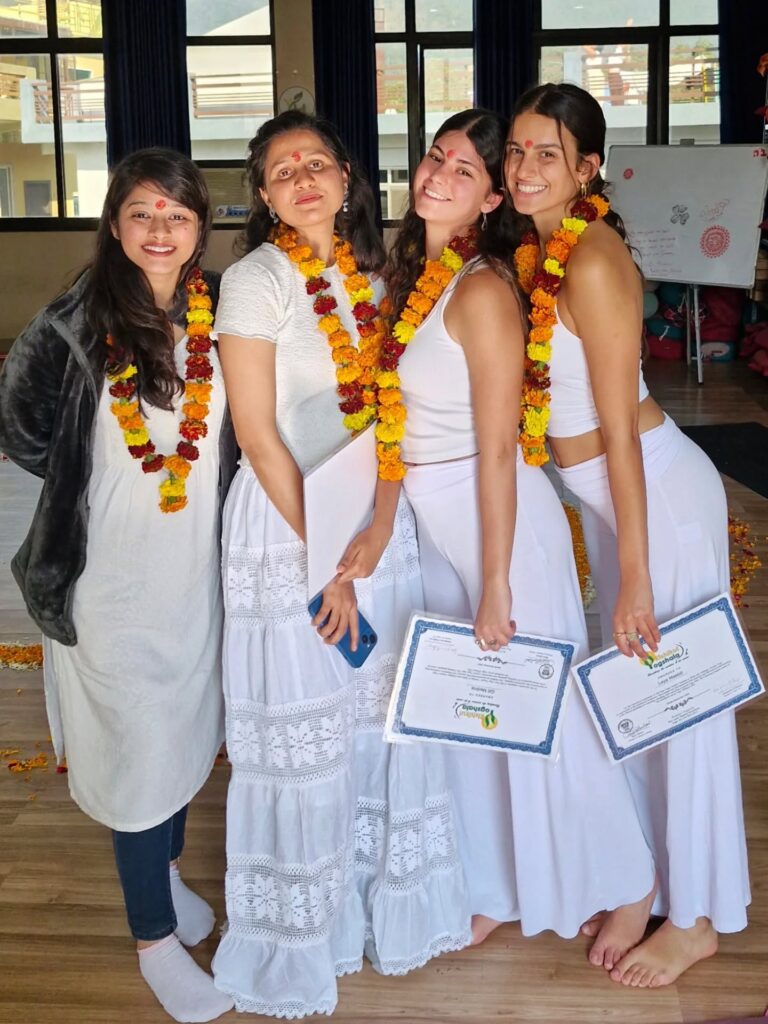
Yes, even if you have never been on a mat. Around 70% of our students since 2010 have been women; most arrive alone, and batches routinely mix students in their twenties with students in their sixties. There is no upper age limit, and flexibility is what the training builds, not what it demands on day one.
This course fits if you are:
- A beginner who wants a lasting foundation
- A practitioner ready to start teaching
- An experienced yogi who wants to refine rather than restart
- Someone practising without formal certification who wants structured training
- Anyone who needs a Yoga Alliance RYT 200 recognised by studios worldwide
Two honest conditions before you book. We ask for at least one month of regular physical activity behind you — yoga, sport, gym or general movement all count. It is not gatekeeping; your body settles into the daily schedule far more comfortably. And if you have had surgery, we ask for a minimum six-month recovery period and a conversation with Bipin Baloni Ji first, so the programme supports your recovery rather than working against it.
We do not recommend the 200-hour during pregnancy; the schedule runs 6:25 am to 6:00 pm for 23 days. Our 85-hour Prenatal Yoga TTC is the right course instead.
What You Will Study?
The 23 days cover eleven modules. This is the full list, not a summary.
- Hatha Yoga — primary series. Surya Namaskar with mantra awareness, Sukshma Vyayama (joints and glands), then standing, kneeling, sitting, prone, supine and inversion series. Every asana taught with its benefits and its contraindications.
- Ashtanga Vinyasa — primary series. What vinyasa actually is, the nine drishti, the role of ujjayi and bandhas, then the full primary sequence from Surya Namaskar A and B through to Uttplutih.
- Pranayama and mudras. Chest versus diaphragmatic breathing, the nadis, Ida, Pingala and Sushumna, then the seven main practices — Kapalbhati, Sheetali, Bhastrika, Sheetkari, Ujjayi, Bhramari and Nadi Shodhana, plus mudra theory and practice.
- Yoga Darshanam — philosophy. What darshanam means, the five koshas, the four faculties and five stages of the mind-field, the eight limbs of Patanjali, and the waking, dreaming and deep-sleep states in yogic science.
- Anatomy and physiology of yogic practice. The skeletal system and joint protection, the muscular system and how yogic practice builds it, and the respiratory system with the yogic view of breathing, including which practices help which conditions.
- Concentration and meditation. Dharana versus dhyana, then breath awareness, mantra awareness, candle and inner-light, and full-moon meditation.
- Yoga Nidra. The four states of consciousness, the Satyananda-tradition practices, and how Yoga Nidra addresses insomnia.
- Adjustment and alignment. Six steps to performing an asana correctly, then side extension, forward bending, backbending, twisting, inversions and centring postures, each with verbal correction and hands-on adjustment, plus modifications and contraindications.
- Shatkarma.Shat kriya according to Hatha Yoga, with practical Jala Neti and Sutra Neti.
- Mantra Yoga. The significance of OM, and mantras for meal purification, obstacles, realisation and wellbeing.
- Teaching methodology. Classroom preparation, sequencing a class, listening and presence, directive versus non-directive dialogue, demonstration, lesson planning, and the discipline expected of teachers and students.
Practical sessions in Ayurvedic cooking and sound healing are included in the fee. Most schools list these as paid extras.
A Day at the Rishikul Yogshala
| Time | Session |
|---|---|
| 06:25 | Herbal tea |
| 06:40 – 08:10 | Ashtanga Yoga |
| 08:25 – 09:25 | Pranayama |
| 09:25 – 10:25 | Breakfast |
| 10:45 – 11:45 | Philosophy |
| 12:00 – 13:00 | Adjustment and alignment |
| 13:00 – 14:00 | Lunch |
| 15:00 – 16:00 | Mantra |
| 16:15 – 17:45 | Hatha Yoga |
| 18:00 – 19:00 | Meditation / Yoga Nidra |
| 19:00 – 20:00 | Dinner |
| 20:00 – 21:00 | Self study |
| 22:00 | Lights off |
Wednesdays are workshops and excursions. Sundays are yours to rest and explore. The timetable can shift with teacher availability or weather; the sequence and the total hours do not.
Workshops and Excursions
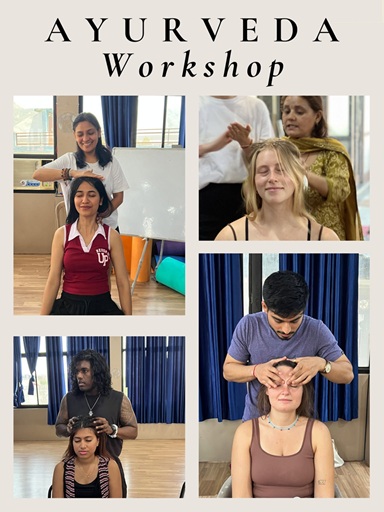
Workshops included in the course: teaching practicum, restorative yoga, Iyengar alignment, an Ayurveda session, sound healing, and yoga therapy.
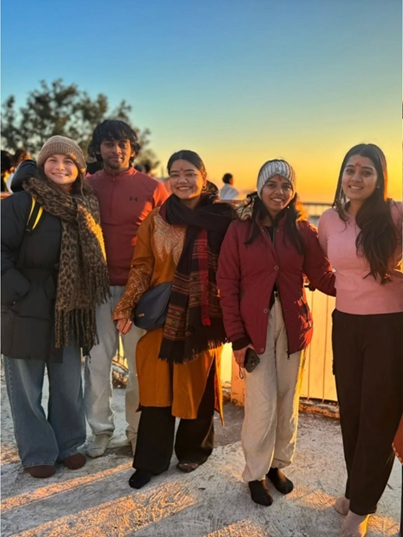
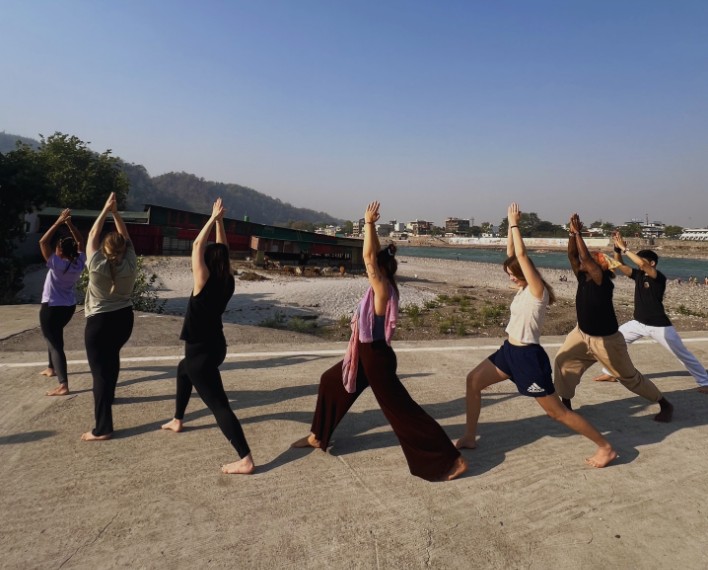
Excursions built into the 23 days: Ganga Aarti at dusk, the sunrise trek to Kunjapuri Temple, Vashistha Cave, Mouni Baba Cave, Bhootnath Temple, and riverside practice on the Ganga. These are not tourist add-ons sold separately; they are part of the rhythm of the course, scheduled week by week according to weather and transport.
Accommodation and Meals
Three accommodation buildings; rooms are assigned on a first-come basis and available as private or shared. Every room has twin beds with proper lighting, a private bathroom with 24/7 hot water, a study desk and chair, free Wi-Fi and a proper mattress. In busy seasons, some rooms are in nearby buildings, a two-minute walk from the main school.
Being straight about this: shared rooms have no air conditioning. AC is available in private rooms at an additional charge. Rishikesh in May and June is genuinely hot, and this is the detail most worth knowing before you book a summer batch.
Three sattvic meals daily, cooked to Ayurvedic and yogic principles, with fruit and vegetables bought fresh from local markets each day. Gluten-free and other dietary needs are accommodated; tell us at registration.
Your Teachers
Every instructor is E-RYT certified by Yoga Alliance USA with 10 to 15+ years of teaching experience, and several have taught here since the school opened in 2010. The same teachers stay with your batch for the full 23 days, which is why they know your practice by the second week.
- Bipin Baloni — Founder. Hatha Yoga, Ashtanga Vinyasa, Pranayama, Yoga Therapy
- Gurmeet Singh — Asana adjustment and alignment, anatomy
- Suraj Chaudhary — Hatha Yoga, pranayama
- Priya Negi — Ashtanga Vinyasa
- Mohit Bhandari — Ashtanga Vinyasa, Hatha Yoga
- Rahul Sharma — Mantra chanting, Indian classical music
Bipin Baloni Ji began practising in 2008, was teaching by 2009, and opened the school in 2010 after studying under teachers in Rishikesh, including direct students of B.K.S. Iyengar and teachers of the Himalayan Tradition. He holds an M.Phil. in Yoga and a postgraduate degree in Yoga from Hemvati Nandan Bahuguna University, is a 500-hour certified International Master Trainer, and serves as President of the Yoga Association Rishikesh — a position that reflects the trust of the wider yoga community here rather than a paid registration.
Fees and Exactly What They Cover
| Room | International students |
|---|---|
| Shared | $1,200 |
| Private | $1,350 |
Special pricing applies for Indian nationals; contact us, and we will share the applicable rate. A 20% advance deposit reserves your seat; the balance is payable on arrival.
Included: 23 nights’ accommodation, three vegetarian meals daily, yoga materials and course manual, cleansing kit, Ayurveda session, sound healing session, 24-hour reception and water supply, free Wi-Fi, CCTV throughout the premises, access to the Ganga for meditation, 200-hour certification on completion.
Not included: Airfare, visa fees, airport or local transport, accommodation before or after the course dates, personal expenses such as laundry and phone, medical expenses.
Airport pickup from Dehradun is available at USD 25 when you send your flight details in advance. Pickup from Delhi can be arranged at the applicable fee.
Refunds: the 20% advance is non-refundable, but if plans change, you can move your booking to any future batch within one year of your original start date. There is no cancellation charge beyond the advance.
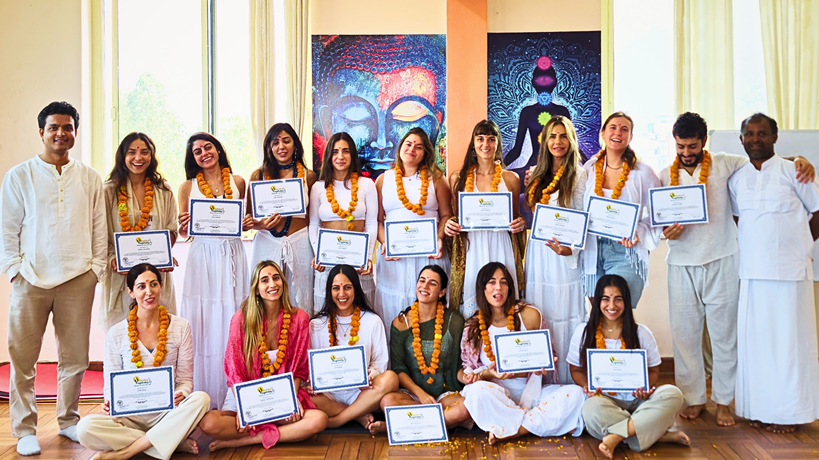
Certification and the Yoga Alliance pathway
To earn the certificate, you attend all sessions and complete a written and a practical assessment towards the end of the course. The curriculum prepares you for both well before you reach them.
Because Rishikul is a Yoga Alliance USA Registered Yoga School, your certificate is registrable as RYT 200 — recognised by studios, schools and insurers worldwide. This distinction matters more than most students realise: plenty of schools issue a certificate that proves attendance but carries no registration behind it. Ask any school you are considering which of the two they offer.
The certificate itself does not expire. What renews annually is your Yoga Alliance membership, paid directly to them, if you want the RYT letters listed against your name in their public directory.
Many students go on to our 300 Hour Advanced Training; completing both qualifies you for RYT 500.
After the Yoga Course
Graduates now teach across Europe, North America, Australia and Asia. Common paths:
- Teaching at studios, gyms, wellness centres or resorts
- Private sessions, in person or online
- Leading retreats, in India or elsewhere
- Corporate wellness programmes
- Integrating yoga into an existing career in healthcare, fitness, education or therapy
- Specialising later in prenatal, therapy or children’s yoga
- Continuing to the 300-hour and RYT 500
Plenty of our students never teach a paid class and do not regret a single day. What you do with the certification afterwards is entirely yours to decide.
What Students Say?
Ratings, all publicly verifiable: 4.8 on Google (369 reviews), 4.7 on Tripadvisor (403 reviews), 4.5 on Yoga Alliance (455 reviews). Those are spread across sixteen years rather than clustered in one good quarter, which matters more than the numbers themselves.
Read them yourself before you contact us. They will tell you more than this page can.
Explore the 200 Hour Yoga Teacher Training in Rishikesh
Other Yoga Schools and Yoga Teacher Training Courses in India
Chosen because each has operated for a decade or more, holds verifiable Yoga Alliance registration, and does something specific that we do not. Listed by year of founding.
1. Yogadarshanam — Srirangapatna, Mysore
Founded 1998 · Ashtanga Vinyasa and Hatha, gurukula style
The oldest school in this segment. Led by Yogacharya Santhosh Kumar, who has taught for 27 years. Over 3,100 certified teachers and 10,000 students from 100+ countries. Yoga Alliance certified at RYS 200, 300, 500 and RPYS 100. The ashram sits at Belagola on Gurukula Road, 8 km outside Gokulam, surrounded by rice farmland.
2. Tattvaa Yogashala — Ram Jhula, Rishikesh
Founded 2007 · Ashtanga in the Pattabhi Jois lineage
Describes itself as Rishikesh’s oldest Ashtanga Vinyasa school. Its distinguishing feature is that Mysore-style self-practice begins in the third week of every course. Yoga Alliance RYS 200, RYS 300 and E-RYT 500, listed since 2012; 10,000+ students from 80+ countries; 4.9 on Google (200+) and 4.66 on Yoga Alliance (205). The 200-hour runs 21 days at $999 shared / $1,199 private.
3. Vinyasa Yoga Academy — Laxman Jhula, Rishikesh
Founded 2010 · The widest range of styles
Teaches Hatha, Ashtanga, Vinyasa, Yin, Acro and Kundalini within one syllabus, with separate tracks in Kundalini, Yin, prenatal and kids’ yoga, plus a developed wellness side including Panchakarma and Ayurvedic treatment. Yoga Alliance RYS 200/300/500 and ISO certified, with a Bali campus. 5,000+ students from 100+ countries; 4.8 on Google. The 200-hour runs 25 days from $990.
4. Samadhi Yoga Ashram — Laxman Jhula, Rishikesh
Founded 2011 · Himalayan tradition and Kundalini
Run as an ashram, in the lineage of Swami Rama and Swami Veda Bharati through founder Yogi Vishnu Panigrahi. Its real specialism is Kundalini, taught as a fully accredited 100/200/300/500-hour track with kriya, mantra and chakra work. Yoga Alliance RYS 200/300/500; 2,000+ graduates; 4.7 on Google (151), 4.9 on Tripadvisor (120). Days run 5:00 am to 10:00 pm. The 200-hour runs 25 days from $990.
5. Goa Yogashala — Agonda, South Goa
Founded 2014 · Coastal multi-style with Ayurveda
A 90,000 sq ft campus at Agonda Beach, founded by Yogi Praveen Reddy. The 200-hour progresses by week — Hatha, then Ashtanga primary, then Vinyasa — with Yin, Ayurveda foundations and yogic cooking throughout. Yoga Alliance registered with YACEP; 6,000+ certified students. 26 days from €1,500 private. Season is October to May only.
Comparison Table
Verified against each school’s own website, August 2026. Confirm fees directly before booking.
| School | Est. | Location | 200-hr length | 200-hr fee from | Certification | Style focus |
|---|---|---|---|---|---|---|
| Rishikul Yogshala | 2010 | Ram Jhula, Rishikesh | 23 days | $1,200 shared | YA RYS + AYUSH + ISO | Hatha + Ashtanga Vinyasa |
| Yogadarshanam | 1998 | Srirangapatna, Mysore | 28 days | 60,600/- INR | YA RYS 200/300/500 + RPYS | Ashtanga Vinyasa + Hatha |
| Tattvaa Yogashala | 2007 | Ram Jhula, Rishikesh | 21 days | $999 shared | YA RYS 200/300, E-RYT 500 | Ashtanga (Jois lineage) |
| Vinyasa Yoga Academy | 2010 | Laxman Jhula, Rishikesh | 25 days | $990 | YA RYS 200/300/500 + ISO | Multi-style + Kundalini |
| Samadhi Yoga Ashram | 2011 | Laxman Jhula, Rishikesh | 25 days | $990 | YA RYS 200/300/500 | Himalayan tradition, Kundalini |
| Goa Yogashala | 2014 | Agonda, Goa | 26 days | €1,500 private | YA registered + YACEP | Multi-style + Ayurveda |
Note. Everything in this table was taken from each school’s own website in August 2026. Fees are indicative rather than fixed — schools update their pricing through the year, room types and discounts change what you actually pay, and rates for Indian nationals are usually different. Always confirm the current fee with the school directly before you book.
Which City Is Best For Yoga Teacher Training in India?
Rishikesh
Rishikesh is one of India’s most established destinations for international yoga teacher training. The Sivananda Ashram opened here in 1936; Parmarth Niketan and Yoga Niketan followed. In 1968 the Beatles came to study with Maharishi Mahesh Yogi and millions of people heard the name for the first time. The town now hosts the International Yoga Festival and has a large concentration of yoga schools and teacher-training programs.
The name comes from the Sanskrit Hrishikesha, “Lord of the Senses”, and appears in the Vedas, the Puranas, the Bhagavad Gita and the Hatha Yoga Pradipika — not as a footnote but as a place of significance.
- Schools cluster in two areas. Ram Jhula and Swarg Ashram on one side — quieter, no alcohol sold, closer to the ashram belt. Laxman Jhula on the other — busier and more commercial. Both sit on the Ganga.
- The advantage: choice, depth of tradition, and an international student community from day one.
- The trade-off: that same density means quality varies more here than anywhere else in India.
Goa
- The advantage: the most comfortable environment and the gentlest landing for a first trip to India.
- The trade-off: schools close through the monsoon, and the atmosphere is retreat-like rather than yogic.
Mysore
- The advantage: the home of Ashtanga Vinyasa, with unmatched depth in one system.
- The trade-off: fewer schools, less teacher-training infrastructure, and some programmes expect prior practice.
| Destination | Best for | Season to avoid | Typical 200-hour length |
|---|---|---|---|
| Rishikesh | Traditional yoga, first 200-hour | Peak heat, May–June | 21–25 days |
| Goa | Comfort, coastal setting | Monsoon; closed June–Sept | 26 days |
| Mysore | Ashtanga depth | — | Varies |
How Much Does Yoga Teacher Training Cost in India in 2026?
| Course | Typical fee range among the schools reviewed | Usual duration |
|---|---|---|
| 100 hour | $550 – $800 | 8–12 days |
| 200 hour | $990 – $1,500 | 21–26 days |
| 300 hour | $1,250 – $1,800 | 26–29 days |
| 500 hour | $2,090 – $2,500 | 48–59 days |
Anything far below these bands usually means dormitories, very large batches, or costs added later. Indian nationals are often quoted separate, lower rates; ask, because it is rarely published.
- What moves the price: Room type (private rooms typically add $150–$300), air conditioning, course length, batch size, teacher experience, and location; Goa costs more than Rishikesh.
- Usually included: Tuition, accommodation for course nights, three daily meals, manual and materials, certification.
- Usually not included: Flights, visa fees, nights before or after the course, laundry, medical costs, insurance. Airport transfer varies. Yoga Alliance charges its own registration and annual membership directly to you; no school fee covers that.
Yoga Teacher Training In India for International Students
- Visa. A tourist e-Visa is what you need, applied for at indianvisaonline.gov.in. Choose the one-year multiple-entry option rather than the 30-day, since most students travel either side of the course. A student visa is issued for universities, and applications for yoga courses are usually rejected.
- Getting here. The nearest domestic airport is Jolly Grant, Dehradun (~35 km). Nearest international airport is Delhi (~250 km). Rishikesh has its own station, Yog Nagari Rishikesh (YNRK), bookable through IRCTC; if no suitable train runs, take one to Haridwar and a cab for the last hour.
- Money. Cards work in cities and unreliably in smaller towns. Carry some cash. Most schools take a 20% deposit online and the balance on arrival.
- Connectivity. Free Wi-Fi at the school and in rooms, good enough for messaging, email and video calls. It drops occasionally during monsoon storms. An Airtel or Jio SIM is easy to buy in Rishikesh with your passport and visa copy.
- Safety. Around 70% of our students since 2010 have been women, and most arrive alone. Every room has its own lock and key, CCTV covers the premises, and reception is staffed 24 hours. Alcohol is not sold in the Swarg Ashram area, and the town is quiet by 10 pm. Excursions go in groups.
- Health. Take travel insurance covering medical treatment, bring your own medication, and disclose any injury history on day one. There are good clinics minutes from the school, and a staff member will come with you to translate.
- What to bring: white clothes for the opening and closing ceremonies, comfortable breathable yoga clothes, flip-flops, passport and visa documents, toiletries, sunscreen, insect repellent, a water bottle, a shawl for meditation, a journal, earplugs if you sleep lightly, and a warm layer between November and February.
Read More: International Students: Everything You Need to Know About Yoga Teacher Training in India
Red Flags: How To Spot a School Worth Avoiding
- A “200-hour certification” in under two weeks. The contact hours do not fit. Every school on this page runs 21 days minimum.
- No named teachers. “Our experienced faculty” with no bios means nothing is checkable.
- A Yoga Alliance logo with no directory listing. Search the name in Yoga Alliance’s own directory before paying anything.
- Fees revealed only after an enquiry form. Publishing prices is the norm among established schools; hiding them is not.
- Reviews clustered in a single month. Compare review dates against claimed years of operation.
- No written refund or transfer policy. A non-refundable deposit is normal. Silence about illness is not.
- Permanent urgency. “Only two seats left” on every batch all year is a script.
- No prerequisite questions. A school that never asks about injuries, surgery or pregnancy before taking your money is not paying attention to safety.
Making The Decision
Choosing a yoga teacher training in India can feel overwhelming, and that is understandable; there are hundreds of schools, and every one of them says it is the best. But the decision is simpler than it looks. Decide what style you want to learn, where you want to be, and what you can spend, and the shortlist shrinks quickly.
Whichever school you choose, verify its Yoga Alliance registration, read the syllabus, and make sure you know exactly what the fee covers. Do that, and a 200-hour teacher training in India will give you far more than a certificate. It will give you a stronger practice, a clearer mind, and the confidence to share what you have learned with others.
Frequently Asked Questions
Is a 200-hour course beginner-friendly?
Yes, completely. You do not need flexibility or prior teaching experience. We ask only for a month of regular physical activity beforehand — yoga, sport, gym, or general movement all count.
Is 200 hours enough to start teaching?
Yes. RYT 200 is the recognised foundational teaching level internationally and is enough to teach beginner and general classes professionally.
Is a certification from India recognised in Europe, the USA and Australia?
Yes. Yoga Alliance USA is an international register, not a national one. An RYT 200 earned at a Registered Yoga School in Rishikesh carries the same weight as one earned in London or California, and insurers in those countries accept it as proof of the 200 contact hours they require.
What is the difference between RYT 200 and YTT 200?
YTT 200 is the course. RYT 200 is the credential you register for with Yoga Alliance after completing it at a registered school. One is the training; the other is the qualification.
Is a 100-hour or 200-hour course better?
The 200-hour is the qualifying credential. A 100-hour course is an immersion and does not lead to RYT registration on its own. Choose 100 hours only if time is short and you do not yet intend to teach.
Is a 300-hour course worth it?
Worth it once you have taught for a while and know which gaps you want to close. Completing 200 and 300 hours qualifies you for RYT 500. Doing the 300-hour straight after the 200-hour, with no teaching in between, usually delivers less than waiting a year.
How physically demanding is it?
Consistent rather than intense. You practise twice daily plus meditation, pranayama and classroom sessions. The first few days take adjustment; most students settle into the rhythm by the end of week one.
Can I do the course if I am not flexible, or over 50?
Yes. Flexibility is what training builds, not what it requires. Postures are taught with modifications and there is no upper age limit.
Can I practise during my period?
Full attendance is expected, but you can rest, skip inversions or take a softer practice when you need to. Just tell your teacher — no explanation required.
What is the best time of year to train in Rishikesh?
Any time. Summers are warm, winters cool and crisp, monsoon lush and green. If you are heat-sensitive, avoid May and June.
This article is for general information and is not medical advice. If you have a respiratory or heart condition, are pregnant, or are unsure whether these practices suit you, please speak to your doctor before beginning.

 +91-8433225327,
 Rishikul Yogshala Rishikesh, Narayan Kunj, Jonk Village, Ram Jhula, Swarg Ashram, Rishikesh, Uttarakhand 249304
 By Airway
 By Railway
 By Bus/Cabs